



Perceptron Basics: How Neural Networks Classify Data
An Introduction to the Perceptron – The Foundations of Neural‑Network Classification
This article is the first in a comprehensive series that explains how to design, train, and evaluate neural networks for complex classification tasks using Python. Our focus is on the multilayer perceptron (MLP), a widely used neural‑network architecture.
Access the full Perceptron series here:
- How to Perform Classification Using a Neural Network: What Is the Perceptron?
- How to Use a Simple Perceptron Neural Network Example to Classify Data
- How to Train a Basic Perceptron Neural Network
- Understanding Simple Neural Network Training
- An Introduction to Training Theory for Neural Networks
- Understanding Learning Rate in Neural Networks
- Advanced Machine Learning with the Multilayer Perceptron
- The Sigmoid Activation Function: Activation in Multilayer Perceptron Neural Networks
- How to Train a Multilayer Perceptron Neural Network
- Understanding Training Formulas and Backpropagation for Multilayer Perceptrons
- Neural Network Architecture for a Python Implementation
- How to Create a Multilayer Perceptron Neural Network in Python
- Signal Processing Using Neural Networks: Validation in Neural Network Design
- Training Datasets for Neural Networks: How to Train and Validate a Python Neural Network
What Is a Neural Network?
Neural networks are computational models inspired by the human brain’s structure. They excel at processing signals and learning patterns from data, enabling them to solve complex problems that traditional algorithms may struggle with. While often labeled “artificial intelligence,” these models are more accurately described as mathematically driven systems that replicate aspects of biological intelligence.
What Is a Perceptron?
A perceptron is the simplest type of neural network. It typically consists of two input nodes and one output node connected by weighted links:
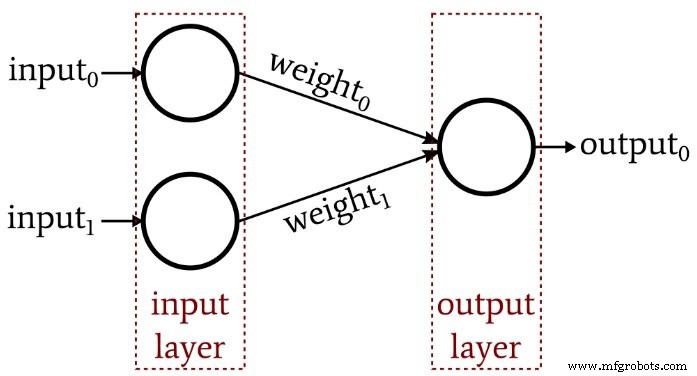
The input vector’s length must match the number of input nodes. For instance, classifying a pattern represented by 20 data points requires a 20‑element vector and 20 input nodes. The output node(s) depend on the task: a single node for binary decisions, multiple nodes for multi‑class classification.
Weights are scalar multipliers that adjust during training. By fine‑tuning these weights, the perceptron learns to map input patterns to desired outputs.
How Does a Node Operate?
Input layer nodes merely pass data forward. Computational nodes—located in hidden and output layers—aggregate weighted inputs and apply an activation function:
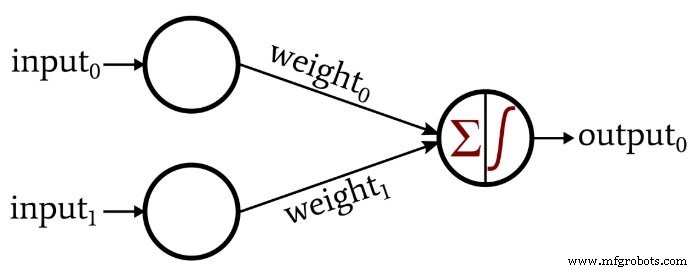
The activation function introduces nonlinearity, which is essential for modeling complex relationships. A common example is the unit‑step function, which outputs 1 when the weighted sum exceeds a threshold and 0 otherwise:
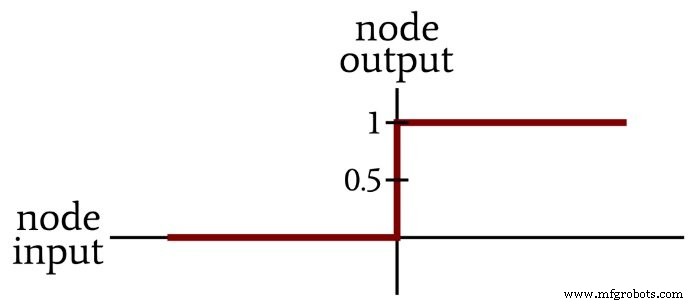
While the binary threshold mirrors biological neuron behavior, more nuanced activation functions—such as sigmoid or ReLU—are often preferred for better learning dynamics. We’ll cover these alternatives in future posts.
Conclusion
We’ve outlined the core components of the perceptron: input structure, weighted connections, and activation mechanics. In the next article, we’ll assemble these pieces to demonstrate a working classification system.
Neural networks encompass a vast field. This series aims to provide clear, actionable guidance for practitioners at every level.
Embedded
- Optimizing Hidden Layer Size to Boost Neural Network Accuracy
- Choosing the Right Number of Hidden Layers and Nodes in a Neural Network
- Building a Multilayer Perceptron Neural Network in Python: A Practical Guide
- Train Your Multilayer Perceptron: Proven Strategies for Optimal Performance
- Training a Basic Perceptron Neural Network with Python: Step‑by‑Step Guide
- A Beginner’s Guide to Perceptron Neural Networks: Classifying Data with a Simple Example
- Wrench Time: Definition, Importance, and Measurement
- Fault Tree Analysis Explained: Purpose, Process, and Practical Implementation
- Discover Your Network Security Key: Easy Steps to Find and Protect Your Wi‑Fi
- Key Drawbacks of Single-Acting Cylinders in Engine Design