



Battery‑Free UHF RFID: Unlocking Lean Industrial IoT
The rapid expansion of IoT is already spotlighting the limitations of battery‑powered devices—both from a sustainability perspective and in terms of predictability and cost. By 2025, the combined consumer and industrial IoT market is projected to reach US$11.1 trillion, according to a 2020 Prudour report. To address these challenges, Industry 4.0 developers are turning to battery‑less solutions, with UHF RFID technologies—particularly those championed by the RAIN RFID Alliance—leading the way.
The RAIN RFID Alliance, similar to the Bluetooth SIG and Wi‑Fi Alliance, promotes a technology that links UHF RFID to the cloud, enabling data from RFID tags to be stored, managed, and shared via the Internet. Membership is open to any organization interested in passive UHF RFID.
Today’s manufacturing floors leverage data stored in RFID tags to drive flexible, efficient, and customized production. Passive RFID tags—unlike active tags or barcodes—do not require a dedicated power source or line‑of‑sight, making them ideal for high‑automation environments and lean supply chains.
While the technology is still emerging, only a handful of vendors currently offer solutions that turn passive RFID chips into the smart sensing devices required for RAIN RFID. These IC families can measure temperature, humidity, motion, ambient light, electrical continuity, and material malleability entirely passively, transmitting data to a standard RAIN RFID reader over ranges of 5 to 10 meters.
No special HW/SW required
Data transfer from the chip to the reader takes just a few milliseconds and fully complies with the EPC Gen2 protocol. Users can acquire and process measured values without additional hardware or software—existing readers can capture and interpret the data, forwarding it to higher‑level systems. In logistics applications, for instance, the asset ID, EPC number, and sensor data are all captured simultaneously.
Inlays are convertible into a wide range of transponder formats—from flexible labels to hard tags. A classic QFN package with an integrated sensor IC is suitable even for harsh environments.
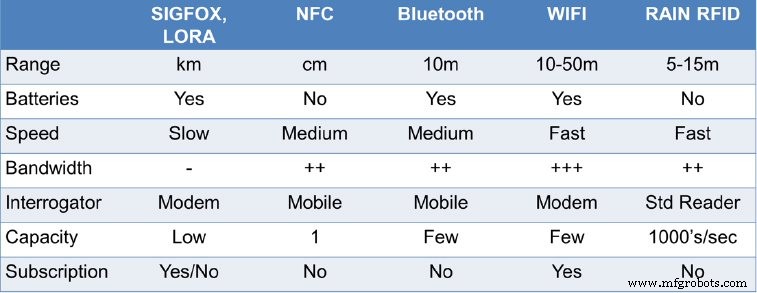
Comparison of communication technologies used for Industry 4.0 (Source: Asygn)
Predictive Maintenance Applications
The global market for battery‑free RFID sensors is expected to expand at a compound annual growth rate of 13.3% to reach US$2,099 million by 2030, driven by advances in battery‑free technology and increased R&D investment, Prudour reports.
Sensor ICs are already deployed in industrial settings—such as detecting pipe distortion, a task that traditionally relied on strain gauges or required complex sensor assemblies. By integrating all necessary components into a single chip and communicating via UHF RFID, batteries and external sensors are no longer needed.
Predictive maintenance benefits are substantial: by anticipating wear or impending failure, maintenance teams can focus on critical issues, generating large data sets that underpin accurate predictive models. Metal superstructures—bridges, large buildings, and other critical infrastructure—are prime candidates; embedding free‑power sensors into concrete at manufacture enables real‑time monitoring of temperature or humidity, providing stakeholders with continuous insight and reducing the risk of catastrophic failures.
Heavy‑industrial equipment manufacturers are also exploring the technology for applications such as detecting overheating on turbine blades in hydro‑ or wind‑power plants. Pressure sensors can safeguard industrial gas cylinders from explosions, while elastomer‑embedded chips could enable vehicle weight or load measurement via tire‑mounted pressure sensors.
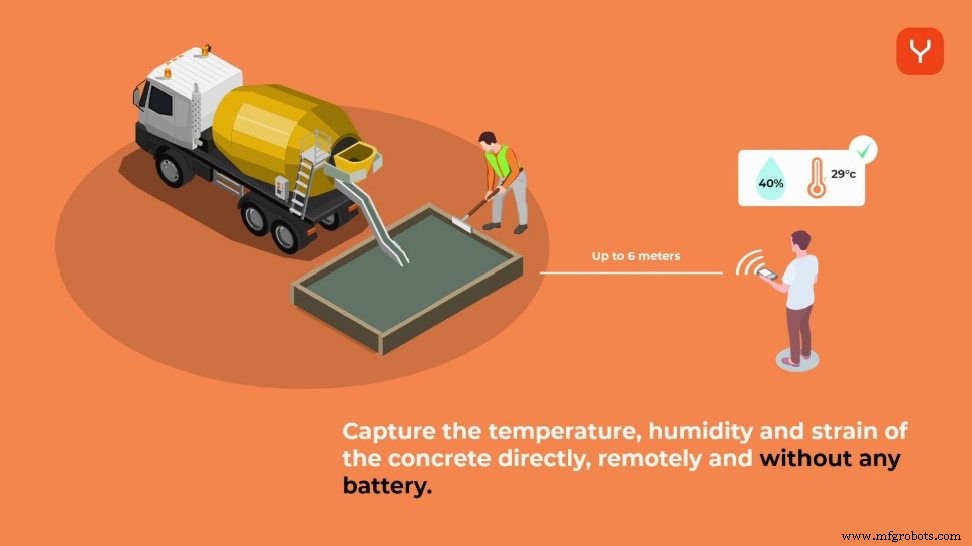
Embedding free‑power sensors into concrete would enable real‑time access to critical parameters so that structures could be monitored over time. (Source: Asygn)
Beyond industry, developers are targeting agriculture and healthcare. Drones equipped with readers can monitor greenhouse and field conditions; livestock can be tracked and monitored for body temperature to detect illness early. RFID sensors integrated into prosthetic devices can reveal strain or temperature deviations, allowing technicians to intervene before a malfunction becomes problematic.
Industry has already embraced IoT; the next step is to make Industry 4.0 solutions leaner and more efficient to maximize ROI. Battery‑free UHF RFID technologies are paving the way.
—Frédéric Maricourt, Sales Director at Asygn.
>> This article was originally published on our sister site, EE Times Europe.
Internet of Things Technology
- Industrial IoT Communication: 6 Proven Infrastructure Protocols
- 6 Industrial IoT Solutions Driving Efficiency and Insight
- How Industrial IoT Sensors Drive Modern Factory Efficiency
- IXrouter: Seamless Edge‑to‑Cloud Connectivity for Industrial IoT
- Future Outlook: Advancing Industrial IoT for Production Excellence
- Safeguarding IoT Adoption: Proven Cybersecurity and Privacy Strategies for Enterprises
- Industrial IoT Security: Rising Threats and the Need for Integrated IT/OT Protection – Part 1
- Industrial IoT Connections Set to Surpass Consumer Devices by 2025, GSMA Forecasts
- Everactive: Pioneering Battery‑Less Sensors for Industrial IoT
- Industrial IoT Demystified: A Comprehensive Guide