



Anticipating 2019’s Game‑Changing Technologies: 5G, AR/VR, Edge Computing, mmWave Radar, Autonomous Vehicles, AI
As the new year unfolds, I’m reflecting on the most influential tech trends poised to shape 2019. While innovations like blockchain and quantum computing capture headlines, I’ll focus on technologies directly relevant to our industry—those that will deliver tangible impact this year.
5G and Industry 4.0
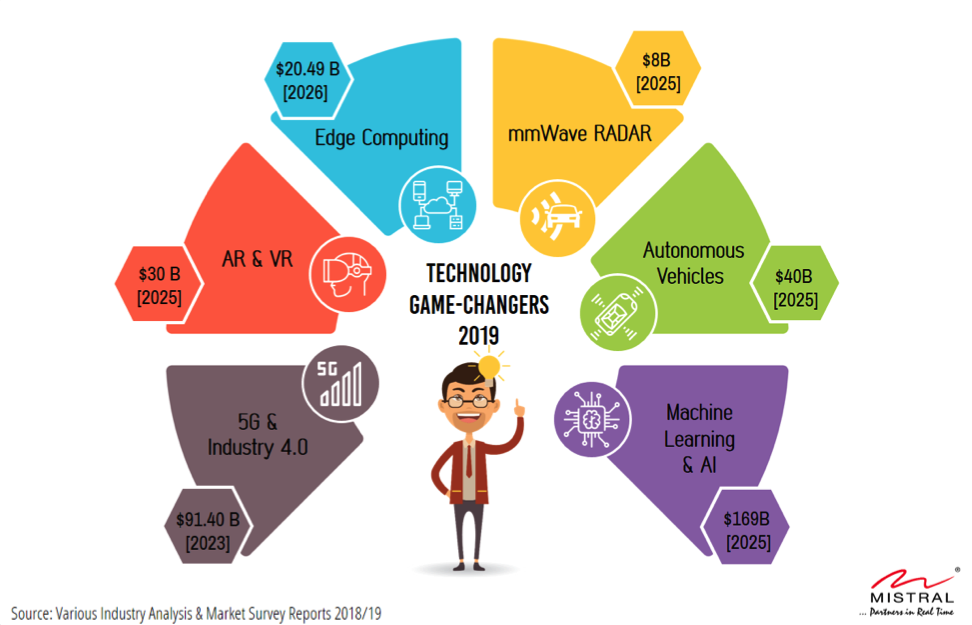
Cyber‑physical systems are becoming mainstream, and machines are increasingly intelligent, equipped with an array of sensors. Edge and cloud computing enable decentralized decision‑making, but the real catalyst will be ultra‑reliable low‑latency communication—5G. Replacing legacy wireline links with a high‑bandwidth 5G network will unlock predictive maintenance, high‑resolution remote inspections, real‑time machine‑to‑machine communication, and advanced robotics. These capabilities promise to boost efficiency, slash downtime, and quadruple productivity. The Industrial IoT market is projected to reach $91.40 B by 2023, underscoring 5G’s role as the next industrial revolution.
AR / VR
The HMD, smart‑glass, and HUD markets have been evolving for years, yet many firms still struggle to define sustainable business models. Recent momentum—highlighted by Microsoft’s sizable contract with the U.S. Defense Department for Hololens—signals that enterprise adoption is shifting from proof‑of‑concept to full deployment. Key use cases include shop‑floor supervision, employee training, remote technical support, logistics, retail customer experience, aerospace, and medical fields. The enterprise AR/VR segment is expected to grow to $30 B by 2025, rewarding companies that focus sharply on their niche, deliver a viable business model, and ship a polished product.
Edge Computing
Edge, or fog, computing moves heavy data processing from a central cloud to local devices, enhancing security, QoS, and real‑time decision making while reducing bandwidth demands. In industrial settings, edge devices can process massive sensor streams locally, forwarding only essential, encrypted data to the cloud. Stratistics MRC reports the global edge‑computing market grew from $7.98 B in 2017 to an expected $20.49 B by 2026, a CAGR of 11%.
mmWave Radar
Millimeter‑wave (30–300 GHz) radar is set to become a cornerstone of automotive and industrial applications. Billions of dollars are being poured into silicon and system development. Combined with cameras, mmWave sensors will power driver safety, ADAS, autonomous driving, lane‑departure alerts, adaptive traffic signals, number‑plate capture, parking assistance, and industrial automation such as robotics, building automation, and security monitoring. The mmWave sensor market is projected to exceed $8 B by 2025.
Autonomous Vehicles
Autonomous cars have moved from sci‑fi to road‑worthy prototypes, with a growing ecosystem of automotive and tech giants. Companies like Tesla, Google, Amazon, Cisco, and Microsoft are investing heavily in self‑driving research, cloud infrastructure, and vehicle connectivity. The convergence of these efforts promises a future where autonomous vehicles are a common sight, reshaping transportation and logistics.
Machine Learning & Artificial Intelligence
ML and AI are no longer niche; they are embedded in everyday life through voice assistants, smart home devices, and industrial automation. The most transformative impacts will come from computer vision, natural‑language processing, robotics, and AI‑driven cybersecurity. Adoption is accelerating across all sectors, promising a leap forward in efficiency and innovation.
These trends—5G, Industry 4.0, AR/VR, edge computing, mmWave radar, autonomous vehicles, and AI—will redefine how we operate, manufacture, and interact with technology in 2019.
 Srinivas Panapakam manages worldwide sales and business development operations for the Product Engineering Services (PES) vertical at Mistral. With over 20 years of experience in solution selling, software & product marketing, product engineering services consulting and business development operations, Srinivas plays a key role in customer acquisition, retention and customer relationship management. Having been with Mistral since its inception in 1997, Srini has greatly contributed to the growth of the company and has helped mold Mistral into a leading global technology company. His experience in technology sales and marketing has helped to significantly optimize Mistral’s technology expertise.
Internet of Things Technology
- Defining the Edge: Where Edge Computing Truly Happens
- Why Edge Computing Is Essential for IoT Success
- IoT Edge Computing: Bridging Devices and Cloud for Real‑Time Insights
- Edge Computing: The Architecture Driving Tomorrow’s Intelligent Networks
- Edge Computing: 5 Potential Pitfalls—and How to Overcome Them
- Edge Computing: Accelerating AI Deployment at the Network Perimeter
- Edge Computing Gets a Clear, Industry-Approved Framework
- Elevate In‑Store Retail with Edge Computing: Data‑Driven Solutions for Better Customer Experiences
- Edge Computing in Manufacturing: A Complete Guide for Manufacturers
- Harnessing IoT Edge Computing for Real‑Time Data Analysis