



Efficient Web Server Solutions for Resource-Constrained Microcontrollers
Efficient Web Server Solutions for Resource-Constrained Microcontrollers
In our previous post, A Fresh Look at Embedding a Web Server, we highlighted the advantages of WebSockets over traditional HTTP GET/POST for embedded devices. Some readers noted that this approach may not fit all small microcontroller projects. Here we clarify why WebSockets—and, more importantly, a lightweight TLS‑enabled implementation—are essential for truly constrained systems.
Why WebSockets Outperform Classic HTTP on Tiny MCUs
When correctly implemented, WebSockets consume fewer CPU cycles and memory than a standard HTTP server. This efficiency becomes critical when you add TLS, which can quickly overwhelm a microcontroller’s limited resources. For a deeper dive into the pitfalls of embedding a full web server with TLS, see our tutorial When Not to Embed a Web Server in a Device.
Modern Web Application Reference Design for Microcontrollers
We have released the Embedded HTTP and WebSocket Server—affectionately known as the Minnow Server—on GitHub. It’s purpose-built for microcontrollers with minimal RAM and flash. The server’s architecture is lightweight enough to run on 8‑bit AVR chips, yet robust enough to support secure TLS.
Single‑Page Application (SPA) Demo
The Minnow Server ships with a reference SPA that demonstrates real‑time device management. The SPA loads over a single HTTP request and then communicates exclusively via WebSockets for all subsequent interactions. This pattern keeps the initial page load minimal while leveraging WebSockets for dynamic updates, firmware uploads, and telemetry.
The demo showcases live LED indicators, a thermostat gauge, and a drag‑and‑drop firmware uploader. The entire SPA occupies only 41 KB of flash, and the WebSocket runtime uses a fraction of a kilobyte of RAM.
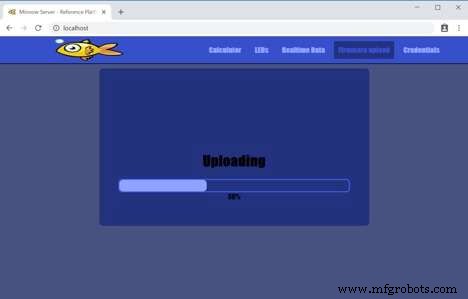
All control messages are JSON text frames, while firmware binaries are sent as binary frames—leveraging the dual‑mode capability of the WebSocket protocol. Modern browsers can handle both data types seamlessly.
Get Started with the Minnow Server
Visit GitHub to download the Minnow Server and start building your own SPA. The reference code is modular: the CSS, HTML5 components, and WebSocket JavaScript library are all reusable and designed for educational use.
Note: While the Minnow Server supports multiple concurrent connections, the reference SPA is limited to a single active WebSocket session. Opening a second browser window will clash with the existing connection. For multi‑user scenarios, extend the server logic accordingly.
If you lack front‑end expertise, consider partnering with a web developer. Treat the SPA like a desktop or mobile app that communicates over TCP—divide responsibilities between firmware and UI teams, and jointly define the WebSocket message schema.
 Wilfred Nilsen, Founder & CTO of Real Time Logic, brings 28 years of embedded software design experience. His vision of connected embedded systems led to the Barracuda Application Server, tailored for low‑footprint, real‑time microprocessors.
Internet of Things Technology
- IC Technology & Microcontrollers: The Cornerstone of Modern Embedded Systems
- Breathable RF‑E‑Textiles: Flexible Conductive Fabrics for Wearable Communications
- Manufacturing Trends for 2021: Cloud, AI, 3D Printing, Blockchain, Cobots & RTLS
- Choosing the Right Asset Location Technology for Your Business
- 5 Key Wireless Standards Powering IoT Connectivity
- ST Microelectronics Showcases 28 nm FD‑SOI MCUs with Embedded PCM for Powertrain, ADAS, and Electrification
- Two Key Factors for Successful Industrial IoT Implementation
- Why SQL Remains the Benchmark for Reliable Data Integration
- Blockchain: A Powerful Partner for IoT Innovation
- Ericsson's 5G Solutions Drive Manufacturing Digital Transformation