



When to Choose a Standalone RTC IC Over an MCU‑Embedded RTC in Low‑Power IoT Devices
RTC ICs first entered the market in the late 1990s, designed to deliver accurate timekeeping and enriched time‑related data beyond a basic counter. Over the years, manufacturers have added features such as alarms, watchdog timers, timestamp logging, and non‑volatile memory, while slashing power consumption to the sub‑microampere range. In the past decade, many of these capabilities have been bundled into MCUs as an MCU‑RTC, offering performance comparable to dedicated RTC chips.
Why would a designer still opt for a dedicated RTC IC? Which scenarios benefit most, and to what degree?
This article examines standalone RTCs in select use cases—particularly IoT devices where power and timing precision are paramount. By comparing features and electrical characteristics side‑by‑side, designers can extract maximum value from a dedicated RTC IC.
Key requirements in IoT and other low‑power applications
IoT devices range from multi‑core smartphones to ultra‑small sensors. Regardless of form factor, most must achieve long battery life. This is especially critical for devices powered by tiny cells or energy harvesters. Figure 1 illustrates a typical low‑power IoT block diagram. The MCU orchestrates all peripherals, turning them on or off based on application logic. Efficient on/off scheduling is a primary strategy for cutting power, achieved by letting the MCU enter deep‑sleep when idle and relying on a precise time base so that wake‑up events align exactly with peripheral needs.
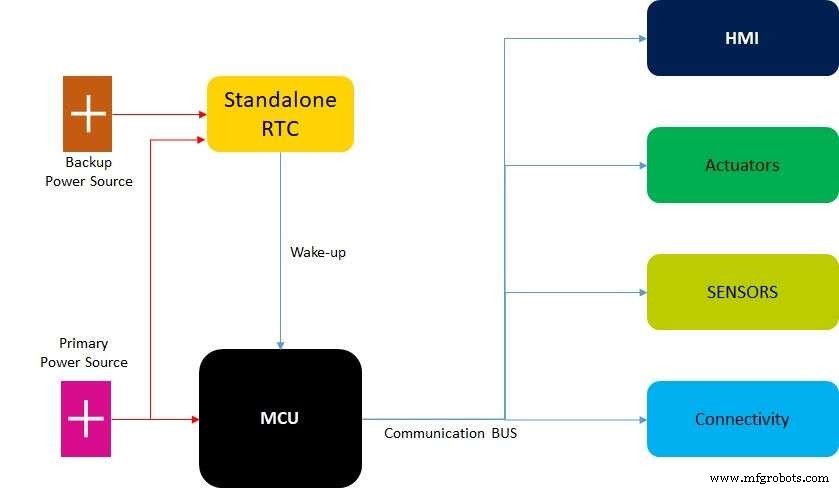
Figure 1: Typical IoT Architecture
Stand‑alone RTC ICs offer highly configurable interrupt handling, capable of waking the host MCU from millisecond intervals to years. Unlike an MCU‑embedded RTC, the external chip’s interrupt logic runs independently of the processor’s firmware, enabling the MCU to stay in deep sleep and thereby boosting application robustness.
In practice, a MCU in RTC mode typically draws a few microamps, whereas an external RTC IC delivers the same timing precision while drawing only a few hundred nanoamps—a substantial saving.
Timekeeping and backup power
Accurate timekeeping is essential for every IoT system. When the main supply is interrupted, a backup source—usually a small coin cell or supercapacitor—keeps the RTC running so that events and communication schedules remain reliable.
Internet of Things Technology
- AirFinder Bluetooth LE & XLE: Top IoT Solutions for Industrial Asset Tracking
- IoT in Transportation: 3 Strategic Use Cases
- Alif Semiconductor Unveils Ensemble and Crescendo Fusion Processors for Secure, AI‑Enabled IoT
- High‑Performance PMICs Power Always‑On Wearables and IoT Devices
- Renesas Launches Low‑Power, High‑Performance Entry‑Level RA2E1 MCUs
- Embedded Hardware Hacking for IoT Devices: Tools, Techniques, and Business Implications
- Revolutionizing Public Restrooms: IoT Fixtures and Wireless Power for Cleaner, Smarter Spaces
- IoT Devices: Unveiling the Hidden Threats of Modern Connectivity
- Why Your Connected Devices Need an IoT Framework: 5 Key Benefits
- Top 5 IoT Development Challenges & How to Overcome Them