



Why Implement IIoT in Your Plant: 5 Key Benefits

In recent years the Internet of Things (IoT) has become a central theme in smart manufacturing, supply‑chain transformation, logistics, factory automation, and data collection. If you’re reading about these topics, chances are the term IIoT will appear.
Simply put, the IoT is the web of computing devices embedded in everyday objects that can send and receive data. The Industrial IoT (IIoT) extends this concept to the factory floor, connecting intelligent machines, sensors, and control systems so they can share real‑time information.
Installing sensors throughout the shop floor gives plant leaders immediate visibility into machine performance, environmental conditions, and production metrics. Alerts can be triggered when key parameters drift, and data can be accessed from any device—ensuring that the right people always have the information they need. Predictive analytics, live monitoring, mobile notifications, and automated decision‑making are just a few of the ways IIoT can transform operations.
1. Lower Hardware Costs
Mass production and economies of scale have slashed the price of sensors, controllers, and gateways. What once required a costly, custom deployment can now be achieved with off‑the‑shelf components that are easy to install and scale. The challenge lies not in cost, but in selecting the right mix of devices, determining optimal placement, and defining the rules that trigger alerts.
2. Universal Internet Connectivity
High‑speed, reliable connectivity—whether wired or wireless—means data can flow anywhere, anytime. Managers can log into the corporate network from a remote location and view dashboards in real time. Key questions arise: Which metrics are critical? How should they be visualized? Who has access? Where is the data stored? How do we protect it?
3. More IoT‑Ready Devices and Sensors
The market now offers a vast array of sensors—pressure, proximity, vibration, temperature, current, and more—each capable of communicating via Ethernet, Wi‑Fi, or Bluetooth. Manufacturers expect these devices to integrate seamlessly with their existing workflow, just as they do with smartphones and tablets. Choosing the right standards, protocols, and data formats is essential.
4. Low‑Cost Analytic Tools
Many sensor vendors provide free or inexpensive analytics suites that transform raw data into actionable insights. By correlating readings from multiple devices, algorithms can predict failures, optimize maintenance windows, and adjust process parameters on the fly. This real‑time capability delivers tangible value.
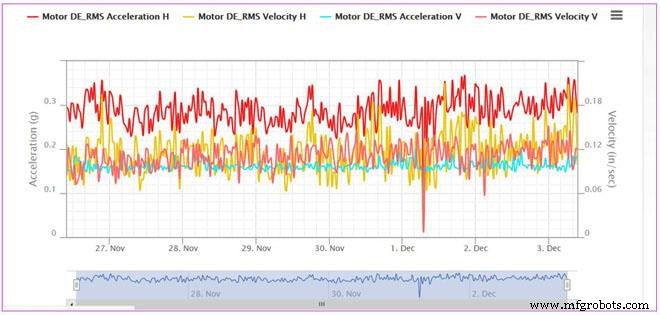
Vibration data from a sensor on a main compressor
Which team in your organization is ready to monitor this data 24/7? What corrective actions can be taken? Do you have personnel skilled in interpreting vibration signatures?
5. Cheaper Cloud‑Based Services
Cloud platforms now offer scalable, cost‑effective storage, processing, and visualization for IIoT data. Instead of building an in‑house data lake, many companies partner with third‑party vendors that specialize in sensor integration and remote monitoring. This approach reduces capital outlay and accelerates deployment.
Before committing to an IIoT solution, quantify the value the data will deliver. Ask yourself: "What do we intend to do with this information to improve plant productivity?" Technology should serve a clear business objective, not become an end in itself. If the answers are unclear, consult an experienced advisor to evaluate potential ROI.
When I first explored sensors in the early 1980s, the cost was prohibitive and the data underutilized. Today, low‑cost wireless sensors coupled with robust analytics have turned IIoT into a viable, profit‑driving investment.
Success hinges on honesty about your organization’s strengths and gaps. Leverage internal expertise where you excel, and outsource where you need external support. The decision is simple: sense or not to sense? The evidence points to the former.
Internet of Things Technology
- Ensuring Continuous Health of Your IIoT Systems
- Why Adopt IIoT in Your Factory: 4 Key Benefits
- 7 Key Reasons Industrial IoT Projects Fail — Expert Guide to Success
- Advance Your IIoT Maturity with Machine Performance Analysis
- Why IXON Is Your Ideal Industrial IoT and Remote Access Partner
- 5 Technological Strategies to Amplify Plant Productivity
- Revolutionizing MRO with Voice-Enabled IIoT
- The Definitive Guide to the Top 10 Industrial IoT Platforms (2024)
- Advanced Vibration Sensors for IIoT: Empowering Predictive Maintenance & Asset Reliability
- Why Your Warehouse Needs IIoT: 5 Key Benefits