



Profitability in IoT: Align with Customers to Drive Growth

At the IoT Solutions World Congress 2018 in Barcelona, I met an old colleague of IoT Now, who chose to remain unnamed. He looked drained after a long day.
"How’s the show going?" I asked.
He sighed and said, "Not much new."
According to Jeremy Cowan, the editor‑in‑chief of IoT Now, this was unusual for him.
Over the next two days, our team filled the schedule with in‑person meetings—because face‑to‑face conversations still deliver more insight than digital exchanges. We captured smiles, photos, and hand‑drawn notes as we navigated every exhibit.
While some view the Internet of Things (and machine‑to‑machine communications) as a fresh wave, many companies treat it as a continuation of decades‑long digital evolution. In a conversation with Hitachi Vantara, Wael Elrifai, VP for Solution Engineering – Big Data, IoT & AI, highlighted that Hitachi is a 108‑year‑old manufacturing firm that has maintained a digital presence for 60 years.
Three years ago, Hitachi acquired Pentaho for $550 million (€484 million) to bridge the gap between machines and technology. The global group now invests $3.5 billion (€3.08 billion) in R&D, with a particular focus on smart cities, AI, and connected transportation—including a forthcoming report on Trains‑as‑a‑Service.
Smart cities thrive in command economies
Justin Bean, director of Marketing for Smart Spaces & Video Intelligence at Hitachi Insight Group, explained that the company is transitioning from delivering products to delivering insights and outcomes. In Andhra Pradesh, India, Hitachi is partnering with 33 government ministries—spanning agriculture, education, and transportation—to leverage data‑driven metrics for services such as pensions, waste collection, and rice distribution.
"Smart cities are never finished," Elrifai said. "Integrated parking offers more than quick access; it reduces stress, eases traffic, and cuts fuel consumption."
When asked how Hitachi defines "smart spaces," he pointed to their impact in retail, passenger transit, city security, critical infrastructure, and education. "We aim to make these environments safer, more efficient, and more enjoyable. The first step is consolidating data into a single platform," he added.

How do you build a smart city business?
There is no single governance model for smart cities, which raises the question of how companies can monetize connected‑city services when data availability is uncertain and SLAs are often absent.
In Navi Mumbai, an extension of India’s mainland capital, Hitachi is applying AI to a wind‑farm project. By integrating data from multiple turbine suppliers—described by Elrifai as "Windfarm‑as‑a‑Service"—the company has cut the industry’s average data error rate in half using machine learning. Future plans include storing excess wind energy in vehicle batteries, while current priorities focus on predicting output to stabilize the power grid.
When asked about the profitability of IoT, Hitachi maintained confidentiality over its P&L figures, citing competitive concerns. However, the relaxed atmosphere at the table suggested that several vendors are indeed generating substantial revenue from IoT solutions.
Everything as a Service?
In an era increasingly dominated by "everything as a service," Elrifai cautioned that not every sector is ready for this model. "We gather market‑sensing data and tailor our offerings to each customer’s needs, tastes, and societal impact," he said.
Software AG’s VP of Online Business, Philip Hooker, shared that the German company is expanding its smart‑city portfolio in the Middle East, where strong government oversight fuels large‑scale projects. Initiatives include street lighting, parking, and waste management—each leveraging shared data streams.
(See also: Abu Dhabi completes smart city project using Software AG’s Cumulocity IoT; Software AG acquires Cumulocity for undisclosed sum to extend its IoT technology leadership)
Hooker noted that Cumulocity, acquired in 2017, is device‑agnostic and supports diverse use cases and connections. For smart lighting, he emphasized that mesh networking is preferable to BLE, which he described as unreliable, and that LPWAN is cost‑prohibitive.
IoT consolidation continues
Smaller players remain targets for acquisition. In October, Software AG purchased Built.io—a San Francisco‑based integration Platform‑as‑a‑Service firm—for an undisclosed sum. Built.io, founded in 2015, offers a workflow integration tool that has gained traction. Hooker reported that 100 cloud applications are now connected, enabling customers to integrate data between, for example, Office 365 and Salesforce.
(See also: Software AG buys Built.io to strengthen its position in hybrid and cloud integration)
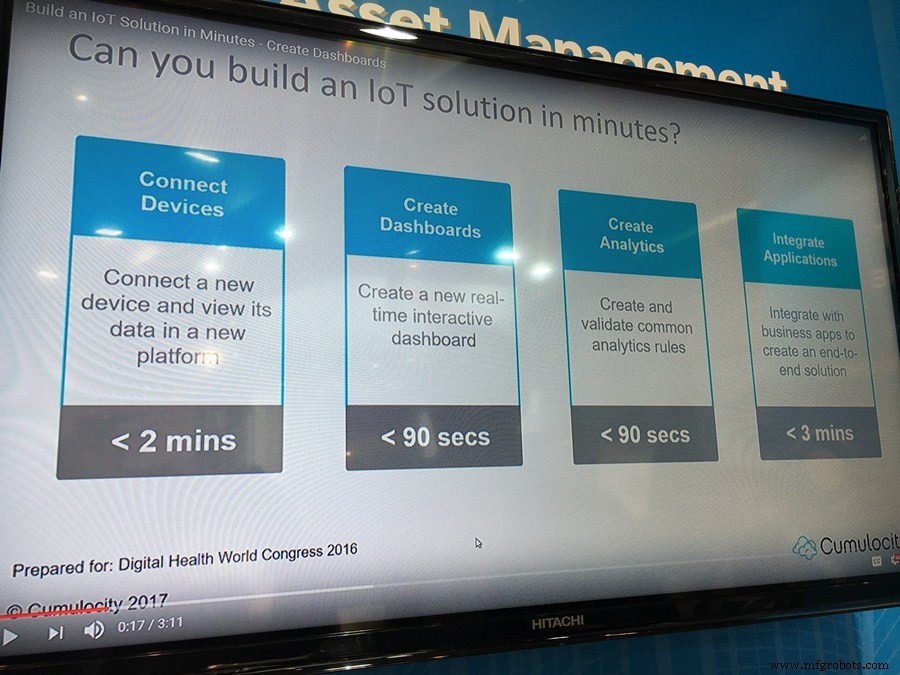
Software AG highlighted simplicity as a key value proposition, claiming that an IoT application can be assembled in eight minutes—shorter than it takes to brew a cup of coffee.
Intel buys Vertex for its Movidius unit
Market consolidation in IoT continues to accelerate. Whether it’s big players absorbing smaller ones or breakthrough technology finding broader audiences, the trend remains clear.
Intel, a blue‑chip enterprise, keeps investing through its Movidius unit. Two months ago, it acquired Seattle‑based Vertex.AI, now part of Intel’s AI Products Group. Vertex continues to develop PlaidML as an open‑source project and will soon transition it to the Apache 2.0 license.
Movidius also unveiled new products at the Barcelona event, targeting AI inference and analytics on edge devices. The launch of the OpenVINO Toolkit in February—an open‑source framework for developing vision‑based applications—has already attracted over 5,000 developer users, with more than 20 companies deploying products on it.
(See also: Intel buying Movidius ‘to accelerate computer vision through RealSense’ for next‑gen computing)
Despite the perception of a stagnant IoT market, the wealth of available technologies and growing customer base suggests that the sector’s Darwinian selection is far from over. Platforms, connectivity solutions, and integrated offerings continue to proliferate.
Notably, many ecosystems are already profitable, as evidenced by the smiles of industry leaders. IoT’s future remains bright for those who stay customer‑aligned and data‑driven.
Report by Jeremy Cowan, editorial director of IoT Now and IoT Global Network.
Internet of Things Technology
- Integrating Qt with DDS: Building Scalable IoT Applications
- Secure IoT: Best Practices for Building Trustworthy Connected Products
- Preparing Your Manufacturing Operations for AI with IoT
- Leveraging 5G and IoT to Propel UK Manufacturing into a Smart Future
- Strategic IoT Integration: A Proven Path to Business Growth
- Leveraging RTUs for Big‑Data Insights in Industrial Operations
- Harnessing IoT Data for Manufacturing Excellence
- Bringing IoT to Life with IBM & Tech Data – Part 2
- Turning IoT Into Reality: Tech Data & IBM Insights – Part 1
- Leveraging Industrial IoT for Oil & Gas Fleet Monitoring: Boost Efficiency and Cut Downtime