



AI‑Enabled IoT Condition Monitoring Extends Predictive Maintenance Across Entire Production Lines
 Brad Hopkins of HID Global
For decades, condition‑monitoring tools were reserved for a handful of high‑value, mission‑critical machines, leaving roughly 85% of a plant’s assets exposed to costly, unplanned downtime.
Brad M. Hopkins, director of Condition Monitoring Product Management at HID Global, explains that existing systems often misalign with plant workflows or carry prohibitive deployment costs.
Today’s breakthrough lies in low‑cost, low‑power IoT sensors paired with AI‑driven cloud analytics, dramatically reducing the cost and complexity of deploying predictive maintenance across an entire asset fleet.
The High Cost of Failure
While motors are traditionally categorized as critical, semi‑critical, or part of the “balance of plant” (BoP), every piece of equipment is operationally vital. A single failure can cost anywhere from US$30,000 per hour in food‑processing plants to $87,000 in petrochemicals, and up to $200,000 at an automotive factory.
Beyond the immediate repair expenses, failures trigger labor costs, replacement parts, and lost production that can erode margins and breach service‑level agreements.
Integrating IoT‑based condition monitoring—comprising inexpensive, low‑power sensors, a wireless communication platform, and AI analytics—cuts those risks. The approach transforms maintenance from reactive or preventive to knowledge‑driven and predictive, covering the full production line.
A New Condition‑Monitoring Paradigm
Deployment Model
Modern IoT solutions use affordable sensors that are simple to install, making it economically viable to monitor every asset, including BoP motors. Algorithms analyze data to assess health, predict failures, and a policy engine raises real‑time alerts.
Unlike legacy systems, these offerings eliminate wired infrastructure, dedicated servers, and antennas. Bluetooth Low Energy (BLE) beacons equipped with vibration and temperature sensors are mounted on each asset, providing on‑off detection and real‑time monitoring of duty cycles, temperature, and vibration.
The beacons perform edge processing to compute machine‑health metrics, reducing the volume of data transmitted through a Bluetooth‑to‑WiFi gateway to the cloud, where deeper analysis occurs. This architecture allows for data collection every two minutes, delivering near‑real‑time insight into machine vibration states.
After an initial training period that learns each asset’s baseline vibration signature, the system builds normal‑activity models. The policy engine flags significant deviations and notifies operators, enabling them to intervene before downtime occurs. From that point, plant managers gain a powerful tool for refining proactive maintenance, inspection, and operational strategies.
These predictive maintenance capabilities are delivered via cloud‑based SaaS subscriptions, offering flexibility—from basic fleet management and remote configuration to advanced fault detection and AI‑based alerting.
Early Successes
Manufacturers across multiple sectors are reaping tangible benefits from AI‑driven IoT condition monitoring. For instance, a leading steel producer now monitors motor temperature and vibration in a 70–80 °C environment, reducing unplanned downtime throughout the plant.
Such solutions often detect issues that routine inspections miss. A top pharmaceutical manufacturer received an alert on a sensor that could not be visually verified; the alert re‑triggered within a week, prompting a comprehensive check with high‑bandwidth, lab‑grade instrumentation. The subsequent analysis confirmed degradation, allowing the plant to repair the issue before costly downtime ensued.
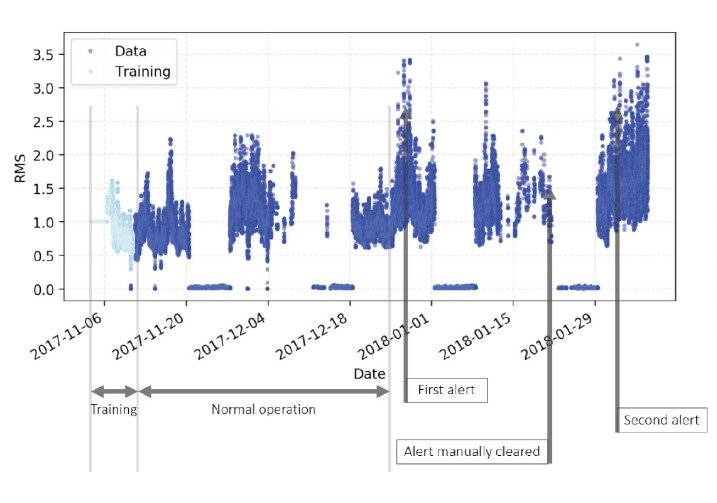
Historically, plants limited condition monitoring to the most expensive or mission‑critical equipment. With this expanded visibility, organizations can prevent unplanned downtime, avoid unexpected repairs, and reduce labor associated with the majority of their fleet.
By combining BLE beacons with a cloud‑based AI analytics engine, the latest solutions address these challenges in a fresh way, offering a quick, easy path to plant‑wide predictive maintenance and smarter operations.
The author is Brad M. Hopkins, director of Condition Monitoring Product Management at HID Global.
Internet of Things Technology
- Revolutionizing Agriculture: How IoT Drives Efficiency and Sustainability
- Mastering Multi-Technology Condition Monitoring for Large Mining Operations
- How Closed‑Loop Digital Twins Amplify Predictive Maintenance for Competitive Manufacturing
- IoT for Predictive Maintenance: Proactive Strategies to Cut Downtime and Costs
- 4 Ways Condition Monitoring Boosts Rotating Equipment Performance
- Transforming Maintenance with IoT Sensors: Predictive Excellence
- Cisco Launches Cloud‑Managed IoT Monitoring for IT & OT Environments
- Industrial IoT Revolutionizes Condition Monitoring Across Sectors
- IoT Drives the Shift from Scheduled to Predictive Maintenance in Industry
- Predictive Maintenance vs. Condition Monitoring: Which Strategy Drives Business Success?