



Unlocking the Advantages of Smart IIoT-Enabled Factories
The Industrial Internet of Things (IIoT) continues to push the potential of the Fourth Industrial Revolution, aka Industry 4.0. This industrial era features embedded automation technologies and powerful wireless sensors that drive manufacturing and production in smart connected factories.
Trending Toward More Automation
Many IIoT devices in smart factory autonomous systems combine with artificial intelligence (AI), mobile edge computing (MEC) infrastructure, cameras, control systems, computer vision, augmented reality (AR), robotics, and machine learning (ML) for real-time, interactive data communication. These innovative automation technologies are continually evolving from “science fiction” to large-scale commercial adoption.
As this era of digital transformation moves on, we increasingly see robotics fueled by the IoT, AI, ML, and more innovations in smart connected factories. We’re in an extraordinary age of connectivity, interoperability, and automation well beyond simple machine-to-machine (M2M) interaction. IoT data from a diverse platform of wireless sensing solutions can transform connected factory operations.
A Time of Real-Time Decisions
Today, connected factory machines make many of their own IoT-AI-ML-enabled, real-time decisions to control and automate processes and keep production running seamlessly. Simultaneously, management in the main office and on the factory floor remotely monitor equipment, workers, and machines with low-power, long-range wireless sensors and quickly make data-driven decisions to:
Improve cost and operational efficiency
Enhance production and product safety
Predict machine and equipment maintenance
Transform business processes and value

Valuable Data Insights Come From Connected Machines
Uptime is everything in manufacturing. When one machine malfunctions or fails, it can create ripple effects of increased time to market and potentially damaging downtime all the way to product delivery and customer service.
Data from the IIoT is the “currency” of the smart, connected factory. It produces reactive, predictive, and even transformative value by fundamentally influencing how and when a person or machine takes control, makes corrections, conducts maintenance, and streamlines production. Actionable data from the IIoT is the main benefit of a connected factory.
Using data to feed dashboards, analytical tools, and operational management systems leads an organization to better innovation, efficiency, and profitability. Wireless sensor data activates the IIoT’s value across a factory — from faster corrective reactions to predictive management to transformative business innovation.
Help Factory Sensor Data Flourish
People and machines must collaborate and share information seamlessly to orchestrate ideal production performance. Wireless sensors embedded in or attached to virtually all assets can deliver the data that managers need to keep the factory humming and to refine processes.
Manufacturers can use many strategies to ensure wireless sensor data gives them the most value from their connected factory. The following are three important data management approaches.
Leverage the autonomous functions of control systems. Many critical assets work together as a seamless unit in a connected factory. But two of the most important assets are industrial control systems (ICSs) and programmable logic controllers (PLCs). An ICS works to run and automate industrial processes by collectively managing data, devices, systems, networks, and controls throughout a factory. In comparison, a PLC can stand alone as a sensor data collection hub or integrate into an ICS as a critical control component of the overall system.
Predictive maintenance depends on ICSs and PLCs. The real-time data from sensors they receive, process, and put into play is vital for running, maintaining, and automating a factory.
Manufacturers can leverage advanced diagnostics, analytics, and insights using data from sensor systems to boost productivity, reduce costs, and improve safety. An ICS is at the core of this endeavor. The automated processes initiated from ICSs free up IT and operational technology (OT) professionals to optimize the factory without having to worry about reactive or routine maintenance tasks. Factory managers can know about machine performance issues in advance and move to predictive rather than repetitive, scheduled maintenance. With sensor data filtered through an ICS, technicians can know which machines to control and when they need maintenance.
Remove data barriers and silos. Data sets shouldn’t stay within individual departments. It was essential to eliminate data silos when the information age began, and it’s even more imperative ever since machines started talking to each other and to us.
A wealth of breakthrough ideas and business-changing opportunities can come from mining IIoT data — that’s one of its primary benefits. Data analysis should be done seamlessly across the spectrum of micro to macro levels — from individual machine performance analysis to the connected factory collectively. You’re in the best position to innovate when barriers are removed to IIoT data access and analysis for everyone, from production line maintenance managers to business analysts to executives.
Take a leaner approach to data sharing. On a global industrial scale, the IIoT generates data in massive volumes. Even on a significantly smaller scale, factory management can still get overwhelmed by the speed and volume of data. Edge computing can help by providing actionable sensor data to frontline factory managers and machines to make fast or automated real-time decisions. With smart sensors and gateways doing edge computing — the method of efficiently capturing, storing, and processing data where it’s generated — managers don’t have to analyze a large amount of raw data to take action. They also don’t have to wait for data to be sent to the cloud, exported, mapped, and analyzed to arrive at the same conclusion the edge devices already delivered.
While it’s important to consistently improve data access and analysis, it’s crucial not to overload anyone who isn’t a data analyst. Keep data alerts, feeds, and reports to what applies to a person’s role. When you glean significant new data insights, ensure key stakeholders are aware and share why specific data points matter to different departments.
Wireless Sensor Platforms Support Maintenance and Business Optimization
It’s important to take a careful, systematic approach to factory automation. It may not matter how automated your factory is if you’re not aware that a machine is vibrating too much. The vibrating machine could mean it’s ready to malfunction. In turn, this failure could cause the entire, or a portion of, an automated system of machines to go offline, creating unplanned, unnecessary downtime. The lesson here is that automation can crumble even when only one cog is loose.
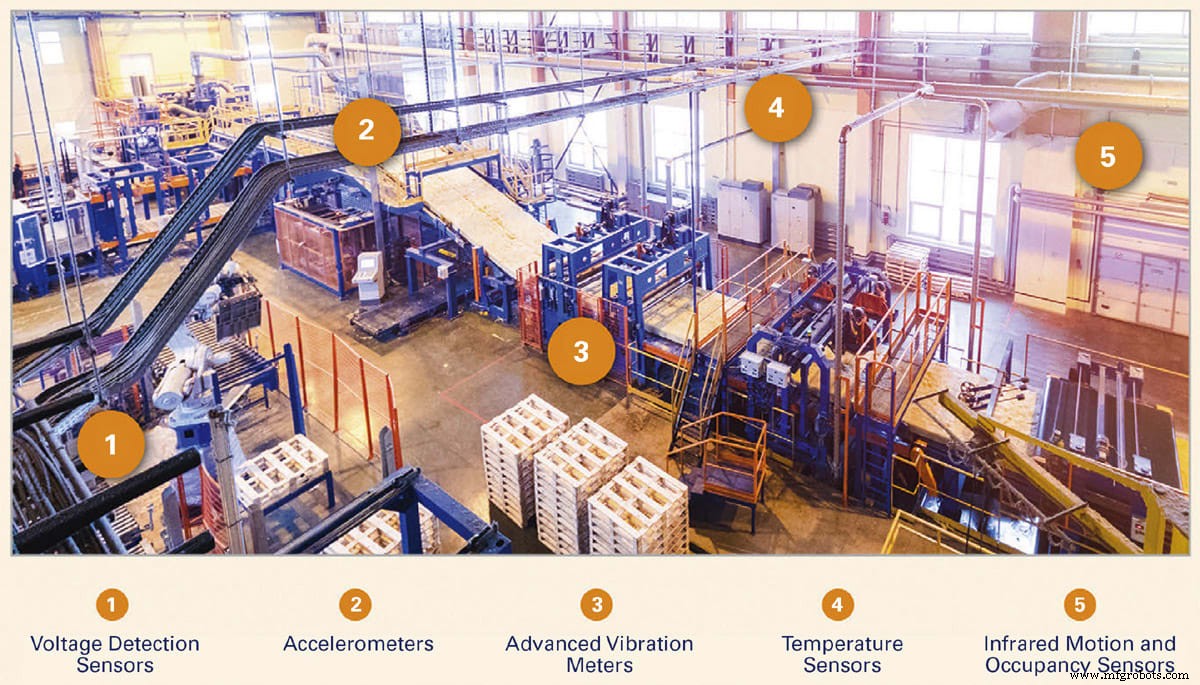
A platform of low-power, long-range wireless sensors distributed across a factory can remedy this — a foundational solution running independently of, but complementary to, automation systems. This sensor network can comprise accelerometers, vibration meters, voltage and current detection and measurement, tilt, passive infrared (PIR) motion, temperature, air quality, humidity, and many more.
A networked wireless sensor platform working mainly behind the scenes ensures your connected factory’s primary performance and condition monitoring is not only predictive but transformed into business optimization and innovation.
Key Sensor Platform Components
In order to keep pace with the evolution of Industry 4.0, connected factories work to implement the following.
Operate on an industrial-grade, wireless, low-power sensor platform focused on real-time data transmission, predictive maintenance, and boosting uptime. A wireless sensor network can be designed to:
Consume power only while sensors are communicating, thereby conserving energy and extending battery life
Deliver instant alerts via text, email, or voice call, when preset parameters are exceeded
Provide trending data and data logs for general insights and compliance data
Streamline data collection, transmission, and analytics with preconfigured algorithms and on-demand processing using sensors and edge gateways rather than manually monitoring machines and collecting data on clipboard checklists. Then, filter the data through control systems using application programming interfaces (APIs), serial Modbus gateways, and PLCs. Only actionable data and sensor alerts will flow in real time through this practice, and raw data can be logged or stored in a database for later analysis.
Integrate with building management systems (BMS) via the Building Automation and Control Network (BACnet™) data communication protocol or Modbus TCP/IP
Strengthen risk management by adding an end-to-end data security platform to the sensor network across the factory.
Employ sensor systems that include data encryption using the Diffie-Hellman key exchange algorithm and 128-bit Advanced Encryption Standard (AES-128) Cipher Block Chaining (CBC) symmetric key encryption to protect data from breaches.
Safeguard web servers and browsers connected to a sensor network with Transport Layer Security (TLS) encryption.
Add 256-bit Secure Hash Algorithm 3 (SHA-3) authentication to protect data from the point of generation through consumption. A secure data token is evaluated via a cryptographic hash function against a unique per-sensor secret key.
Amplify long-range wireless sensor communication reliability with wireless Frequency-Hopping Spread Spectrum (FHSS). With this reliable long-range and robust spectrum, signals spread and hop among rapidly changing radio frequencies. This communication spectrum is highly resistant to interference, and signals are difficult to intercept because they only transmit over extremely short intervals. This makes FHSS essentially cybersecure. With FHSS, data communications from wireless sensors have:
Strong impairment immunity from physical obstructions, external wireless radio frequency systems, and electromagnetic interference (EMI)
Up to 1200+ ft. connectivity in manufacturing environments
Connected factory managers can use an integrated wireless system for optimizing all aspects of a factory’s operations. They can implement automation systems in parallel with optimizing maintenance and production processes, for example.
Add autonomous guided vehicles for picking and packing inventory, material handling, placement, and delivery.
Use industrial robots to arc and spot weld, tend machines, paint products, lift and assemble, glue and connect parts, and more.
Attach accelerometers to assembly lines and robotic arms, vibration meters to machine motors, tilt sensors to detect safe machine operation, and current meters to monitor power consumption.
Install temperature and humidity sensors in HVAC systems, production areas, and motors, as well as PIR motion sensors in restricted and production control areas.
The Bottom Line
Manufacturers should implement an IIoT sensor platform that delivers realtime, actionable data to predict machinery downtime, increase operational efficiencies, boost the bottom line, and reap the benefits of the latest industrial revolution.
This article was written by Brad Walters, Founder and CEO of Monnit (South Salt Lake, UT). For more information, contact Mr. Walters at This email address is being protected from spambots. You need JavaScript enabled to view it. or visit here .
Sensor
- Why Adopt IIoT in Your Factory: 4 Key Benefits
- How Smart Supply Chains Transform Manufacturing Efficiency
- How IIoT & Data Analytics Transform EHS: Boosting Safety, Efficiency, and Savings
- How Interconnectivity Drives Efficiency, Safety, and Sustainability in Modern Workplaces
- Smart Factories: From Vision to Reality—Why Most UK Businesses Still Miss the Mark
- Revolutionizing Industry: The Future of Connected Devices
- Digital Factories: Smart Manufacturing for Industry 4.0
- How IIoT Drives Efficiency in Smart Factories
- Unlocking Efficiency: The Benefits of a Connected Machine Shop
- Unlocking CNC Efficiency: Embrace Connected Control