



Biodegradable 3D‑Printed Mini‑Battery: Eco‑Friendly Power for Future Microdevices
The number of data-transmitting microdevices will increase sharply in the coming years. All these devices need energy but the number of batteries would have a major impact on the environment. Researchers have developed a biodegradable mini-capacitor that can solve the problem. The new battery consists of carbon, cellulose, glycerin, and table salt and is manufactured using a 3D printer.
The fabrication device is a modified, commercially available 3D printer that dispenses a mixture of cellulose nano-fibers and cellulose nanocrystallites, plus carbon in the form of carbon black, graphite, and activated carbon. To liquefy all this, the researchers use glycerin, water, and two different types of alcohol as well as a pinch of table salt for ionic conductivity.
To build a functioning supercapacitor from these ingredients, four layers are needed, all flowing out of the 3D printer one after the other: a flexible substrate, a conductive layer, the electrode, and finally the electrolyte. The whole thing is then folded up like a sandwich, with the electrolyte in the center.
The mini-capacitor can store electricity for hours and can already power a small digital clock. It can withstand thousands of charge and discharge cycles and years of storage, even in freezing temperatures, and is resistant to pressure and shock. When the battery is no longer needed, it can be tossed in the compost or simply left in nature. After two months, the capacitor will have disintegrated, leaving only a few visible carbon particles.
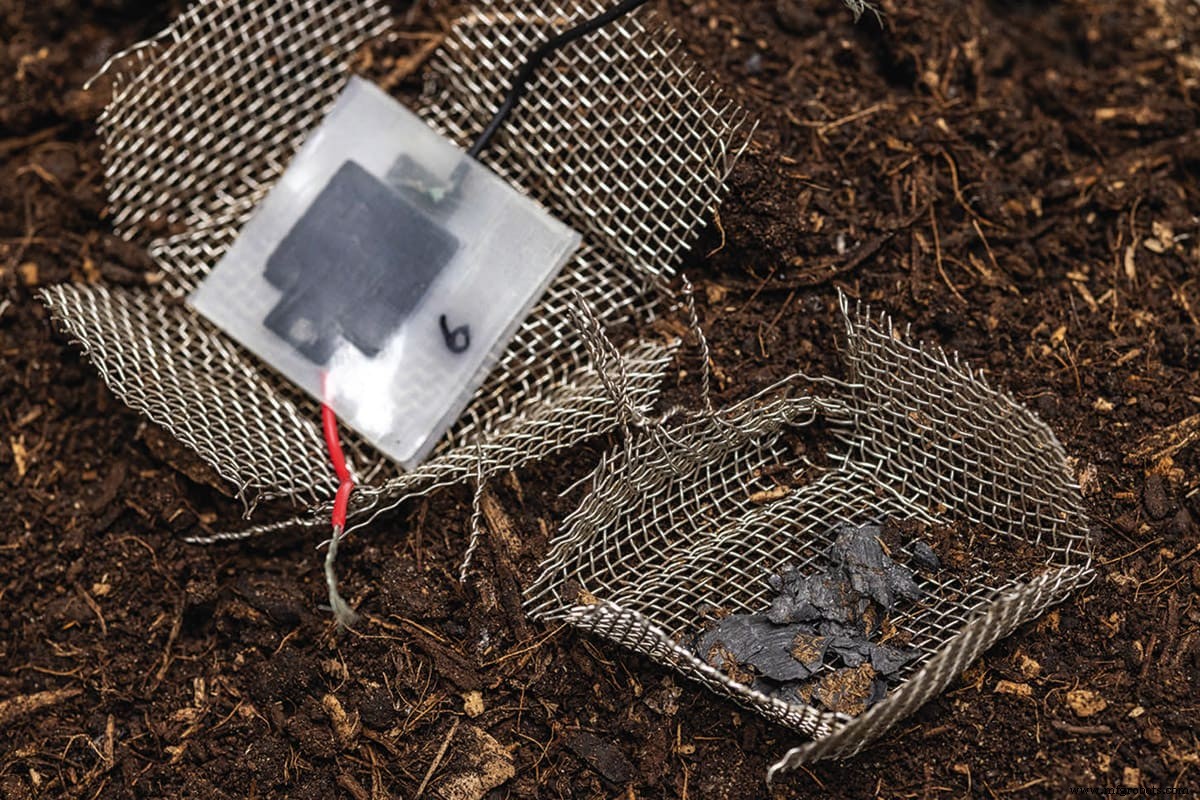
The gel material is not only an environmentally friendly, renewable raw material but its internal chemistry makes it extremely versatile. The supercapacitor could soon become a key component for the Internet of Things. Such capacitors could be briefly charged using an electromagnetic field, for example, and then provide power for a sensor or a micro-transmitter for hours. This could be used, for instance, to check the contents of individual packages during shipping. Powering sensors in environmental monitoring or agriculture is also conceivable — there’s no need to collect these batteries again, as they could be left in nature to degrade.
The number of electronic microdevices will also be increasing due to a much more widespread use of near-patient laboratory diagnostics (point-of-care testing), which is currently booming. Small test devices for use at the bedside or self-testing devices for diabetics are among them.
Sensor
- Carbon Paper: History, Materials, and Modern Manufacturing
- Carbon M2: 20× Faster Digital Light Synthesis for High‑Resolution Production Parts
- 3D‑Printed Carbon Fiber: A Superior Alternative to Aluminum Amid Global Shortages
- Polyaniline‑Coated Activated Carbon Aerogel/Sulfur Composite Yields Superior Lithium‑Sulfur Battery Performance
- Custom Arduino TV Remote – Battery‑Powered, 3D‑Printed Case
- Arevo Unveils First 3D-Printed Carbon-Fiber Unibody Bike Frame and Rim at Eurobike 2019
- Arevo Launches 3D‑Printed Carbon‑Fiber Unibody Frames for Pilot’s New E‑Bike Line
- SGL Carbon Secures BMW Contract to Produce Advanced Composite Battery Enclosures
- Sustainable 3D‑Printed Magnets: Eco‑Friendly, Precision‑Shaped Solutions for Modern Electronics
- NASA Ames Solid‑State CO₂ Sensor: Accurate Detection Across Temperature, Pressure, and Humidity