



Smarter Voice‑Data Processing Delivers Longer Battery Life for Always‑On Devices
Always‑on devices—from smart speakers to wearables—have transformed everyday life, yet their battery demands remain a pressing challenge.
Although voice assistants feel like a staple of modern living, Amazon only launched its first smart speaker, the Echo, in late 2014. Today, hundreds of millions of voice‑first devices, from home hubs to earbuds, are permanently listening for a wake word. SAR Insight & Consulting projects that by 2023 the installed base of always‑on, voice‑enabled devices will approach one billion units.
At the heart of these systems are ultra‑miniature MEMS microphones that capture environmental sound. Initially, cloud‑based analysis seemed ideal, but the sheer volume of data generated by IoT devices—41.6 billion devices projected to produce 79.4 zettabytes of data by 2025 (International Data Corp.)—has overwhelmed network bandwidth and drained device batteries. This bottleneck has accelerated the shift toward edge computing, bringing sophisticated processing closer to the sensor.
Edge Computing Meets TinyML
Modern edge solutions leverage low‑power digital signal processors and microcontrollers equipped with embedded neural‑network cores—TinyML chips. These chips can perform complex wake‑word detection locally, reducing reliance on cloud resources. However, they still inherit the legacy architecture that forces every analog audio sample to be converted to digital immediately, even when no voice is present. Consequently, OEMs waste 80–90 % of battery life on processing irrelevant data, forcing consumers to choose between wall‑powered, non‑portable assistants and battery‑constrained, portable ones.
The Power of Analog‑First Processing
To overcome this inefficiency, designers are turning to a paradigm inspired by the human sensory system: process raw analog signals first, and only invoke digital engines when necessary. Analog circuitry excels at low‑power, real‑time feature extraction—detecting whether a sound contains voice, for instance—before any digital conversion occurs. This strategy keeps high‑power digital processors in deep sleep until a genuine wake word is detected, dramatically extending battery life.
Adopting an analog‑first, bio‑inspired architecture does not require each chip to emulate a brain. Instead, it re‑imagines the system hierarchy: an analog front‑end acts as a traffic manager, filtering noise and forwarding only salient data to the TinyML core.
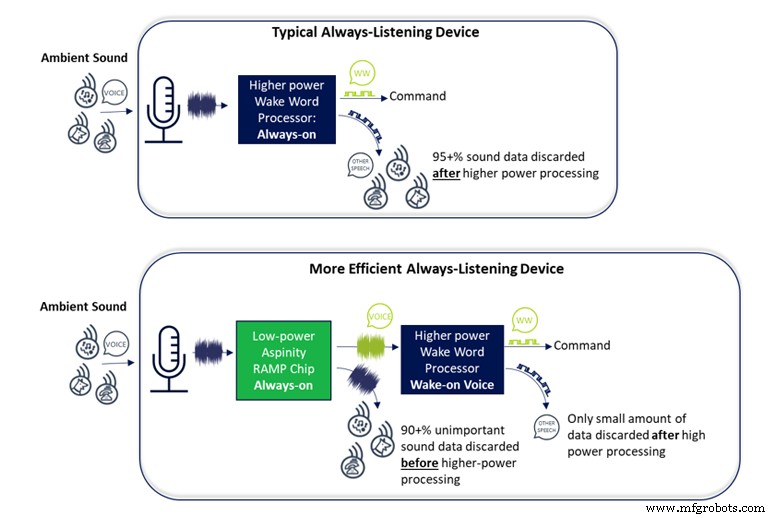 Bio‑inspired edge processing focuses digital power on the most pertinent sensory data. (Image: Aspinity)
Consumer‑Centric Benefits
By minimizing data conversion and leveraging analog pre‑processing, manufacturers can deliver voice assistants that run for months on a single battery set, eliminating the need for constant wall‑power. The result is a more flexible, user‑friendly experience—imagine a voice‑activated TV remote that operates for a year on one charge.
Reference
1 International Data Corp. Worldwide Global DataSphere IoT Device and Data Forecast, 2019–2023. June 2019
>> This article was originally published on our sister site, EE Times Europe.
Sensor
- Why Digital Memory Matters
- Digital Memory Fundamentals: Addressing, Access, and Volatility
- How to Become a Digital Champion in Manufacturing: A Practical Guide
- EV Safety Relies on Advanced Battery Management
- Selecting Microcontroller Peripherals for High‑Performance DSP Projects
- Mastering Digital Asset Management: A Comprehensive Strategy for Data‑Driven Asset Excellence
- Predictive Maintenance: Harnessing Industry 4.0 for Uninterrupted Production
- Leveraging Data to Accelerate Digital Transformation
- Python Data Classes: Streamline Data Management with Modern Syntax
- Understanding Hadoop: A Guide to Big Data Processing