



Sapcorda’s L‑Band GNSS Service Delivers Centimeter‑Level Accuracy for Autonomous Vehicles
Precision positioning is critical for countless mobile applications, especially autonomous vehicles. Sapcorda, a nascent company, supplies GNSS correction services that deliver rapid, reliable, centimeter‑level location data across diverse markets.
On 1 Dec 2020, Sapcorda launched its L‑Band augmentation signal across the U.S. and Europe. Transmitted from two geostationary satellites, the service boasts 99.9 % uptime and supplies PPP‑RTK data‑feed redundancy, automatically switching to a backup channel when IP connectivity fails—enhancing safety and reliability for autonomous vehicles and heavy machinery.
Bosch, Geo++, Mitsubishi Electric, and u-blox founded Sapcorda in 2017 as a joint venture to enable precise and reliable GNSS service. The company’s name stands for Safe and Precise Correction Data Services and describes exactly its purpose: to provide correction services for GPS and GLONASS satellite systems in order to improve positioning accuracy. Support for GALILEO and BeiDou is planned soon.

Botho Graf zu Eulenburg, CEO of Sapcorda
“We are the only service worldwide that can offer a solution tailored to mass‑market applications,” Botho Graf zu Eulenburg, CEO of Sapcorda, told EE Times Europe. The solution “provides the correction data in an open, industry‑driven format at the lowest bandwidth to retrieve high‑precision position accuracy in convergence times below 30 seconds,” he said.
The company offers a B2B business model to GNSS manufacturers, system integrators, and OEMs. It operates globally and owns offices in Germany (Berlin and Hannover) as well as in the U.S. (Scottsdale, Arizona). “It is very important for us as a new enterprise to have the strong background of the founders to enter into long‑term business [relationships], especially with automotive OEMs, which are the main market,” the CEO said.
Geodetic high‑precision GNSS receivers for professional use have continued to evolve over the past two decades. Traditional GNSS has allowed navigating mobile objects to an accuracy of about 10 m but is expensive and is prone to inaccuracies and errors. Sapcorda’s Safe and Precise Augmentation (SAPA) services overcome traditional limitations and deliver centimeter‑level accuracy in a few seconds. With SAPA global services, accuracy improves to a radius of 10 cm or less. Observation data is acquired by the roughly 300 GNSS reference stations spread across North America and Europe and is passed to data centers. The data centers calculate and model for each source of error over the coverage area. The corrections are then delivered via mobile internet (IP) or L‑Band geostationary satellites to the receiver—e.g., in a car—for high‑precision positioning. The correction data is broadcast continuously.
The SAPA services are hardware‑independent and can be used with all GNSS receivers and GNSS chips. The continued development of receiver chips to optimize cost/performance now allows the design of low‑cost GNSS systems with highly precise positioning. Sapcorda designed its solutions to address automotive, mobile autonomous, and mass‑market applications—markets that demand high data availability, compliance with functional safety, and efficiency in submitting the data to the rover, but also the processing of that data on low‑cost chips. Traditional correction services can achieve the same performance but require quite a long time to retrieve the respective accuracy.
click for full size image
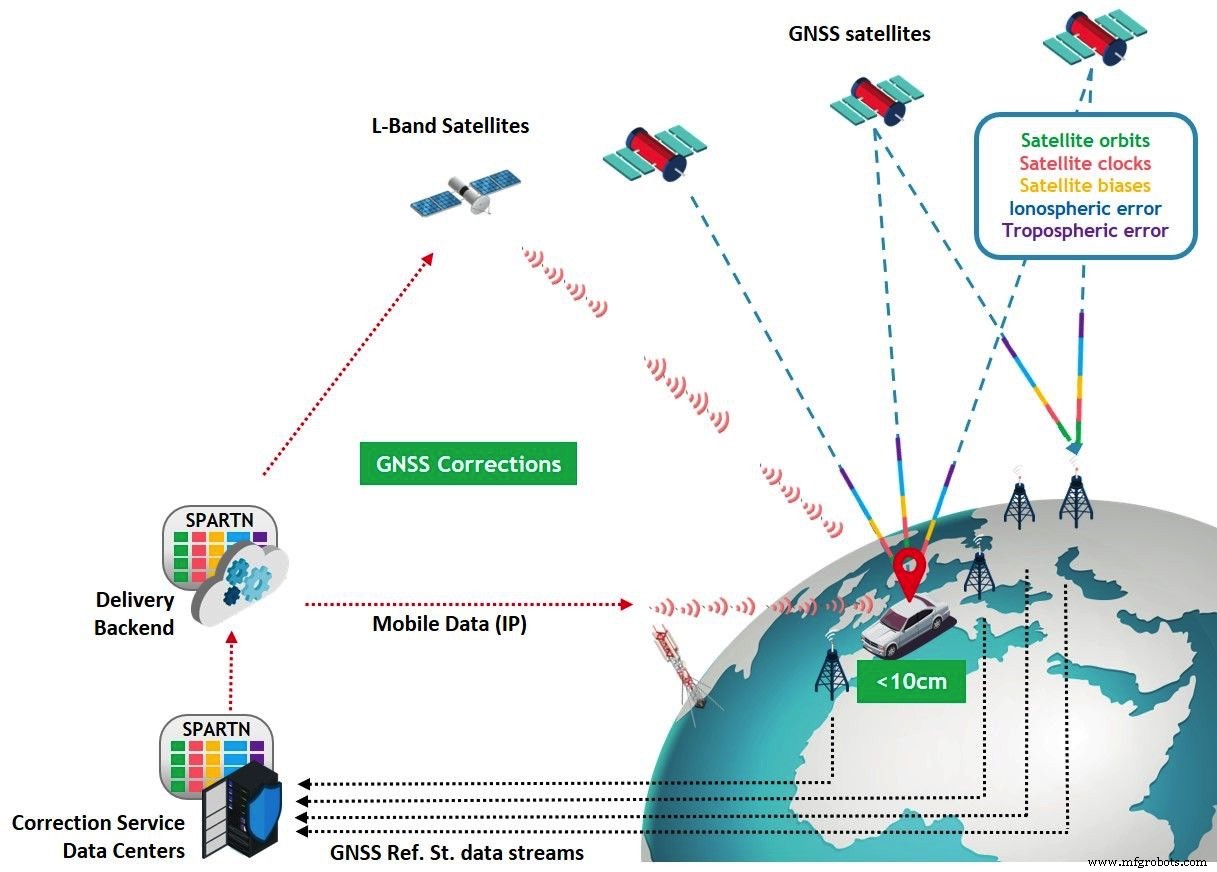
Schematic representation of the SAPA services, which improve global positioning accuracy (Source: Sapcorda)
Optimized communication format
SAPA is delivered via the Safe Position Augmentation for Real Time Navigation (SPARTN) format, so use of the services might require the format to be integrated if not already available. SPARTN is an industry‑driven standard for communication of GNSS high‑accuracy correction data between service providers and end users. Sapcorda developed it specifically for IP‑based and geostationary satellite distributions. Modern positioning systems require a combination of low bandwidth, accuracy, availability, reliability, and integrity for safety‑critical applications. The SPARTN message format meets those requirements and thus represents an evolution of legacy state space representation (SSR) formats that have been made available by various players in the GNSS industry.
“This evolution combines the advantages of state representation with state‑of‑the‑art communication protocol fundamentals for GNSS corrections,” said zu Eulenburg.
Sapcorda provides three services — SAPA Basic, SAPA Premium, and SAPA Premium+ —and three delivery options: IP‑based direct and back‑end‑to‑back‑end options and L‑Band satellite. The IP‑based basic and premium services rolled out for evaluation in Europe and the United States earlier this year. SAPA Basic provides position accuracy from 30 cm up to 1 m with satellite orbit, satellite clock, signal bias, and basic atmospheric data corrections. SAPA Premium provides positioning accuracy to within 10 cm and includes sophisticated atmosphere messages (ionosphere and troposphere models). Integrity messages are transmitted only in SAPA Premium+ data streams, for safety‑critical applications; release is slated for 2021.
GNSS augmentation service via L‑band
Available in areas without GSM coverage or a mobile internet signal, the new L‑band beam solutions from two geostationary satellites provide precise point positioning over real‑time kinematic via SSR (PPP‑RTK) data‑feed redundancy in real time by swapping to a second data feed when internet connectivity is not available. This automated swapping significantly improves reliability for life‑critical applications such as autonomous cars. “By expanding our SAPA services with industry‑leading L‑band transmission, we enable a high‑power correction data stream for homogeneous performance and end‑to‑end data security with continental coverage in the United States and Europe,” said zu Eulenburg.
The L‑band signal will be transmitted in the open SPARTN format for safety‑critical applications in automotive (such as V2X and ADAS/autonomous features) and maritime applications (with a coverage of 12 nautical miles of coastline and inland waters), as well as a variety of uses across sectors such as industrial, robotics, and drones. Demodulation by any L‑band demodulator on the market today simplifies hardware design and reduces the bill of materials.
 A new book, AspenCore Guide to Sensors in Automotive: Making Cars See and Think Ahead, with contributions from leading thinkers in the safety and automotive industries, heralds the industry’s progress and identifies the engineering community’s remaining challenges.
It’s available now at the EE Times bookstore.
>> This article was originally published on our sister site, EE Times Europe.
Sensor
- Bosch IoT Insights: Empowering Global IoT Data Management
- u-blox M9 GNSS Platform Achieves Meter‑Level Accuracy and Advanced Security
- IPS2200: High‑Speed, High‑Accuracy Inductive Position Sensor for Industrial Motors
- u‑blox F9 GNSS Platform Enhances Xpeng P7 ADAS Precision
- GE Launches Predix Cloud: Dedicated Platform for Industrial Data & Analytics
- How Accurate Maintenance Reports Drive Smarter Operations
- Intelligence-as-a-Service: Enhancing Supply Chain Efficiency through Data-Driven Insights
- Why Accurate Real‑Time Data Is Critical for Business Success
- Enhance Robot Precision with Heidenhain's Advanced Rotary Encoders
- Conexiom: How 100% Data Entry Accuracy Drives Customer Loyalty & Supply Chain Efficiency