



Radar Interference Threatens Automotive Safety: Industry Urges Collaboration
The growing ubiquity of automotive radar has turned a once‑minor concern into a critical safety issue: when multiple vehicles transmit simultaneously, their signals can interfere with one another.
Radar has become a cornerstone of advanced driver assistance systems (ADAS), complementing CMOS cameras with all‑weather visibility and enabling features such as automatic emergency braking (AEB). However, if radars “cross each other’s streams,” as NXP’s Huanyu Gu famously warned, their performance can be compromised.
“There’s something very important I forgot to tell you. Don’t cross the streams. It would be bad.”
Although manufacturers have not yet publicly highlighted this risk, the sheer density of radar‑equipped vehicles on modern roads means interference is inevitable.
Radar is used across a spectrum of safety functions—from adaptive cruise control and blind‑spot detection to forward‑collision warning and intelligent parking assistance. Achieving a 360‑degree view requires both short‑range and long‑range units, and AEB systems often combine radar with lidar and cameras for all‑weather detection.
The rapid global rollout of AEB has turned radar suppliers into a double‑edged sword. On one hand, demand is soaring; on the other, the risk of cross‑vehicle interference looms large.
Regulatory milestones illustrate the scale of adoption: China’s NCAP mandated factory‑equipped AEB for all trucks in 2020; Japan now requires front and rear AEB on all new cars; 20 U.S. automakers pledged a 100 % AEB fit rate in 2022; and 90 % of vehicles sold in Europe already carry car‑to‑car crash‑avoidance technology.
NXP Semiconductors forecasts that automotive radar penetration will reach 55 % by 2030. In a recent EE Times interview, NXP’s senior product marketing manager for ADAS, Huanyu Gu, warned that “when multiple radars transmit at the same time and in the same or overlapping frequency band, and if they share a common visible path, interference becomes inevitable.”
Martin Duncan, GM of ADAS and ASIC at ST Microelectronics, echoed this concern: “With 25 % of new vehicles already equipped with radar, the problem is real. Real‑time road‑condition capture means multiple vehicles will be transmitting concurrently, and because they all use the same 76‑81 GHz band, interference will only worsen as market penetration rises.”
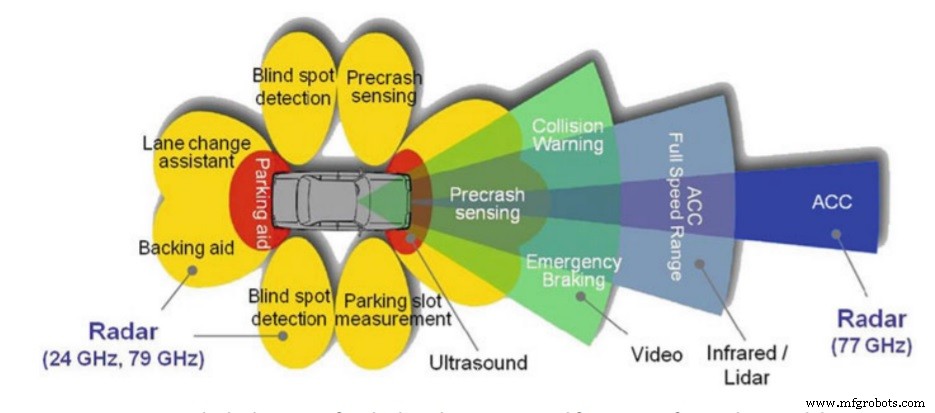
An example deployment of multiple radar sensors used for active safety and assisted driving systems (Kissinger, 2012)
The principle is simple: each radar relies on reflected signals to estimate distance and speed. When multiple radars operate in close proximity, their echoes superimpose, causing constructive and destructive interference that degrades detection accuracy. NHTSA’s “Radar Congestion Study” (Sept 2018) explained that in congested environments, the interference power can exceed the echo power by several orders of magnitude.
Such degradation could jeopardize safety. “Worst‑case scenarios could lead to fatalities caused by radar interference,” said Phil Magney, founder and president of VSI Labs. “Even today, radar stacks use aggressive filtering to eliminate false positives, but that’s a band‑width trade‑off, not a cure.”
The industry has been warned for a decade
With every additional radar‑equipped car on the road, the collective sensor environment becomes increasingly complex, forcing suppliers to act. Yet the industry’s response has been fragmented.
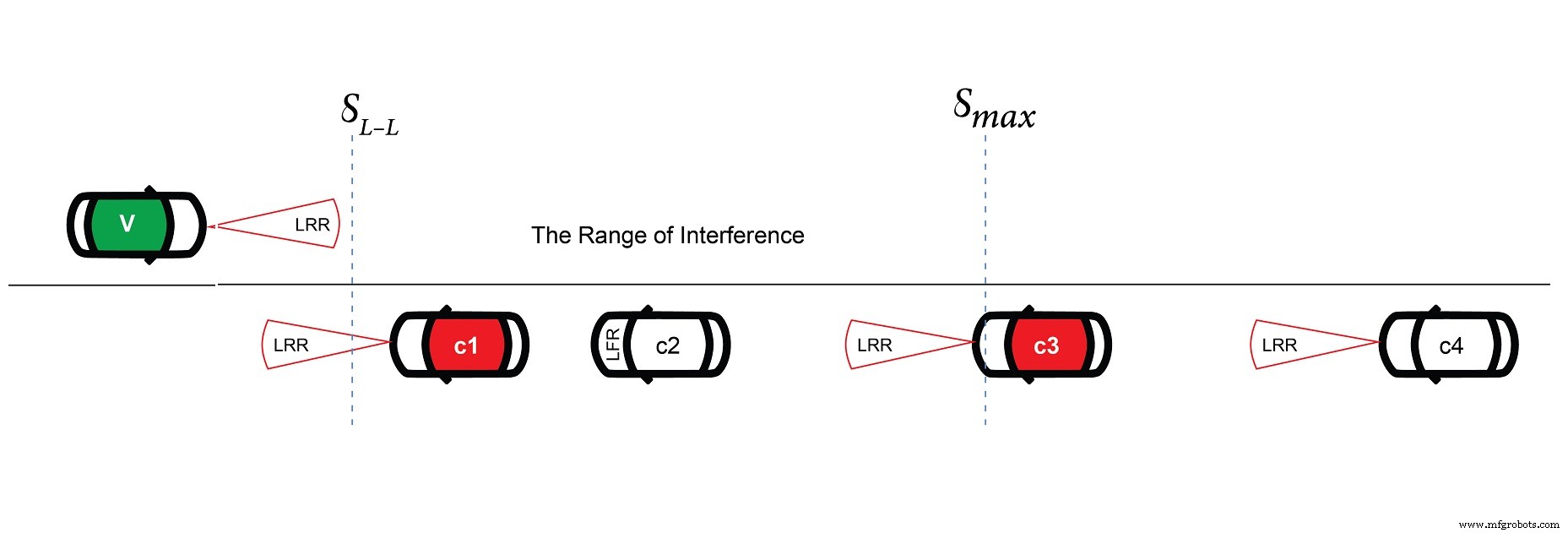
The simple common traffic scenario in which the interference is calculated at the victim radar (green) and is generated by the other vehicles (red)3. (Source: NXP)
In 2012, the European MOSARIM project examined mutual radar interference and proposed mitigation techniques. NHTSA’s recent study posed two key questions: (1) How much power does a radar receive from other transmitters? (2) How does this affect collision‑warning performance? The answer: interference levels in dense traffic can overwhelm legitimate echoes by up to four orders of magnitude.
Collaboration or regulation?
Given the long lead time, one would expect OEMs and Tier‑1 suppliers to adopt proactive strategies, such as dynamic waveform adaptation. The radar community has the tools—channel‑access protocols from telecom (TDMA, FDMA, CDMA) could be repurposed for automotive radars. A “listen‑before‑talk” scheme could prevent simultaneous transmissions.
However, the automotive sector lacks regulatory oversight for waveform parameters, and the market has historically eschewed standardization. NXP’s Gu noted that “radar waveform parameters are not regulated, and there is no industry agreement on how to share the spectrum fairly.”
Instead, most manufacturers resort to signal‑processing hacks: randomizing transmit timing or frequency to reduce predictability. Gu cautioned that “this blind approach may work when few vehicles are present, but as penetration grows, collaborative solutions become essential.”
In a white paper, NXP concluded that “eventually, a market‑wide agreement will be required to allocate sensing resources equitably while preserving differentiation.”
Free‑for‑all dynamics
Radar sensor companies often prioritize proprietary DSP algorithms that improve resolution and mitigate interference over industry‑wide standards. “The industry tends to throw more signal processing at the problem rather than establishing cooperative protocols,” said Egil Juliussen, veteran analyst.
During a recent interview, NXP’s Gu outlined three mitigation approaches: (1) protect the front‑end from saturation; (2) digitally identify and cancel interference; (3) dynamically adapt waveform parameters. The third is least likely in the current 77 GHz band but could become viable if a higher band (e.g., 140 GHz) becomes available.
Front‑end protection can involve dual‑gain settings or spatial nulling with multiple antennas to blind the radar toward interfering directions. Digital techniques rely on accurate interference detection; however, diverse FMCW waveforms across manufacturers make universal detection challenging.
FMCW remains the de‑facto standard for automotive radar because of its bandwidth efficiency and velocity estimation capability. Yet manufacturers vary key parameters—carrier frequency, bandwidth, chirp duration, sampling time, sensing cycle duration—so the same “interference” signal may appear differently on each radar.
Thus, the first step is detection: identify the alien waveform, then remove it without corrupting the target echo. While textbook algorithms exist, they are limited to low‑correlation interferences and typically handle only one or two interferers.
ST Micro’s Duncan said, “If we know what the chirp should look like, we can filter out spurious signals. Introducing chirp signatures also helps.” He added, “More standardization on transmitted signals would greatly ease counter‑measure design.”
Do we already feel radar interference?
NHTSA’s simulation scenarios illustrate expected interference levels:
- On a two‑lane highway, random carrier frequencies can cause interference power up to 40 dB above the echo power of a typical reference target.
- Blind‑spot radars facing rearward can experience interference from forward AEB radars up to 50 dB greater than their own target echoes.
Despite these predictions, real‑world evidence remains scarce. “We have never observed radar‑to‑radar interference on public roads,” said Magney of VSI Labs. “We suspect exposure exists because of the mix of short‑ and long‑range radars, but it has not manifested in field tests.”
Tesla’s recent announcement to eliminate radar from its vehicles sidesteps the issue for that brand, but other OEMs, Tier‑1s, and suppliers continue to rely on radar for its weather‑resilience and cost effectiveness.
“Radar remains one of the most cost‑effective ADAS sensors, and its penetration will grow dramatically over the coming years,” stressed Magney.
>> This article was originally published on our sister site, EE Times.
Related Contents:
- ADAS experts ponder sensor integration in future vehicles
- ADAS vehicles score poorly on pedestrian safety
- Automated vehicle future faces unanswered sensor questions
- Enhancing road sensing beyond visual with smart data processing
- 60‑GHz radar‑on‑chip supports automotive industry requirements
- Automotive mmWave sensors enable smarter radar
For more Embedded, subscribe to Embedded’s weekly email newsletter.
Sensor
- Radar Sensors Explained: How They Work & Their Modern Applications
- Automotive Shop Safety Rules: Expert Guidance for Technicians
- NSITEXE Launches NS31A, a RISC‑V 32‑bit CPU Meeting ISO 26262 ASIL D for Automotive Safety
- Advancing Automotive Quietness: New Audio Tech Powers Superior Active Noise Cancellation
- Arbe Unveils First Automotive-Grade 30 fps 4D Imaging Radar Processor
- Digital Radar: The Solution to Growing ADAS Interference Challenges
- How Advanced Driver Assistance Systems Are Revolutionizing Global Road Safety
- Atom‑Based Radio Sensor Reveals Signal Direction for Cleaner Communications
- Defeat EMI in Automotive Circuits: 5 Expert Design Tips
- High-Precision Metal Tubing Enhances Automotive Safety Systems