



Color Masterbatch Mixing in Plastic Manufacturing: Expert Guide to Resin Selection and Process Optimization
I. Selecting the Right Color Masterbatch
Choosing the correct color masterbatch is a critical step that often goes overlooked until project launch. By addressing color considerations early in material selection, manufacturers can avoid costly redesigns and ensure product consistency. The decision hinges on resin type, application requirements, and cost constraints.
Key resin attributes that influence color performance include melt rate, processing temperature, transparency, crystalline versus amorphous structure, and the presence of reinforcing agents or fillers.
1. Pigment Palette – Understanding Colorants
Colorants come in two main forms: dyes and pigments. Dyes dissolve in the polymer matrix, offering vibrant hues but are less effective at masking surface imperfections and can degrade in outdoor conditions. Pigments, by contrast, remain as discrete particles, providing robust coverage, excellent surface defect masking, and superior weatherability.
Within pigments, there are organic and inorganic varieties. Organic pigments are typically more efficient, delivering bright, lustrous colors at lower loadings (0.2‑0.5 %) compared to inorganic pigments, which may require up to 2 % for similar opacity. Organic pigments also enable coloring of transparent plastics. Inorganic pigments, while less mobile, excel in heat and weather resistance, making them suitable for high‑temperature or outdoor applications. Industry trends are shifting toward organic pigments due to improved performance and reduced health hazards.
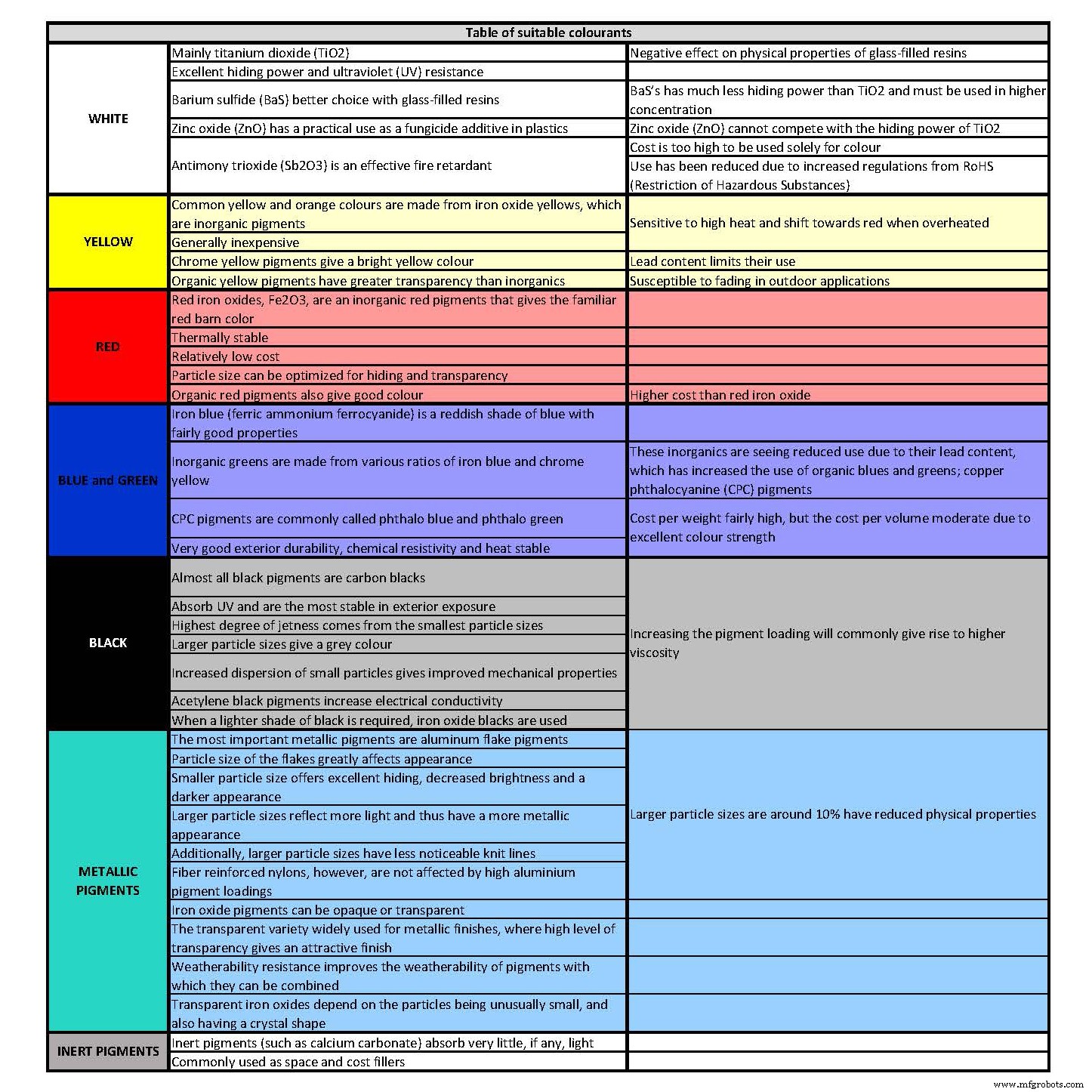
II. Impact of Colorants on Polymer Properties
Incorporating a color masterbatch can alter a polymer’s mechanical, thermal, and optical characteristics. Compatibility between the polymer chemistry and the colorant is essential. High processing temperatures and the presence of other additives—such as flame retardants—can amplify the interaction effects.
For example, a colorant that is neutral to pure polycarbonate may react differently when the material is blended with flame retardants. Transparent colors typically use dyes that disturb the polymer matrix less than pigments used in opaque colors, reducing the risk of dimensional shifts during injection molding.
Colorant particle size also influences material performance. Coarser pigments can lead to micro‑voids or surface roughness, whereas finer particles improve flow and finish but may increase melt viscosity.
Understanding these nuances allows engineers to predict tolerances, ensure part uniformity, and maintain performance standards across color variations.
III. Coloring Methods and Their Effects
Manufacturers employ several techniques to achieve desired colors:
- Masterbatching – blending pre‑colored pellets with a base polymer.
- Dry blending – direct mixing of pigments or dyes into the melt.
- Surface coating – applying color to the finished part.
Each method impacts mechanical properties differently. For instance, masterbatching preserves polymer integrity but requires careful compounding to avoid phase separation. Dry blending offers flexibility but can introduce viscosity variations if not homogenized properly.
By selecting the appropriate method and optimizing process parameters, manufacturers can control color consistency without compromising part quality.
Dye
- Global Leaders in Color Masterbatch Production: Quality, Expertise, and Trust
- Color Masterbatch Market: Growth Drivers and Industry Applications
- Four Reliable Ways to Color Plastic Moulds – Masterbatch, Compounding, Solvent, and Dry Pigment
- Choosing the Right Color Masterbatch for Plastic Production
- Color Masterbatch: The Preferred Choice Over Pigments in Modern Plastic Production
- High‑Performance PP Filler Masterbatch for Industrial Plastic Production
- Calcium Carbonate Masterbatch: Applications & Benefits in Plastic Production
- Color Masterbatch: The Premier Solution for Industrial Plastic Coloration
- Enhancing Plastic Production with CaCO3 Filler Masterbatch – Benefits, Applications & Sunrise Colours Expertise
- How to Choose a Leading Plastic Additive & Color Masterbatch Supplier in Vietnam