



Refitech Expands RefiFLEX with 40×40 mm Carbon Tubes & Connectors; Now Supplies CarboSix Pultrusion Profiles to Benelux
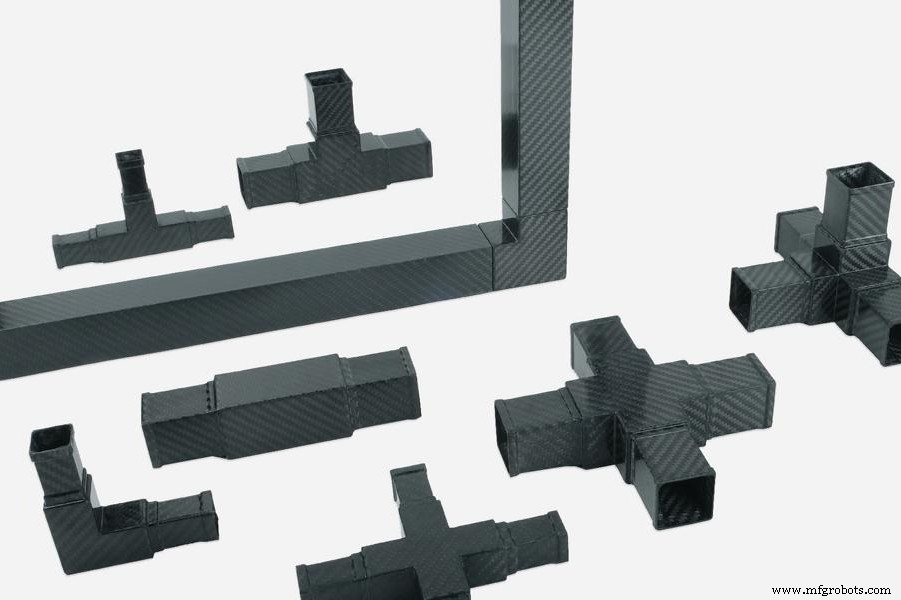
Refitech (Waalwijk, Netherlands) has expanded its range of RefiFLEX carbon fiber square tube construction solutions, which now include a 40 x 40-millimeter high-precision tube with a standard length of 1,600 millimeters, as well as the corresponding connectors, RefiFLEX 40S. Further, Refitech says it can now supply CarboSix (Mondovì, Italy) unidirectional (UD) carbon fiber pultrusion profiles to customers in the Benelux, a politico-economic union in western Europe. The profiles have integrated mounting slots to enable them to be screwed rather than glued together to form frames, using a variety of fixing materials.
“We see a growing demand for lightweight systems,” says Bas Nijpels, sales engineer at Refitech. “As a result, more and more mechanical engineers are starting to use our carbon fiber tubes and profiles. This, in turn, has led to increased requests for larger sized tubes, in addition to our successful 20-, 25- and 30-millimeter RefiFLEX tubes. Like its smaller RefiFLEX comparator, the new 40 x 40-millimeter tube is smooth inside and out, ensuring the connectors can be glued on to fit perfectly. By combining the different RefiFLEX elements, lightweight frames for all kinds of applications can be constructed with ease.”
Nijpels notes that the RefiFLEX tubes and connectors range now includes 18 different shapes and sizes. Moreover, says Nijpel, they continue to meet construction challenges, including high performance at a reduced weight. A recent customer application include large LED screen frames.
Further, as a result of a cooperative agreement, Refitech has now added CarboSix’s construction system to its portfolio. Unlike the multi-layered prepreg RefiFLEX system, the CarboSix profiles consist of UD carbon fiber pultrusion profiles, making them ideal for solutions that require high bending stiffness at low weight. Three available sizes include 90 x 90 millimeters, 90 x 45 millimeters and 45 x 45 millimeters, and have an integrated mounting slot so profiles can be screwed together to form frames.
“These profiles are used to make calibration frames or assembly jigs in the automotive, mechanical engineering and aerospace industries,” adds Nijpel. “These carbon fiber frames and jigs are both lighter and stiffer than their metal counterparts. Compared to aluminum frames, this system can save up to 70% in weight at a comparable strength and stiffness. End-user advantages are not only high dimensional stability and a very low ergonomic load, but also enables more flexibility for adjustment or the rearrangement of components if required in the production process.”
fiber
- Mastering Python For Loops: Syntax, Examples, and Advanced Patterns
- AI in Manufacturing: Three Key Trends Shaping 2019
- Flexible Printing Solutions for Construction Materials: Codes, Logos, and Barcodes
- Affordable Arduino-Based Light & Flash Meter for Photographers
- Scheurer Swiss Delivers 3D‑Printed Carbon‑Fiber Engine Parts for Toyota FT‑60 Racing Car
- Exel Composites Delivers Lightweight Fiberglass Profiles to 33 Electric Buses in Helsinki
- Construction Commences on NMIS Facility in Renfrewshire's Advanced Manufacturing Innovation District
- Techniplas Delivers High-Capacity FRP Drinking Water Tanks for Fertilizer Plant
- Michelman Enhances Technical Textile Performance with New Surface Modification Solutions
- Stäubli Broadens Robotics Portfolio to Accelerate Life Sciences Innovation