



New Design Method Cuts Carbon Fiber Weight, Boosting Lighter Aircraft & Vehicles

Researchers from Tokyo University of Science (TUS, Japan) have adopted a new design method that optimizes both carbon fiber thickness and orientation, achieving weight reduction in fiber-reinforced composites and opening doors to lighter aircrafts and automotive vehicles.
TUS points to carbon fiber-reinforced polymers (CFRP) which has been continuously studied to improve strength. Most of these studies, says TUS, have focused on a particular technique called “fiber-steered design,” which optimizes fiber orientation to enhance strength.
However, the fiber-steered design approach is not without its drawbacks. “Fiber-steered design only optimizes orientation and keeps the thickness of the fibers fixed, preventing full use of the mechanical properties of CFRP. A weight reduction approach, which allows optimization of fiber thickness as well, has been rarely considered,” explains Dr. Ryosuke Matsuzaki from TUS, whose research is focused on composite materials.
Against this backdrop, Dr. Matsuzaki — along with his colleagues at TUS, Yuto Mori and Naoya Kumekawa — proposed a new design method for optimizing the fiber orientation and thickness simultaneously depending on the location in the composite structure, which allowed them to reduce the weight of the CFRP compared to that of a constant thickness linear lamination model without compromising its strength. Their findings can be read in a new study published in Composite Structures.
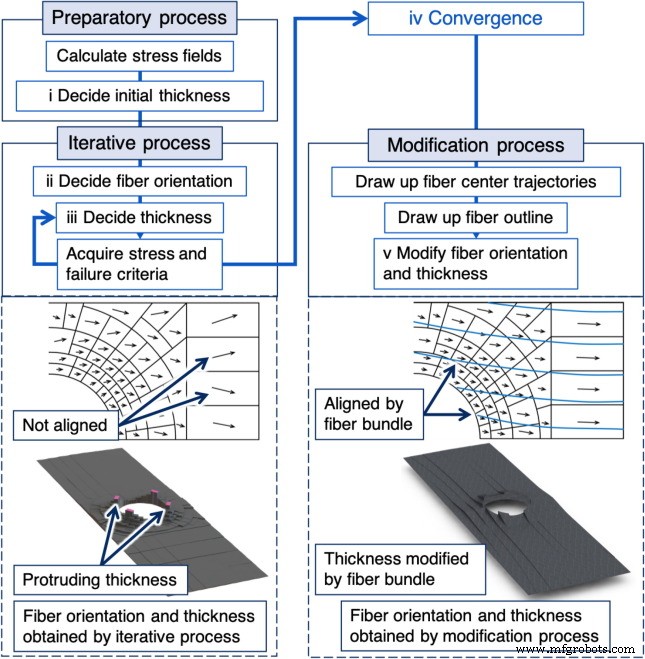
Their method consisted of three steps: the preparatory, iterative and modification processes. In the preparatory process, an initial analysis was performed using the finite element method (FEM) to determine the number of layers, enabling a qualitative weight evaluation by a linear lamination model and a fiber-steered design with a thickness variation model. The iterative process was used to determine the fiber orientation by the principal stress direction and iteratively calculate the thickness using “maximum stress theory.” Finally, the modification process was used to make modifications accounting for manufacturability by first creating a reference “base fiber bundle” in a region requiring strength improvement and then determining the final orientation and thickness by arranging the fiber bundles such that they spread on both sides of the reference bundle.
The method of simultaneous optimization led to a weight reduction greater than 5% while enabling higher load transfer efficiency than that achieved with fiber orientation alone.
The researchers note that they’re excited by these results and look forward to the future implementation of their method for further weight reduction of conventional CFRP parts. “Our design method goes beyond the conventional wisdom of composite design, making for lighter aircraft and automobiles, which can contribute to energy conservation and reduction of CO2 emissions,” observes Dr. Matsuzaki.
fiber
- Carbon Fiber Explained: Strength, Production, and Industry Applications
- Is Carbon Fiber Conductive? Understanding Its Electrical and Thermal Properties
- Forged Carbon Fiber: The Definitive Guide to Advanced Composite Materials
- Mach 3 Composites Carbon Fiber Laptop Case – Premium Protection, Now Discontinued
- Recycling Composites: Unlocking Value in Carbon Fiber Waste
- Upcoming Composite Events Spotlight Recycled Carbon Fiber and Filament Winding Innovations
- ATL Composites Powers Next-Gen Powerboat with Advanced Carbon Fiber Hull
- Rock West Composites Expands Portfolio with Durable 3Form Varia Ecoresin Carbon Fiber Panels
- Bucci Composites Announces Successful Test of Advanced 22‑inch Carbon Fiber Wheel
- Vision Composite Products Partners with IDI Composites for High‑Performance Carbon‑Fiber Forged Wheels