



Reviving Carbon Fiber: Repair, Restore, and Recycle Explained
Carbon fiber’s durability is legendary, yet cracks, fading, or minor damage can be addressed without discarding the material. This guide explores proven repair methods, restoration techniques for faded finishes, and the emerging possibility of recycling carbon composites.
RELATED: How Strong Is Carbon Fiber? | Learn What Makes This Element So Tough
In this article:
- Can Carbon Fiber Be Repaired?
- Should You Replace Or Repair Carbon Fiber?
- How Do You Bring Faded Carbon Fiber Back to Life?
- Can Carbon Fiber Be Recycled?
Can Carbon Fiber Be Repaired?
Many manufacturers caution against repairing carbon‑fiber parts, but the reality is that, when performed correctly, repairs can restore structural integrity and extend service life.
The aviation sector, for instance, routinely repairs damaged carbon‑fiber components in aircraft such as those built by Boeing, demonstrating the feasibility of reliable repair techniques.
Choosing the right repair approach depends on the component, the extent of damage, and the expertise available. Minor cosmetic issues can often be handled in-house, whereas structural repairs should be performed by certified specialists.

Cosmetic Repairs
Cosmetic fixes target surface imperfections—scratches, small dents, or discoloration—without compromising load‑bearing capacity. These repairs typically involve surface preparation, application of a compatible epoxy or polyester resin, and a fresh coat of paint or clear finish.
Because the underlying fibers remain intact, cosmetic repairs are relatively straightforward and require minimal specialized equipment. The key is to use a high‑quality epoxy that matches the original resin system.
Structural Repairs
Structural repairs are more complex. The weave pattern, number of layers, and fiber orientation all influence the final strength. A skilled technician must reconstruct the original lay‑up, aligning each ply with its intended orientation to preserve mechanical properties.
Some severely damaged components—such as bike rims that have been subjected to heat or repeated impact—may not be viable for repair, in which case replacement is the safest option.
Should You Replace Or Repair Carbon Fiber?
Deciding between repair and replacement hinges on several factors:
Longevity of the repair
A repair situated in a well‑supported area, such as a door panel’s central region, can be highly durable. Conversely, an edge‑cut on a vehicle door may experience repeated stress and could fail prematurely.
Extent and cost of damage

Large or complex damage may render repair impractical or cost‑prohibitive. For example, repairing a carbon‑fiber hood on a Shelby Mustang might be more economical than ordering a new part, whereas a damaged bike fork is often cheaper and faster to replace outright.
Visual impact
Painted carbon‑fiber components can conceal repair scars, but unpainted surfaces will reveal the work, which may be undesirable for high‑profile applications.
RELATED: Learn To Make Your Own Carbon Fiber Parts: Carbon Fiber Starter Kit
How Do You Bring Faded Carbon Fiber Back to Life?
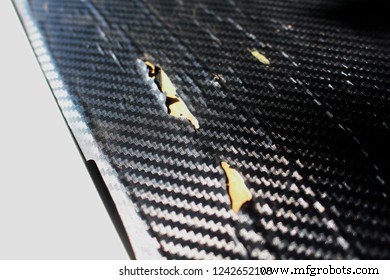
UV radiation gradually degrades the epoxy resin and clear coats that protect carbon‑fiber surfaces, leading to a hazy, yellowed appearance. Re‑coating is often the only viable solution when the underlying material remains sound.
Below is a step‑by‑step approach you can follow if the damage is superficial. For deep cracks or fiber‑level defects, professional intervention is recommended.
1. Clean thoroughly. Remove all wax, grease, and surface contaminants with soap and water, then wipe with rubbing alcohol.
2. Sand carefully. Use progressively finer grit sandpaper, stopping when you see a light brown residue. Darkening indicates you are sanding the fiber, which should be avoided.
3. Fill chips. Apply a high‑strength epoxy to any deep pits, let it cure overnight, then sand smooth.
4. Apply clear coat. Finish with a UV‑resistant clear coat that matches the original finish.
Watch this video for a visual demonstration of the restoration process.
Can Carbon Fiber Be Recycled?
Recycling carbon‑fiber composites is technically feasible but remains resource‑intensive. Thermal or chemical processes can recover the fibers, yet they may suffer from reduced tensile strength.
While the technology has existed for decades, the commercial market for recycled carbon fiber is still nascent. However, major OEMs—including Airbus and BMW—are investing heavily in recycling initiatives, signaling rapid industry growth.
Because recycled carbon fiber can be repurposed into new components, it offers a sustainable alternative to landfill disposal.
Visit our website to learn more. Carbon Fiber Gear also offers products made from recycled carbon fiber.
Up Next:
- What is Carbon Fiber?
- Carbon Fiber Manufacturing
- Carbon Fiber Children's Car Seat Prototype By Rory Craig
fiber
- Top 3 Benefits of Carbon Fiber Watches for Luxury Timepieces
- Unidirectional Carbon Fiber: The Strength, Lightness, and Cost‑Savings Advantage for Modern Manufacturing
- Carbon Fiber: 3 Key Properties That Drive Innovation
- 5 Unexpected Carbon Fiber Innovations Reshaping Modern Life
- Carbon Fiber Weaves: Types, Properties & Industrial Applications
- Carbon Fiber Explained: Strength, Production, and Industry Applications
- Is Carbon Fiber Recyclable? A Guide to Sustainable Recycling & Repair
- How Carbon Fiber Footwear Enhances Speed, Energy, and Performance
- Carbon Fiber in Aerospace: Enhancing Performance, Sustainability, and Safety
- Is Carbon Fiber Conductive? Understanding Its Electrical and Thermal Properties