



How Stainless Steel Is Made: From Raw Materials to Finished Products
What Is Stainless Steel?
Stainless steel is an iron‑based alloy that incorporates 12–20 % chromium, giving it superior resistance to staining and rust. Since the 1800s, metallurgists have refined over 57 distinct grades, each tailored for specific performance requirements. The alloy’s high chromium content forms a passive oxide layer that protects the metal even under aggressive environmental conditions.
Its combination of corrosion resistance, high strength, and attractive appearance makes stainless steel indispensable across sectors—from food‑processing equipment in India, which consumes roughly 200,000 t of nickel‑containing grades annually, to iconic architectural facades such as the stainless‑steel crown of the Chrysler Building. Chemical, petrochemical, and oil‑and‑gas industries also rely on stainless steel for valves, pumps, tanks, and pipelines.
Classes of Stainless Steel
The stainless‑steel family is grouped into five principal classes, each defined by crystal structure and characteristic properties:
- Austenitic: 200‑ and 300‑series grades, most widely used for their excellent formability and corrosion resistance.
- Ferritic: 400‑series alloys with good resistance to stress corrosion cracking.
- Martensitic: 400‑series grades offering high strength and moderate corrosion resistance.
- Precipitation‑hardening: Provide the best combination of strength and toughness at elevated temperatures.
- Duplex: 200‑series duplex alloys with balanced austenitic/ferritic phases, delivering superior strength and corrosion resistance.
Grade selection is governed by the precise proportions of iron, chromium, nickel, molybdenum, and carbon, as well as any additional alloying elements introduced to meet specific demands such as low‑temperature toughness or weldability.
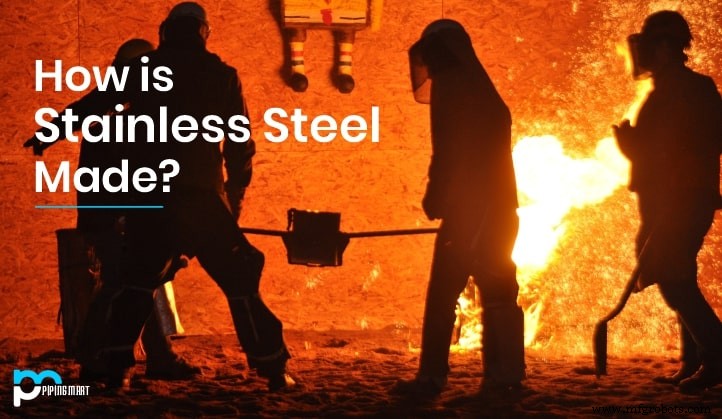
How Is Stainless Steel Made?
The manufacturing journey of stainless steel is a sequence of carefully controlled steps, each critical to ensuring the final product meets its design specifications. Below is a concise overview of the process.
1. Raw‑Material Selection
Choosing the correct blend of elements is the foundation of a quality alloy. Higher chromium levels translate to greater corrosion resistance, while nickel enhances formability. The exact composition is dictated by the intended application.
2. Melting
All raw materials are melted together in an electric‑arc furnace. The furnace’s high temperatures—typically 1500 °C for austenitic grades—melt the steel and dissolve the alloying elements into a homogeneous liquid. This same furnace is used in recycling, underscoring stainless steel’s 100 % recyclability.
3. Excess Carbon Removal
Carbon is added for toughness, but excessive carbon can lead to carbide precipitation during welding. Two decarburization methods—argon‑oxygen decarburization (AOD) and vacuum‑oxygen decarburization (VOD)—reduce carbon content to the desired level, creating low‑carbon grades such as 304L.
4. Tuning
During tuning, the molten alloy is stirred and held at temperature long enough to eliminate unwanted inclusions and achieve chemical uniformity. This step refines the alloy’s consistency and prepares it for subsequent shaping.
5. Forming (Casting)
Once tuned, the liquid steel is cast into primary shapes—blooms, rods, slabs, or tubes—using dedicated molds. These forms serve as the starting point for further processing.
6. Rolling
Hot rolling, performed above the recrystallization temperature, transforms blooms and slabs into bars, wire, sheets, or plates. Cold rolling, conducted below that temperature, refines the surface finish and dimensional accuracy.
7. Cutting & Finishing
Final dimensions are achieved through precise cutting—using guillotine, circular, or high‑speed blade saws. After cutting, surfaces are finished by grinding, polishing, or abrasive‑belt machining to meet visual and functional standards.
Metal
- How Stainless Steel Is Produced: From Smelting to Finished Products
- Stainless Steel Explained: Composition, Production, and Global Impact
- Stainless Steel: Properties, Manufacturing, and Future Applications
- Effective Stainless Steel Cleaning & Passivation: Protect Against Rust & Corrosion
- Carbon Steel vs Stainless Steel: Choosing the Right Alloy for Your Project
- Steel vs. Stainless Steel: Choosing the Right Metal for Your Project
- The Steel-Making Process Explained: From Iron Ore to Alloy
- Stainless Steel Fabrication: From Raw Materials to Finished Products
- How to Keep Stainless Steel Clean & Corrosion‑Free: A Practical Guide
- Mastering Stainless Steel Welding: Techniques & Tips