



Enhancing Perovskite LED Performance via High‑Polarity Alcohol Treatment of PEDOT:PSS Hole Transport Layers
Abstract
Perovskite light‑emitting diodes (PeLEDs) built on an ITO/PEDOT:PSS/CH3NH3PbBr3/TPBi/Ag stack benefit substantially from a simple spin‑coat treatment of the PEDOT:PSS layer with high‑polarity alcohols. Methanol (MeOH) treatment elevates the maximum luminance to 2075 cd m−2 and current efficiency to 0.38 cd A−1, surpassing untreated devices (261 cd m−2, 0.10 cd A−1). The improvement stems from two synergistic effects: (1) enhanced hole injection due to increased PEDOT:PSS conductivity, and (2) improved MAPbBr3 crystallinity and coverage driven by a higher surface energy of the treated layer. This straightforward method offers a scalable route to high‑performance PeLEDs.
Background
Hybrid perovskites combine low cost, solution processability, high carrier mobility, and tunable bandgaps, making them attractive for display and solid‑state lighting applications. Their narrow full‑width‑at‑half‑maximum (FWHM) and high photoluminescence quantum yield (PLQY) position them favorably against organic LEDs, enabling roll‑to‑roll fabrication and reduced manufacturing complexity.
Since the first solution‑processed PeLED reported in 2014, performance milestones have risen dramatically: from 364 cd m−2 luminance and 0.1 % EQE, to 42.9 cd A−1 current efficiency via precursor optimization, to 11.7 % EQE using self‑organized quantum wells, and 92 % PLQY achieved by incorporating low‑dielectric‑constant polymers.
Device architecture typically follows anode/HTL/EML/ETL/cathode. PEDOT:PSS is the most common HTL due to its transparency and solution compatibility, yet its high hole injection barrier (0.4–0.7 eV) relative to the perovskite HOMO (5.6–5.9 eV) limits charge balance. Conventional barrier‑reduction strategies involve doping PEDOT:PSS with perfluorinated ionomers or MoO3, which, while effective, complicate large‑scale fabrication.
This study introduces a non‑doping approach: spin‑coat high‑polarity alcohols on PEDOT:PSS prior to annealing. By leveraging the solvent’s polarity to screen PEDOT/PSS Coulomb interactions, we selectively remove insulating PSS and increase PEDOT conductivity, while simultaneously enhancing the surface energy that promotes finer, well‑covered MAPbBr3 grains.
Methods
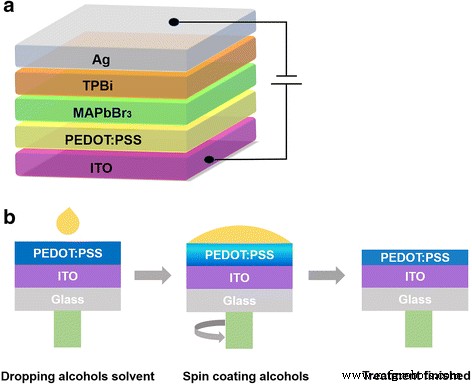
Device Structure – ITO (15 Ω sq−1)/PEDOT:PSS (70 nm)/MAPbBr3 (70 nm)/TPBi (40 nm)/Ag (100 nm). ITO and Ag serve as anode and cathode, respectively.
Substrate Preparation – ITO wafers cleaned sequentially in detergent, acetone, deionized water, and IPA (15 min each) in an ultrasonic bath, followed by 15 min O2 plasma.
PEDOT:PSS Treatment – 5000 rpm spin for 60 s. Control samples were annealed at 120 °C for 20 min without solvent. Experimental samples received 30 s spin of MeOH, EtOH, or IPA at 5000 rpm, then annealed under the same conditions.
Perovskite Layer – 5 wt % MAPbBr3 in DMF, spin‑coated 500 rpm/20 s and 3000 rpm/60 s with 400 µL chlorobenzene drop at 40 s. Annealed at 100 °C for 10 min.
ETL and Cathode – 40 nm TPBi evaporated, then 100 nm Ag deposited in high vacuum. Active area: 0.2 cm2.
Electrical and optical measurements employed a Keithley 4200 source, spectrophotometer OPT‑2000, and four‑point probe for conductivity. Morphology examined via AFM and SEM; crystallinity via XRD; time‑resolved PL (TRPL) used a 368 nm pulsed laser with FL‑TCSPC.
Results and Discussion
Device Performance
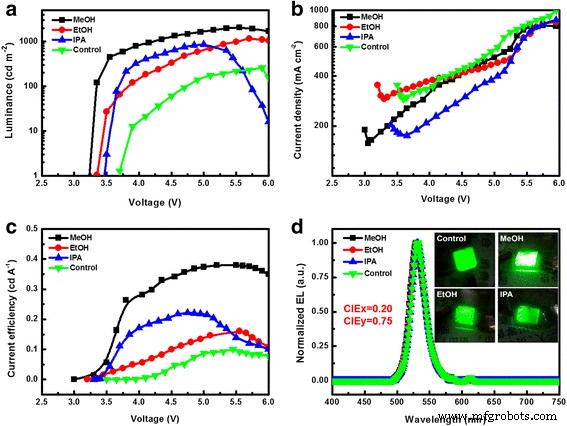
Figure 2 illustrates the luminance, current density, and current efficiency of devices with untreated and alcohol‑treated PEDOT:PSS. MeOH treatment yields a maximum luminance of 2075 cd m−2 and current efficiency of 0.38 cd A−1, compared to 261 cd m−2 and 0.10 cd A−1 for untreated devices. EtOH and IPA treatments provide intermediate improvements (1166 cd m−2, 0.16 cd A−1; 863 cd m−2, 0.22 cd A−1, respectively), confirming a polarity‑dependent effect.
Electroluminescence spectra remain centered at 532 nm with a 27 nm FWHM across all devices, indicating that the emission originates solely from MAPbBr3.
PEDOT:PSS Conductivity and Morphology
Conductivity measurements show a clear rise with solvent polarity: untreated (0.1 S cm−1), IPA (230.2 S cm−1), EtOH (327.5 S cm−1), and MeOH (605.0 S cm−1). Correspondingly, film thickness decreases from 40 nm (untreated) to 27–35 nm after treatment, reflecting PSS removal.
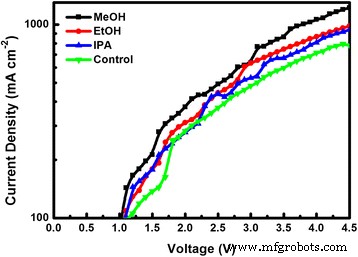
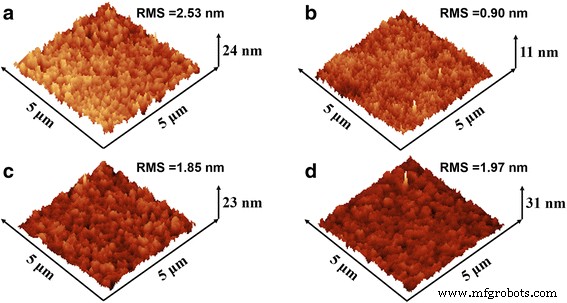
AFM reveals smoother surfaces: RMS roughness drops from 2.53 nm (untreated) to 0.90–1.97 nm (treated), with MeOH providing the most uniform morphology. Hole‑only device measurements confirm higher current density for MeOH‑treated films, demonstrating improved hole injection.
MAPbBr3 Crystallization and Morphology
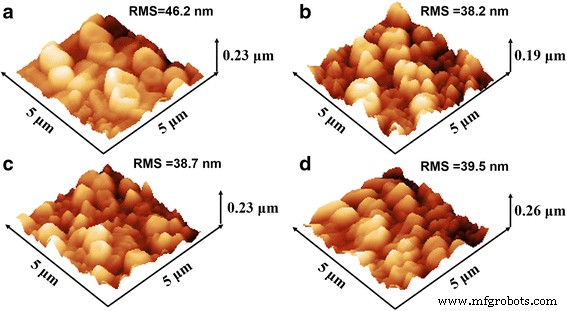
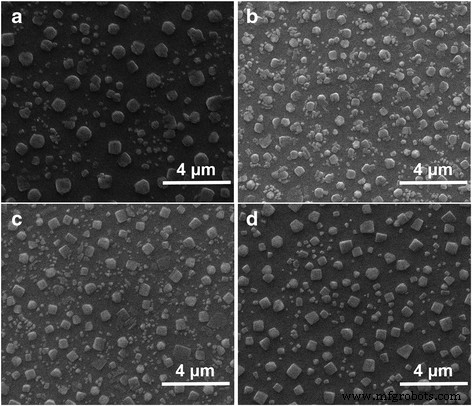
AFM of the perovskite layer shows reduced RMS roughness (46.2 nm to 38.2–39.5 nm) and smaller grain sizes (328 nm to 232–273 nm) after treatment, especially with MeOH. SEM confirms higher surface coverage (24.95 % → 37.34 %) and a finer grain distribution.
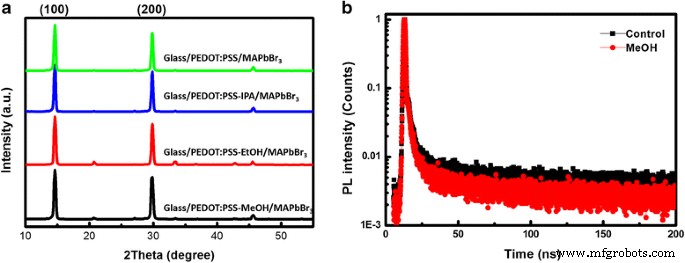
XRD patterns exhibit sharp (100) and (200) peaks at 14.602° and 29.845°, unchanged by treatment, indicating preserved cubic crystal structure. TRPL decay shortens after MeOH treatment, signifying increased radiative recombination efficiency.
Conclusions
Spin‑coating high‑polarity alcohols on PEDOT:PSS before annealing markedly enhances PeLED performance. Methanol treatment delivers the best results, achieving 2075 cd m−2 luminance and 0.38 cd A−1 current efficiency. The dual benefits—enhanced hole injection through increased PEDOT conductivity and improved perovskite crystallinity via higher surface energy—highlight this approach as a scalable, industrially friendly route to high‑brightness PeLEDs.
Abbreviations
- AFM
- Atomic force microscope
- CB
- Chlorobenzene
- CE
- Current efficiency
- CEmax
- Maximum current efficiency
- EL
- Electroluminescence
- EML
- Emission layer
- EQE
- External quantum efficiency
- ETL
- Electron transport layer
- EtOH
- Ethanol
- FWHM
- Full width at half maximum
- HOMO
- Highest occupied molecular orbital
- HTL
- Hole transport layer
- IPA
- Isopropanol
- ITO
- Indium tin oxide
- J‑V‑L
- Current density‑voltage‑luminance
- Lmax
- Maximum luminance
- MAPbBr3
- CH3NH3PbBr3
- MeOH
- Methanol
- PEDOT:MoO3
- Mixed PEDOT:PSS with MoO3
- PEDOT:PSS
- Poly(3,4‑ethylenedioxythiophene):polystyrene sulfonate
- PeLEDs
- Perovskite light‑emitting diodes
- PFI
- Perfluorinated ionomer
- PLQY
- Photoluminescence quantum yield
- PMMA
- Poly(methyl methacrylate)
- RMS
- Root mean square
- SEM
- Scanning electron microscopy
- TPBi
- 1,3,5‑Tris(2‑N‑phenylbenzimidazolyl) benzene
- TRPL
- Time‑resolved photoluminescence
- XRD
- X‑ray diffraction
Figures
Device structure and alcohol‑solvent spin‑coat process.
Device performance: (a) L‑V, (b) J‑V, (c) CE‑V, (d) EL spectra and photos.
Hole‑only device current density vs. voltage.
AFM images of PEDOT:PSS films.
AFM images of MAPbBr3 films.
SEM images of MAPbBr3 films.
XRD and TRPL of MAPbBr3 films.
Nanomaterials
- Methanol‑Enhanced PEDOT:PSS Hole Transport Layer Boosts Silicon/Organic Hybrid Solar Cell Efficiency to 12.2%
- Superior Performance of Inverted Perovskite Solar Cells Using CdSe Quantum Dot and LiF Electron Transport Layers
- UV‑Ozone‑Treated Reduced Graphene Oxide Enhances PEDOT:PSS Hole Transport Layer in Inverted Perovskite Solar Cells
- High‑Performance PEDOT:PSS/n‑Si Solar Cells with Textured Surfaces and Silver Nanowire Electrodes
- Ultra‑Efficient AlGaN Deep‑UV LEDs with Superlattice p‑Electron Blocking Layer for Near‑Zero Efficiency Droop
- Low‑Temperature UV‑Cured SnO₂ Electron Transport Layers Deliver 14.4% Efficiency in Planar Perovskite Solar Cells
- Lead‑Free Bismuth‑Doped Cs₂SnCl₆ and Mn‑Doped CsPbCl₃ Quantum Dots Deliver Highly Stable, High‑Efficiency White LEDs
- Boosting AlGaN Deep UV LED Efficiency with Chirped Superlattice Electron Deceleration Layers
- Enhanced Quasi‑2D Perovskite LEDs with Poly(vinylpyrrolidone) Treatment: Record Brightness & Efficiency
- High-Performance Red LEDs via All-Inorganic CsPbI3/TOPO Nanowire Color Conversion Films