



Gallium Phosphide: Pioneering On‑Chip Photonics for the Next Generation of Information Technology
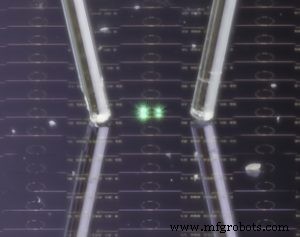
Photograph of a GaP‑on‑insulator chip with integrated devices being measured with optical fibers. The green glow is the third‑harmonic light generated while pumping one of the ring resonators with a laser.
In the peer‑reviewed paper Integrated Gallium Phosphide Nonlinear Photonics published in Nature Photonics, our team demonstrates a breakthrough in on‑chip light manipulation using crystalline gallium phosphide (GaP). This development unlocks a broad spectrum of applications—telecommunications, sensing, astronomy, and quantum computing—by enabling high‑performance photonic devices that can be seamlessly integrated with existing semiconductor technology.
Gallium phosphide has long been a cornerstone of photonics, yet the lack of scalable fabrication methods limited its use to basic light‑emitting devices. At IBM Research – Zurich, we pioneered a manufacturable process that layers high‑quality GaP onto standard electronic wafers. Coupled with partners at EPFL, we now produce ultra‑compact photonic circuits that can coexist with silicon, indium‑phosphide, or CMOS electronics, marking a new era for hybrid computing hardware.
On‑Chip Frequency Comb Generation
We illustrate the power of our GaP platform by engineering waveguide resonators that generate broadband optical frequency combs. These combs—arrays of equally spaced spectral lines—serve as optical ‘rulers’ for ultraprecise clocks, high‑resolution spectroscopy, and microwave‑to‑optical signal conversion. Traditionally, comb generation required bulky, expensive equipment; our integrated solution operates at low power, with a threshold of only 3 mW, and is compatible with mass‑production.

Scanning electron microscope image of a GaP‑on‑insulator waveguide ring resonator on a silicon chip.
GaP’s strong second‑order nonlinearity allows simultaneous generation of frequency‑doubled light near the visible spectrum, and certain devices exhibit efficient Raman lasing. The waveguides display an exceptionally low propagation loss of 1.2 dB/cm, matching state‑of‑the‑art silicon‑on‑insulator performance while offering superior nonlinear interaction.
Why GaP Stands Out
GaP combines a high refractive index (n > 3 for wavelengths up to 4 µm) with a wide bandgap (2.26 eV). This rare combination delivers tight optical confinement, a broad transparency window extending into the visible, and reduced two‑photon absorption at 1310 nm and 1550 nm, enabling higher optical intensities in nanophotonic devices. Its high second‑ and third‑order nonlinear susceptibilities facilitate efficient three‑ and four‑wave mixing, the key processes behind frequency combs, wavelength conversion, and supercontinuum generation.
Broad‑Spectrum Applications on the Horizon
Beyond comb generation, our GaP devices perform on‑chip frequency doubling and tripling, opening avenues for compact wavelength converters. The platform also supports supercontinuum generation—a broadband, coherent light source useful for advanced sensing, optical communication, and biomedical imaging techniques such as optical coherence tomography. Because the fabrication process is fully CMOS‑compatible and substrate‑agnostic, GaP can be monolithically integrated with silicon or indium‑phosphide photonics, or even with electronic circuits, enabling complex hybrid systems. Potential applications include high‑speed electro‑optic modulators for data centers, quantum‑coherent transducers linking superconducting qubits to optical fibers, and beyond.
This work was carried out in collaboration between IBM Research – Zurich and EPFL, supported by the European Union’s Horizon 2020 Programme under grant agreements No. 722923 (Marie Skłodowska‑Curie H2020‑ETN OMT) and No. 732894 (FET Proactive HOT).
Nanomaterials
- 5 Key Wireless Standards Powering IoT Connectivity
- Tin Nanocrystals: The Next Frontier for High‑Capacity Lithium‑Ion Batteries
- Preparing for an Autonomous Future: How Fleet Owners Can Get Ahead
- Smart Cities: Leveraging 5G, IoT, and Fiber for a Net‑Zero Future
- Securing Billions of IoT Devices with Cyber Resilience: A Blueprint for the Future
- Blockchain: The Trust Engine for Tomorrow’s Transactions
- Fortifying Smart Devices for the Future of Work
- Advanced Ignition Systems for Reliable CubeSat Electric Propulsion
- Ericsson's 5G Solutions Drive Manufacturing Digital Transformation
- FDA Unveils Proposed UDI Rule to Standardize Medical Device Identification