



Revolutionizing Quantum Computing: Single‑Atom Qubits Controlled by Scanning Tunneling Microscopy
Our IBM Research team has achieved a landmark breakthrough in quantum control, demonstrating that individual atoms can serve as reliable qubits for quantum information processing.
In the newly published paper “Coherent spin manipulation of individual atoms on a surface,” appearing in the journal Science, we report the first successful use of single atoms as qubits. Quantum bits, or qubits, are the foundational units that enable a quantum computer’s unprecedented processing power.
This achievement marks the first time a single‑atom qubit has been realized using a Scanning Tunneling Microscope (STM), an IBM invention that earned a Nobel Prize for its ability to image and reposition atoms one at a time. The STM’s precision is critical because it allows each atomic qubit to be placed and arranged with nanometer accuracy, giving researchers fine‑grained control over the qubit network.
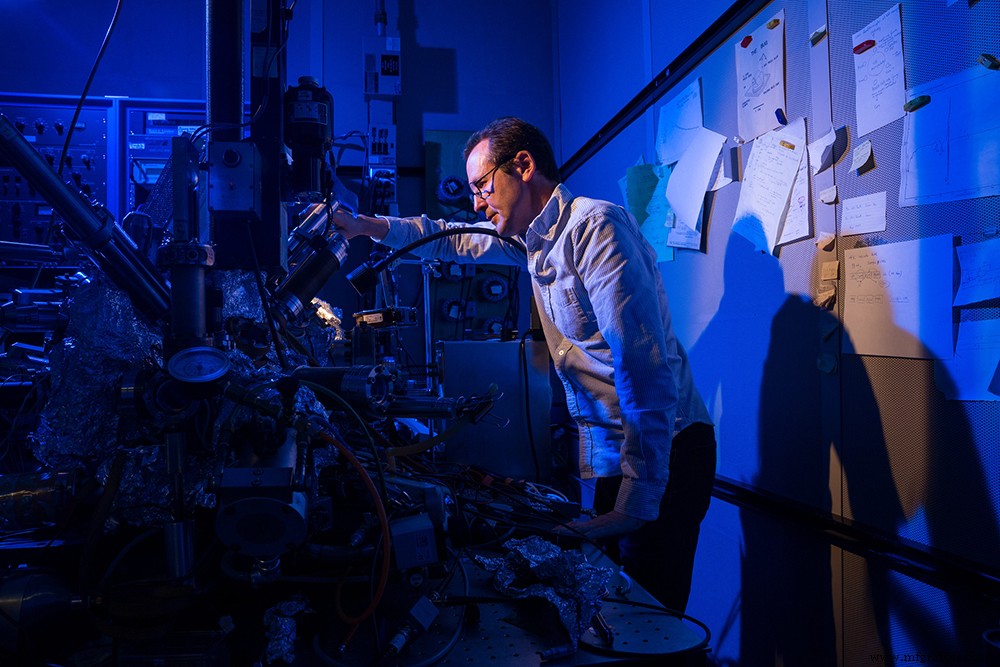
Co‑author Dr. Christopher Lutz of IBM Research – Almaden in San Jose, Calif. stands beside IBM’s Nobel‑prize‑winning microscope used to create the first single‑atom qubit. (Stan Olszewski for IBM)
A quantum leap from atomic bit to qubit
In conventional computers, the basic data unit is a bit, which can hold only a “0” or a “1.” A qubit, by contrast, can exist in a superposition of both states simultaneously, a property that lies at the heart of quantum advantage. The superposition allows quantum processors to evaluate many possibilities at once, dramatically accelerating certain calculations.
Our experiments employ the quantum property of spin in a titanium atom as the physical embodiment of a qubit. A titanium atom’s spin endows it with a tiny magnetic moment, analogous to a miniature compass needle. The two possible magnetic orientations—north‑pointing or south‑pointing—define the logical “0” or “1” of the qubit. We stabilize this spin by placing the titanium atom on an ultrathin magnesium oxide layer, which protects its magnetic moment and preserves coherence.
Teaching a titanium atom to dance
To steer the atom’s spin into a desired superposition, we deliver high‑frequency microwave pulses via the STM tip. These microwaves act like a resonant radio‑frequency field that tips the magnetic moment of the atom. When the pulse frequency matches the spin resonance, the titanium atom undergoes a rapid precession—known as a Rabi oscillation—completing a full rotation in roughly 20 nanoseconds. By adjusting the pulse duration, we can halt the atom’s precession at any intermediate angle, thereby encoding any superposition state we require. This technique, pulsed electron spin resonance, is monitored in real time through the STM’s extraordinary sensitivity.
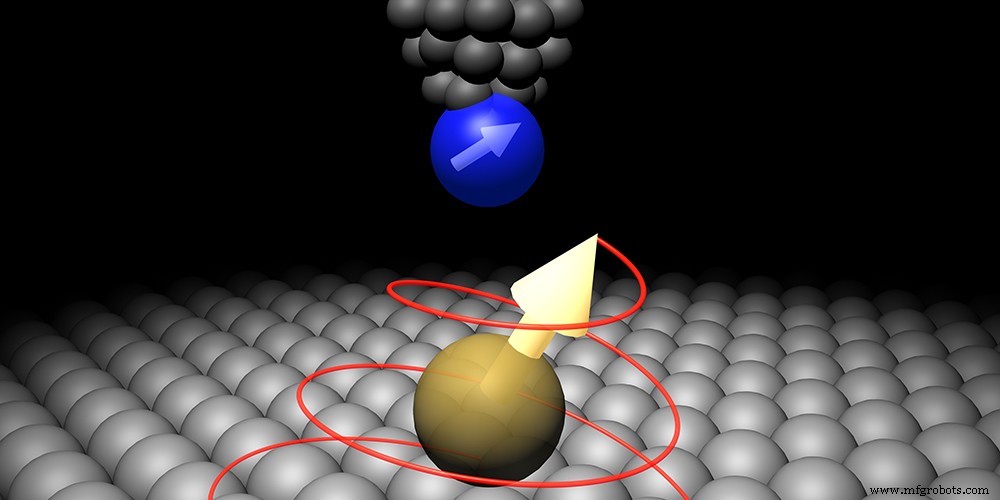
Figure 1. An artist’s rendering of a single titanium atom’s quantum dance above a magnesium oxide surface, controlled by the STM tip’s microwave field.
Because these single‑atom qubits are highly sensitive to magnetic fields, they also function as quantum sensors, capable of detecting minute magnetic interactions from nearby atoms. Leveraging this sensitivity, we have entangled two titanium qubits to form a two‑qubit system—a crucial step toward scalable quantum processors that rely on entanglement for speed‑up.
To construct the two‑qubit device, we use the STM to manipulate the titanium atoms into precisely defined positions, achieving an inter‑atomic spacing of just 1 nanometer. The figure below illustrates this engineered pair.
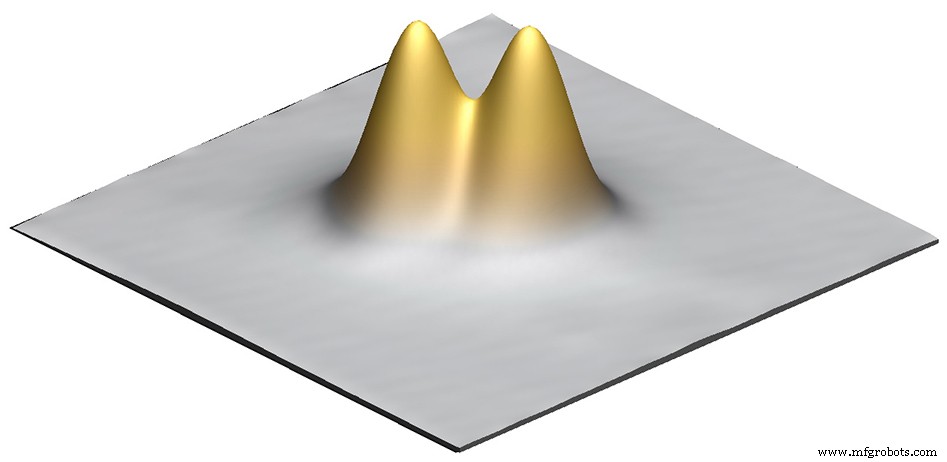
Figure 2. Two titanium atoms positioned 1 nm apart, enabling controlled quantum operations.
The magnetic interaction between the two atoms—known as the quantum exchange interaction—causes their spins to align in opposite directions, much like two fridge magnets. This interaction is the mechanism that allows the qubits to become entangled, creating a shared quantum state that cannot be described independently for each atom. We can fine‑tune the degree of entanglement by adjusting the atomic spacing and the parameters of the microwave pulses.
Control over superposition and entanglement via pulsed spin resonance opens avenues for exploring fundamental quantum phenomena such as decoherence, as well as for testing novel quantum materials and magnetic molecules. This breakthrough effectively provides an analog quantum simulator, offering a platform to probe complex magnetic interactions that could inform next‑generation quantum algorithms.
Coherent spin manipulation of individual atoms on a surface, Kai Yang, William Paul, Soo‑Hyon Phark, Philip Willke, Yujeong Bae, Taeyoung Choi, Taner Esat, Arzhang Ardavan, Andreas J. Heinrich, Christopher P. Lutz, Science 366, 509 (2019)
Nanomaterials
- Quantum Devices: Beyond CMOS – Harnessing Tunneling, Quantum Dots, and Spintronics for Future Electronics
- What Defines a Skyscraper? Insight from Architect T.J. Gottesdiener
- The Microscope: From Glass Lenses to Nanometer‑Scale Imaging
- IBM Breaks New Ground: First Liquid‑Phase Atomic Imaging of 2D Materials at Room Temperature
- IBM Breakthrough: Ballistic Electron Transport in InAs Nanowire Cross‑Junctions
- New Quantum Algorithm Enables 20‑Million‑Qubit Computer to Crack 2048‑Bit RSA in Just 8 Hours
- Optical Microscopy: Principles & Applications
- Quantum Sensors Reveal Material Transformations Under Extreme Pressure
- Quantum Automation Secures Frost & Sullivan 2021 Building Automation Leadership Award
- Florida's Manufacturing Landscape: Growth, Innovation, and Opportunity