



EconCore, Toray, and Bostik Join Forces to Develop Fire‑Safe Thermoplastic Honeycomb Panels for Aircraft Interiors
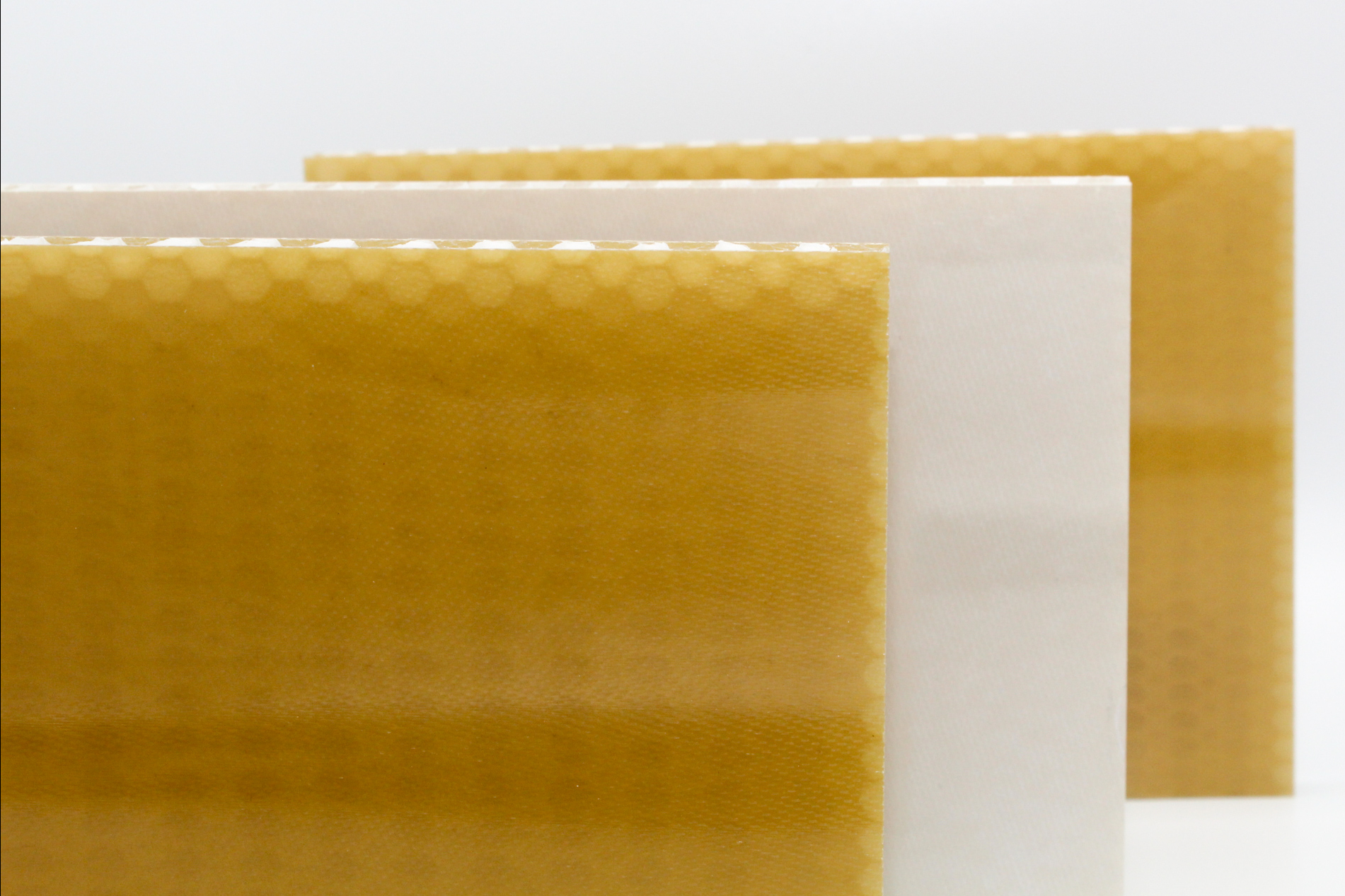
Photo Credit: EconCore
EconCore (Leuven, Belgium), Toray Advanced Composites (Morgan Hill, Calif., U.S.) and Bostik (Milwaukee, Wisc., U.S.), reported on Sept. 7 the company’s collaboration to develop a thermoplastic honeycomb core sandwich panel for use in mass transportation applications, including aircraft interiors.
A combination of Toray’s Cetex-reinforced thermoplastic laminates as skins, EconCore’s thermoplastic honeycomb core based on thermoplastic chemistries with fire, smoke and toxicity (FST) qualifications and Bostik’s flame-retardant thermoplastics polyester web adhesive, the novel material has already passed FST regulations applying to aircraft interiors.
The development was in lieu of providing a sustainable solution to more expensive and labor-intensive fabrication of parts based on conventional sandwich layup, such as that of phenolic prepreg skins and phenolic-impregnated aramid honeycomb core. Compared to thermoset resins, which are said to require lengthy and expensive handling and processing of the sandwich components, EconCore points to its thermoplastic technology, which is said to take around 60 seconds to form the desired shape. In addition to shorter processing times, Econcore’s thermoplastic honeycomb skin is considerably more sustainable and can be easily recycled, shredded and repurposed into composites.
“We are excited about this collaboration, especially as we have been able to develop a sustainable technology that is recyclable and which, next to the automotive and transportation applications, has the potential to be used in a variety of markets such as rail, aviation or ship building,” says Tomasz Czarnecki, COO of EconCore. “With the FST thermoplastic honeycomb technology, we are looking for cost savings at both ends; within the continuously produced honeycomb core and panel, as well as within the fast, easy and clean conversion of a sandwich panel into a lightweight sandwich part.”
According to the companies, while the thermoplastic honeycomb core and skins are often welded to each other within EconCore’s technology, the use of adhesive from Bostik enables for the reduction of lamination temperatures and processing simplifications. Further, the traditional phenolics usually used for curing, replaced with the company’s web adhesive which is flame-retardant, is said to provide a unique way of application which Bostik says opens new possibilities to produce lightweight materials.
With a clean bonding process, suitable for lightweight materials, EconCore’s technology is reportedly versatile with regards to the type of thermoplastic materials applied as well, which further enables optimization of the product toward specific applications.
Resin
- EconCore Showcases Advanced Lightweight Honeycomb Technology at K 2019
- Advanced Thermoplastic Honeycomb Sandwich for Lightweight Overmolding Applications
- EconCore Thermoplastic Honeycomb Cores: Superior Heat Resistance & Easy Recyclability
- Toray Advanced Composites Boosts Thermoplastic Composite Production with New High-Heat Laminate Press
- Toray Launches High-Modulus Carbon Fiber & Thermoplastic Pellets for Lightweight, Eco‑Friendly Parts
- EconCore ThermHex: Advanced Thermoplastic Honeycomb Panel Production for Lightweight, High-Performance Sandwich Structures
- Covestro & EconCore Launch FST‑Certified Lightweight Honeycomb Panels for Rail & Aerospace
- EconCore Partners with Fynotej to Deliver Advanced Thermoplastic Honeycomb Core for North American Automotive Interiors
- EconCore & MEAF Collaborate on Advanced Continuous Thermoplastic Honeycomb Cores
- Thermoset vs Thermoplastic: Key Differences and Definitions Explained