



PEEK vs. PEKK: Selecting the Optimal Thermoplastic for Future Aircraft Structures
Which is better for the in-situ consolidation (ISC) of thermoplastic composite (TPC) tapes being developed for the production of primary aircraft structures, polyetheretherketone (PEEK) or polyetherketoneketone (PEKK)? This sidebar presents the PEEK vs. PEKK debate that is part of the larger discussion as to whether ISC as a truly one-step, out of autoclave (OOA) process can meet the cost and production rate goals for future aircraft production — that is 60-70 aircraft/month for an A320 neo type single-aisle jetliner. The alternative is to use two steps: layup of thermoplastic composite tapes via automated fiber placement (AFP) and then consolidate in an autoclave or heated press. See “Consolidating thermoplastic composite aerostructures in place, Part 1” and “Part 2” for more details.(Also see Jeff Sloan’s recent feature article on thermoplastic tapes.)
Both PEEK and PEKK are members of the broader polyaryletherketone (PAEK) family, often referred to as polyketones. “PEKK looks a lot like PEEK, and its crystallization behavior is similar, but its processing temp is 375°C vs. 385°C for PEEK,” says Henri de Vries, senior scientist, composites, in the Structures Technology Dept. at the Netherlands Aerospace Centre (NLR, Amsterdam). NLR and GKN Aerospace’s (Redditch, UK) Fokker business (Papendrecht and Hoogeveen, The Netherlands) have pioneered many TPC technologies in the TAPAS 1 and TAPAS 2 programs, including a 12m span torsion box and most recently a 6m long, 28mm thick CF/PEKK engine pylon upper spar made using AFP but consolidated in an autoclave. (See “Thermoplastic composite demonstrators — EU roadmap for future airframes”).
De Vries sees PEKK as more amenable for AFP, “because the process window is wider. You have to be at 385-390°C for PEEK — so processing at 360°C is not ideal. However, with PEKK, processing is quite good even at 355°C. So not only is your lower boundary lower, but you get just a little more time before the material sets so the total time that it’s in the melt is a little longer, hence better consolidation.”
De Vries adds that PEKK is interesting for press forming, the faster option for consolidation in a second step vs. vacuum bagging and cycling in an autoclave. “The older grades of PEKK (DS) were too slow for press forming but the newer grades (FC) are better and also cheaper than PEEK.”
“Oxford Performance Materials (OPM) has been working with PEKK since 2000,” says DeFelice, “developing both materials and applications technology. All PEKK products on the market today are made using the DuPont method.” He explains that basically all polyketones were developed at the same time, in response to a need for improved fire, smoke and toxicity (FST) performance in aircraft interiors being threatened by new FAA regulations in the 1990s. However, the regulations never materialized, and the initial market for PEEK and PEKK evaporated. Thus, ICI spun PEEK out to Victrex and DuPont sold PEKK to Fiberite, which was acquired by Cytec, which in turn was acquired by Solvay. DeFelice says Arkema became a partner with OPM with the purpose of gaining PEKK expertise, and ultimately developed a DuPont method PEKK product. As a result of this partnership, Arkema became the second source for PEKK in the composites industry.
“Hexcel also invested in OPM,” says DeFelice. (Here, we make a quick diversion to explain Hexcel’s acquisition of OPM’s Aerospace & Defense additive manufacturing business. “We developed an additive manufacturing technology using selective laser melting (SLM) with carbon fiber reinforced PEKK that is qualified at Boeing, Northrop Grumman and others for AEROSPACE applications. This was attractive to Hexcel, who was already a substantial shareholder in OPM.” Thus, in Dec 2017, Hexcel acquired OPM’s aerospace and defense (A&D) business (South Windsor, CT, US). OPM, however, maintains its 3D PEKK printing business outside of aerospace & defense, and continues to develop its core material science technologies.
“All PEKK is not the same,” asserts DeFelice. “Solvay and Arkema practice the DuPont method, which uses high temperature synthesis (HTS), so it runs a little faster, which lowers the cost. However, it also has its drawbacks.” He explains that initially, there were problems with the melt stability and purity of the PEKK polymer which made it difficult for DuPont to fabricate parts. Over time, the DuPont method improved, as did the polymer somewhat, and parts became more reproducible. For example, beyond the aforementioned additive manufacturing technologies, OPM has developed injection molding as well as film applications with PEKK.
“But we’ve always seen that PEKK could be made differently and improved upon,” says DeFelice. “Now, if you go back to the original players, there was actually a third, and that was Raychem, which sold to BASF, who simply abandoned PAEK. But Raychem’s technology was for low temperature synthesis (LTS). This is very different from HTS.” He notes that instead of producing polymer flake which must then be ground before being mixed with solvent, etc. for prepreg and 3D printing applications, this patented LTS technology allows for the production of a powder with a spherical shape that is possible to control. Because LTS is a “cold” process, it is also much more controllable in terms of the finished polymer’s molecular weight and molecular structure. However, the process is slower, so a little more costly. “But it is also possible to go directly to powder, with no grinding step,” says DeFelice. “So this helps to offset the slower processing.”
This new product, OXPEKK-LTS, offers the best of both worlds: a controllable process that produces a product with a spherical polymer powder. “With grinding, you end up with jagged ‘rocks’ of polymer which are difficult to stack uniformly when coating and impregnating a tape,” DeFelice explains. “The round shape of OXPEKK-LTS allows more precision during tape making. So now we can improve the tape and enable true OOA processing via in-situ consolidation, which is hampered by current tape dimensional fidelity.”

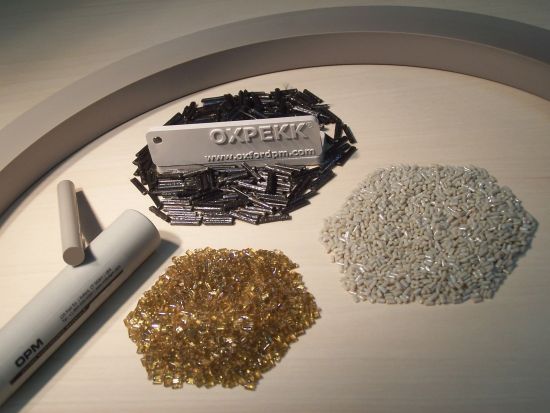
The spherical particles in OXPEKK-LTS enable a more uniform thermoplastic tape,
which aids in achieving one-step, out-of-autoclave (OOA) in-situ consolidated primary composite aircraft structures. SOURCE: Oxford Performance Materials.
So it’s possible to produce better tape and still match the price of PEEK? “The cost that Airbus and their suppliers are debating for composite primary structures is much more complicated than just the polymer raw material cost,” counters DeFelice. “Raw material is definitely a piece of the overall component cost, but the fabrication process and performance are the key cost elements. First, the compressive strength of PEKK is much higher than PEEK, which is a substantial advantage. You are able to achieve much better fatigue performance in the composite structure, which in turn means you can design lighter structures which don’t require as much material. In other words, we provide a way to achieve higher strength-to-weight ratios. But we also enable ISC, so these lighter structures are now produced in one step, not two.”
But OPM is not stopping there. DeFelice asserts that all carbon fiber used in polyketone prereg for aerospace applications is used without sizing. This is key because sizing applied to the fiber enables it to move through all of the various processing steps with predictability, reduced damage and repeatability. “No one in aerospace uses carbon fiber with sizing for PAEK thermoplastic primary structure because all of the known sizings adversely affect mechanical properties,” he explains.
A quick note here. Matthias Schubert, technical service for Teijin Carbon in Europe disagrees. “We have used a special sizing for PAEK thermoplastics for many years,” he explains. “It was necessary because standard sizings have some outgassing due to their epoxide chemistry that degrades at PAEK processing temperatures. Our sizing actually increases resin adhesion, which is about 20% higher compared to unsized carbon fibers.” He notes this has been measured by transversal 4-point bending tests and can be attributed to controlled initialization of crystalline structures at the fiber-resin interface. (Note, this sizing development is explained by Jean-Philippe Canart at Teijin Carbon America in the blog “PEEK vs. PEKK vs. PAEK”.)
“With OXPEKK LTS, we also have proprietary chemistry to put the PEKK into solution and use it as a sizing that will further speed processing and improve tape performance.” says DeFelice. This extends all the way through to in-situ consolidation. “So now there is an extremely strong business case emerging for large primary structures made using this technology.”
What about thicker tapes? NLR has said it would like to have a tape as thick as 0.25 inches, which further helps to meet production rates of 60-70 aircraft/month. “Speed pushes back against fidelity in the process and performance in the final structure,” says DeFelice. “So it is always a balance between these opposing factors. The physics of round polymer particles in prepregging is well-established. We believe we offer control of these particles which then gives more levers to achieve the balance needed for producing large OOA primary structures that meet cost and performance targets. We have very powerful tools to get this technology where Airbus and others want it to be.”
OPM’s track record of blazing new paths gives it confidence. “No one else has qualified 3D printing with PEKK and carbon fiber for spacecraft with a full B-basis allowables,” says DeFelice, “and no one else has developed skull, spine and orthopedic implants with FDA clearance, certified biocompatibility and performance. We are confident we can provide PEKK thermoplastic composite solutions for aircraft.”
OXPEKK LTS will be introduced for developmental purposes by the end of this year. The product will be commercially available in early 2019.
Resin
- How Live TV Will Transform: The Computing‑Driven Future of Broadcast
- The Four Leading Grades of PEEK and Their Key Industrial Applications
- PEEK Medical Implants: Advanced Biocompatible Solutions for Spinal, Orthopedic, Cardiovascular, and Dental Applications
- How AI Will Transform Human Resources: Benefits, Risks, and Implementation
- The Future of Collaborative Robots: Innovation & Growth
- Composite Rebar: Safeguarding Future Infrastructure Against Climate Stress
- Dubai's Museum of the Future: Constructing a 78‑Meter Architectural Icon
- Compression RTM: Advancing Production of Future Aerospace Composite Aerostructures
- Choosing the Right Thermoplastic Composite: PEEK, PEKK, PAEK, and Continuous Compression Molding
- AI's Role in Shaping Tomorrow: From Healthcare to Sustainability