



Elevating PVC Processing Sustainability with Advanced Screws & Barrels
Polyvinyl chloride (PVC) is a cornerstone of contemporary manufacturing, underpinning everything from window and door profiles to critical medical tubing. Its durability, hygiene, and consistent performance make it indispensable in construction and healthcare alike.
Yet, as the global spotlight on sustainability intensifies, the PVC industry faces growing scrutiny over its environmental footprint. From energy‑use targets to carbon‑reporting mandates, processors must now balance throughput with responsible stewardship.
Featured Content
Today’s sustainability agenda demands that extrusion equipment be judged not just on the quantity or quality of the product it delivers, but on how cleanly and efficiently it operates over its entire life cycle. Twin‑screw lines—especially those used for PVC compounding and profile extrusion—are now examined for energy efficiency, reliability, and end‑of‑life impact.
In this context, screws and barrels move beyond being simple consumables; they are strategic levers for sustainability. By adopting durable, recyclable, and rebuildable components, the PVC sector can slash energy use, extend equipment life, and champion circularity.
Wear: The Hidden Sustainability Challenge in PVC Processing
PVC’s complex formulations—filled with stabilizers, additives, and fillers—create a corrosive and abrasive environment that takes a heavy toll on extrusion components. Over time, wear erodes screw and barrel geometry, reduces output, and forces machines to work harder, inflating energy consumption.
Historically, the response has been to replace worn parts, a strategy that quickly becomes unsustainable. Every discarded screw or barrel represents lost material, wasted embodied energy, and unnecessary carbon emissions.
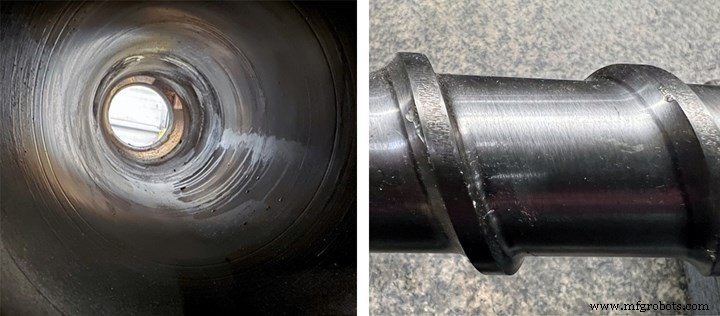
Photographs of wear observed during inspection. Left: barrel inlay wear. Right: screw outer‑diameter (OD) wear. Source: Xaloy
Rethinking Screw and Barrel Design for Sustainability
Meeting modern sustainability goals requires reimagining the very design of polymer‑processing components—screws, barrels, check valves, nozzles, and endcaps—to prioritize wear mitigation, service life, and recoverability.
Specialty coatings and advanced materials play a pivotal role. Optimized surface treatments—such as nitriding or anodizing—can drastically reduce corrosion and abrasion, preserving clearances and lowering friction. Meanwhile, new screw flight geometries and barrel designs that facilitate refurbishment can spread load, minimize stress concentrations, and extend operational life.
However, not all parts are equally amenable to rebuild. Screws, for instance, are fragile; even a minor crack can propagate, potentially causing catastrophic failure, gearbox damage, and safety risks. A run‑to‑failure strategy is therefore untenable from both a safety and sustainability standpoint.
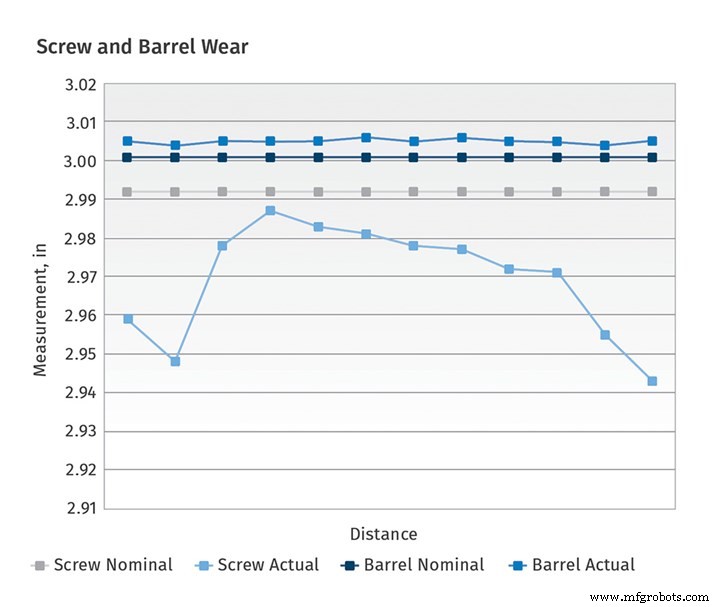
Comparative analysis of nominal vs. actual screw and barrel measurements.
In twin‑screw systems, gaps between flights tend to widen after rebuilds, allowing more material slip. This generates excess heat, elevates energy consumption, and accelerates wear throughout the extruder and downstream components—undermining any sustainability gains.
Material selection becomes critical. Conventional twin screws made from 4140 steel with nitriding and chrome plating are increasingly hard to justify—chrome plating presents environmental and regulatory challenges, and the wear life remains limited. Transitioning to advanced alloys such as Nitralloy offers a cleaner, more durable alternative. Nitralloy delivers a hard, polished surface that eliminates the need for chrome plating, extends service life, and reduces environmental impact.
Circularity Through Refurbishment, Not Disposal
While screws present rebuilding challenges, barrels offer a clear path to circularity in PVC processing. Unlike screws, barrels can often be restored multiple times without sacrificing performance, provided they are engineered with refurbishment in mind.
For conical twin barrels, refurbishment is a sustainable solution. Worn barrels can be precisely machined and relined with bimetallic treatments, preserving the existing housing, cutting raw material use, and slashing the energy and emissions of producing a new barrel.
Parallel twin barrels lend themselves well to relining. Instead of scrapping the entire assembly, a new wear‑resistant liner can be installed inside the existing barrel body. Relining restores tight clearances, boosts processing efficiency, and extends barrel life—often at a fraction of the cost and environmental impact of replacement.
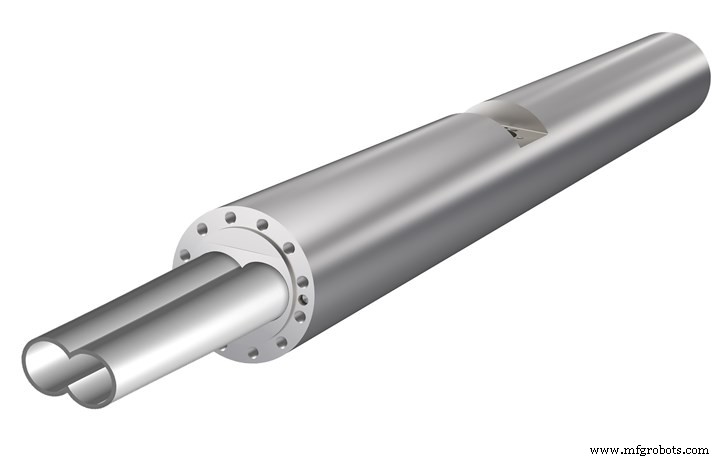
Illustration of a new twin‑barrel liner being guided into the barrel assembly during relining.
Both refurbishment strategies dramatically reduce waste, prevent premature entry of large steel components into the scrap stream, and lower the overall carbon footprint of extrusion operations. Refurbished and relined barrels also maintain optimal processing conditions, further cutting energy use and improving PVC performance.
From a sustainability perspective, refurbishing and relining barrels represent low‑hanging fruit—a concrete, immediate action that aligns operational efficiency with fiscal prudence and environmental responsibility.
The Path Forward
PVC will remain a manufacturing linchpin for decades. The pressing question is whether twin‑screw extrusion equipment can evolve swiftly enough to meet rising sustainability expectations.
Custom, wear‑optimized, and rebuildable designs for screws and barrels chart a clear route forward. By extending service life, cutting energy consumption, eliminating problematic coatings, and embracing refurbishment where feasible, the PVC industry can markedly improve its sustainability profile without compromising performance.
PVC processing must evolve—not because sustainability is a passing trend, but because it has become a core metric of operational excellence.
ABOUT THE AUTHOR: Cheryl Sayer is Xaloy’s CTO and VP of engineering, leading global engineering strategy, innovation, and product development. With more than 20 years in the industry, she has held roles at TRW Automotive, Pall Life Sciences, Kortec, Milacron, and Mold‑Masters. She holds a B.S. in mechanical engineering, an M.S. in plastics engineering, and an MBA, and serves on the University of Massachusetts Plastics Engineering Advisory Board. Contact: 330‑726‑4000; cheryl.sayer@xaloy.com; www.xaloy.com.
Resin
- AGC Chemicals Showcases Advanced mPEEK & Fluon+ EA-2000 at CAMX 2019
- MITO Material Solutions Secures $1M Series Seed Funding to Advance Graphene-Functionalized Polymer Additives
- Volume Resin Prices Rise: Key Drivers and Market Outlook
- KVE Composites Deploys First Commercial Mobile Induction Welding Cell at Daher’s Nantes Facility
- TUMI Launches McLaren‑Inspired Premium Composite Capsule Luggage Collection
- AZL, EconCore, and Audi Collaborate on Advanced Composite Battery Casings for Electric Vehicles
- Conventus Polymers Re‑engages In‑Person Partnerships Amid Rising COVID‑19 Vaccines
- Hexcel & NaCa Systems Innovate Lightweight Hybrid Carbon/Wood Composite Car Seat Back
- Solvay Delivers Advanced Thermoplastic Film to Safran, Enhancing Aerospace Performance
- Eastman Invests $250M to Launch Global-Scale Plastic-to-Plastic Recycling Plant in Tennessee