



Delrin® Homopolymer: Engineering Excellence in Fasteners and Custom Parts
Delrin® Homopolymer
Delrin® homopolymer—also known as polyoxymethylene (POM)—is a crystalline engineering plastic that excels in demanding fastener applications such as screws, hex nuts, threaded rods, and set screws. Its material properties bridge the gap between metals and conventional plastics, delivering high tensile strength, rigidity, and low friction.
Key attributes include a tensile strength comparable to many metals, hardness that resists deformation, and the ability to maintain dimensional stability even at temperatures as low as –40 °C. The material also offers excellent fatigue resistance, creep resistance, toughness, and stiffness.
Because of its high crystalline content, Delrin® is naturally white and opaque, although black variants are also available for aesthetic or functional purposes.
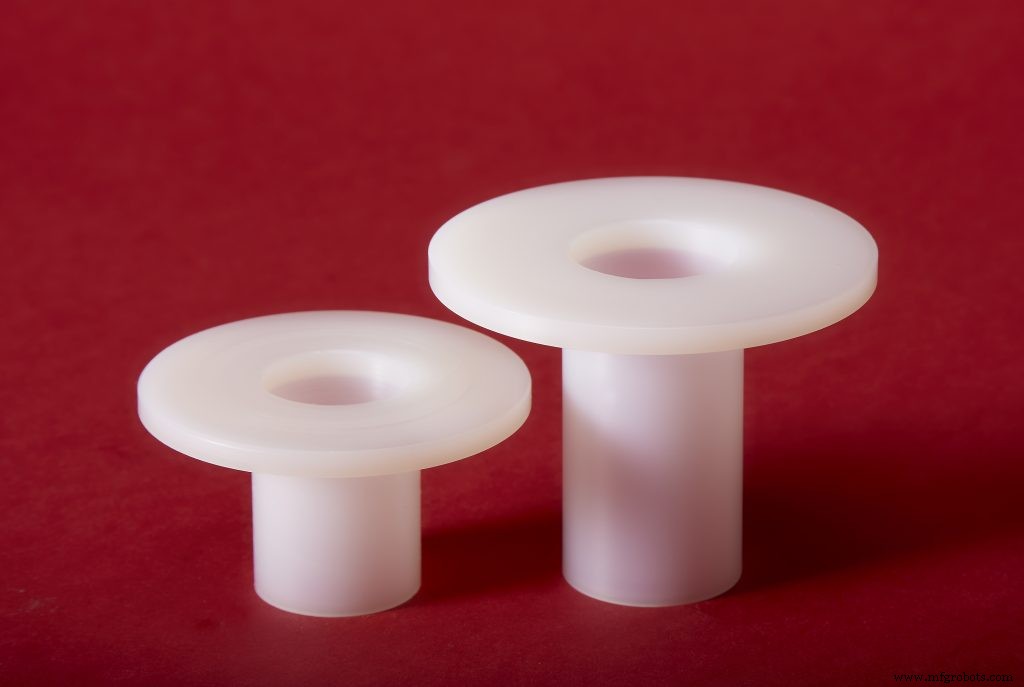
Development
German chemist Hermann Staudinger first synthesized the polymer in the 1920s, pioneering the field of polyoxymethylene. His work earned him the 1953 Nobel Prize in Chemistry. Early iterations suffered from limited thermostability, delaying commercial adoption.
DuPont
DuPont's research team, led by R. N. MacDonald, produced the first commercially viable high‑molecular‑weight Delrin® in the early 1950s. Although initial patents addressed synthesis, further refinement was needed to achieve sufficient thermal stability. By 1960, DuPont had established a dedicated plant in Parkersburg, West Virginia, to manufacture acetal resin at scale.
Celanese
Parallel to DuPont, Celanese developed its own acetal formulations. A production facility in Kelsterbach, Hessen, began operations in 1962, and Hostaform was introduced a year later. Both Delrin® and Celcon remain in continuous production today under Celanese’s portfolio.
Fabrication
Delrin® can be processed through injection molding, extrusion (sheet or rod), rotational molding, or blow molding, depending on the desired geometry. Infrared CO₂ laser cutting delivers clean, precise cuts for POM sheets. Extruded sections are commonly supplied as continuous lengths and can be trimmed to custom dimensions for machining.
Machining
Unlike metals, Delrin® has lower rigidity, so machining requires light clamping forces and ample work‑piece support to prevent deformation. Turning, milling, drilling, and other standard machining operations are feasible. While a soluble cutting lubricant is not mandatory, it is recommended to improve surface finish and tool life.
POM Burns
POM meets UL94 HB flammability classification. When ignited, it produces a blue flame that can be nearly invisible and releases formaldehyde gas, which irritates the eyes, nose, and throat. This combustion behavior should be considered in safety‑critical designs.
Center Line Porosity
A characteristic defect in homopolymer Delrin® is center‑line porosity. During cooling, the outer material solidifies first, leaving voids along the core that manifest as a white stripe or circular void in the finished part. These voids can weaken structural integrity and serve as pathways for liquids or bacteria, especially in food or medical applications.
What Causes Center Line Porosity
Gas entrapment during the solidification process creates these voids. While copolymer variants exhibit reduced susceptibility, careful process control or material selection is essential when porosity could compromise performance.
Applications
Delrin®’s combination of mechanical strength, low friction, and dimensional stability makes it ideal for high‑performance components: gear wheels, ski bindings, fasteners, lock systems, and even consumer items like zippers and yoyos. The material is also employed in medical devices such as insulin pens and inhalers, musical instruments (picks, flutes, bagpipes), automotive parts, and consumer electronics. The versatility of Delrin® continues to expand across industries.

Resin
- Isoplast® 40% Long Glass TPU – Ultra‑Durable Plastic for Hex Screws, Nuts, and Custom Fasteners
- PVDF Fasteners & Custom Parts: High‑Purity, Chemically Resistant Solutions
- Nylon Fasteners: Hex Nuts, Cap Screws, Washers, Spacers & Standoffs – Applications & Performance
- Ultem® PEI Fasteners: High‑Temperature Screws, Hex Bolts, and Custom Parts for Advanced Applications
- High‑Performance Teflon® (PTFE) Fasteners & Custom Parts for Extreme Environments
- Polyoxymethylene (POM): Properties, Production, and Key Industry Applications
- Plastic Threaded Rods: PEEK, Nylon, PTFE, Vinyl Ester, Acetal, and Ultem® – Materials, Applications, and Benefits
- High-Performance Acetal Fasteners: Screws, Nuts, Rods & Custom Parts
- Premium Nylon Fasteners: Screws, Hex Nuts, Flat Washers & Custom Parts
- Enhance Your Custom Enclosures: Mastering Type 2 & 3 Anodizing Techniques