



From Ancient Resins to Modern Epoxy: A Complete History
Epoxy resin has become a staple in art, restoration, and industrial applications thanks to its strength, versatility, and user‑friendly properties. But where did this material originate, and how did it evolve into the ubiquitous substance it is today?
Below is a concise overview of the evolution of epoxy resin, from ancient natural resins to the modern synthetic polymer that artists and engineers rely on.
What Is Epoxy Resin?
In technical terms, epoxy resin is a thermosetting polymer that hardens when combined with a curing agent. The reaction between the resin and hardener transforms the liquid mixture into a rigid, durable solid.
The base chemistry of epoxy resins typically involves bisphenol‑A and epichlorohydrin, though other bisphenol derivatives can be used. Historically, phenol—originally isolated from coal tar—was a key component in early formulations; today, phenol is usually extracted from petroleum feedstocks.
When Did Epoxy Resin First Appear?
Natural resins have been employed for millennia, from Greek antiquity to medieval Europe, for purposes such as wood preservation, artistic coatings, and fragrance creation.
The synthetic counterpart, however, was a 20th‑century breakthrough. In 1934, German chemist Paul Schlack patented the first commercial epoxy resin, marking the beginning of modern polymer science.
During the 1930s and 1940s, researchers worldwide explored bisphenol‑A‑based systems. Swiss chemist Pierre Castan emerged as a key figure, developing epichlorohydrin‑diphenol formulations that proved suitable as varnishes and adhesives. His work was licensed by the Swiss company Ciba Ltd., which grew into one of the world’s leading epoxy manufacturers.
In 1946, Sylvan Greenlee of Devoe & Raynolds Company secured a U.S. patent for a bisphenol‑A/epichlorohydrin resin, further expanding commercial availability.
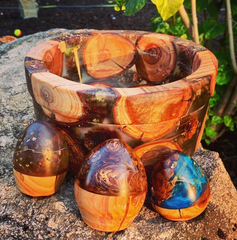
The post‑war boom in industrial applications—construction, aerospace, electronics—propelled epoxy resin into mainstream use. Artists soon followed, experimenting with pigment‑mixed epoxy to create layered paintings, jewelry, and mixed‑media works that lock in natural objects and provide long‑term protection.
Today, epoxy resin is readily accessible through hardware outlets and specialty art suppliers. While the fundamental chemistry remains unchanged, modern formulations rely on petroleum‑derived ingredients rather than coal tar.
Resin
- Epoxy Resin’s Essential Role in High‑Performance Carbon Fiber Manufacturing
- The History and Mechanics of the Screw: From Ancient Inventions to Modern Applications
- Creative & Practical Applications of Epoxy Resin
- Woodworking & Epoxy Resin: Protecting, Preserving, and Coating Wood Surfaces
- Transform Your Finished Puzzle into a Timeless Masterpiece with Epoxy Resin
- Professional Guide to Using Epoxy Resin for Artwork Preservation
- Epoxy Resin Crafting: A Low‑Cost, Family‑Friendly Hobby
- Why Resin Selection Matters: Enhancing Composite Strength & Performance
- Polyester Resins: Essential Guide for Composite Applications
- Tracing the Evolution of Metal Manufacturing: From Ancient Tools to Modern Tech