



Industrialising Additive Manufacturing: Three Key Trends of 2021
Additive manufacturing hinges on three pillars—design, production, and post‑processing. Understanding the evolving trends in each area is essential for scaling 3D printing into mainstream manufacturing. Design for additive manufacturing (DfAM) remains largely manual. Even seasoned engineers can spend 30 minutes to several hours determining the optimal orientation, technology, and material for a new part. For manufacturers aiming to 3D‑print hundreds of components, this translates into tens of thousands of dollars in engineering time over a single year. Software vendors are tackling this bottleneck with a mix of reusable workflows, automated lattice generation, and serial‑number insertion. For instance, nTopology’s nTop platform streamlines repetitive tasks, while PrintSyst’s AI‑driven assessment tool evaluates STL files, recommending suitable processes, materials, and cost estimates to enable rapid, accurate decision‑making. Complex parts—such as composites or metals—often demand more than file‑level checks. Simulation software allows engineers to model the build process, predict parameter effects on material properties, and reduce costly trial‑and‑error. Although full‑scale simulation can be computationally intensive, cloud‑based solutions are emerging to offload heavy calculations. Ultimately, interoperability across design and simulation tools is unlocking a truly connected digital thread. Larger players are bundling their offerings into single suites—Autodesk, for example, has integrated its Netfabb tools into Fusion 360 and added a simulation extension—while smaller vendors collaborate to create seamless toolchains. Industrialising additive manufacturing means eliminating manual tasks to achieve scalable, error‑free production. One emerging trend is the rise of advanced production‑management platforms. These solutions orchestrate the full AM workflow: batching orders for a build, scheduling printers, planning post‑processing and QA, and tracking each step against the plan. Many AM users still rely on spreadsheets and manual data entry, which breeds errors and inefficiency. Digitising these processes centralises, standardises, and automates operations—capabilities that were impossible with fragmented tools. Additive manufacturing execution systems (MES) have become the cornerstone of this digital transformation. For example, an MES can automatically allocate incoming orders to the most suitable printer, schedule builds based on availability and material, and trigger post‑processing steps. Modern additive MES platforms also integrate data from AM hardware, supply chains, and HR systems, providing a holistic view that helps managers identify bottlenecks and optimise resource utilisation. Read also: How Can You Transform Production Planning in Additive Manufacturing? While polishing, powder, and support removal technologies have matured, many manufacturers still manually handle the high‑volume post‑processing of printed parts. Consider a typical HP powder‑bed fusion run. To maximise throughput, operators load the printer with as many parts as possible, resulting in a mixed batch of components from different orders. At the end of the build, each part must be identified, sorted, and routed to the appropriate post‑processing station—a process still largely manual. Manual sorting scales poorly: adding another AM system often necessitates hiring additional staff, eroding the cost advantage of digital manufacturing. Automated post‑processing is therefore essential for industrialised AM. AM‑Flow exemplifies this shift, offering AI‑powered computer vision for part identification, robotic arms for sorting, and automated guided vehicles that transport components to the right station—all coordinated by a MES backbone that ensures traceability and efficient flow. As 3D printing moves from prototyping to production, the cost of hardware and materials is no longer the primary barrier. Instead, fragmented processes across the ecosystem hinder scalability. The most significant driver of industrialisation is collaborative effort—companies partnering to create integrated, automated solutions that make additive manufacturing a reliable, profitable technology poised to reshape global manufacturing.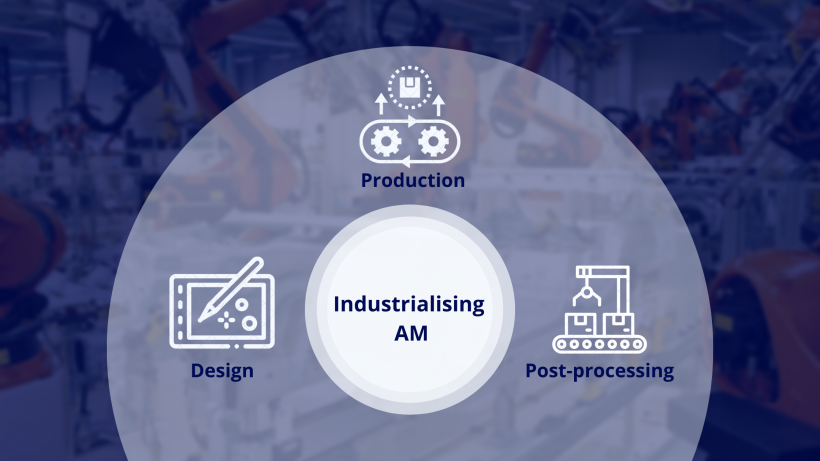 \n\n
\n\nAutomating Design for Additive Manufacturing
\n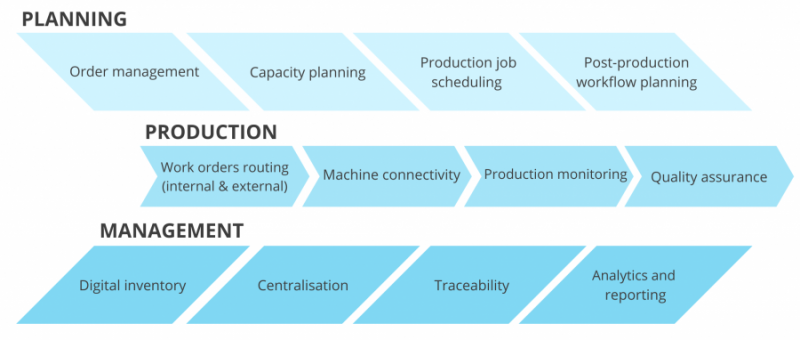
Digitised AM Production Management
\n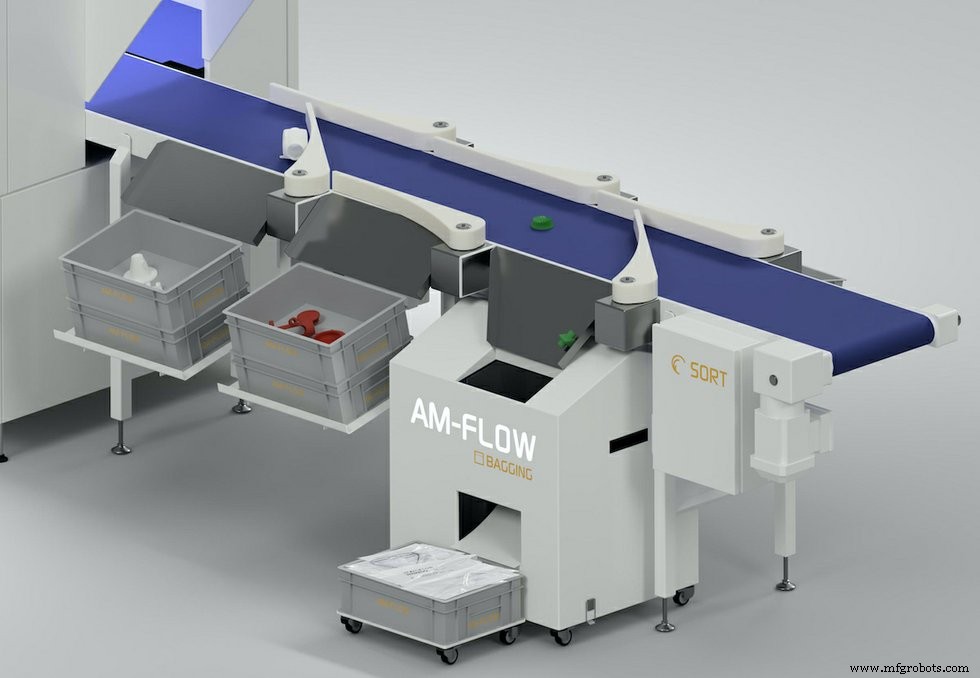
Optimising the Post‑Processing Workflow
\nIndustrialising Additive Manufacturing: The Ecosystem Approach
\nIf you want to be part of this trend, start digitising your AM production today
\n\n
\n
3D printing
- Four Emerging Automation Trends Shaping Additive Manufacturing
- 25 Pivotal Milestones Shaping Additive Manufacturing in 2019
- Additive Manufacturing in Smart Factories: 5 Essential Success Factors
- 5 Key Additive Manufacturing Trends Driving 2021 Innovation
- Manufacturing Trends for 2021: Cloud, AI, 3D Printing, Blockchain, Cobots & RTLS
- Unlock Profitability: 2021 Manufacturing Trends Webinar – Expert Strategies & Insights
- Top 6 Manufacturing Trends Driving Success in 2022
- Additive Manufacturing: Driving Innovation and Cost Efficiency in Aerospace
- Additive vs. Subtractive Manufacturing: Unlocking the Future of Production
- Innovations Shaping Modern Manufacturing: Key Trends and Solutions