



Top 10 Advanced 3D Printing Simulation Software for Production‑Ready Parts

As additive manufacturing (AM) moves from prototyping to full‑scale production, manufacturers face critical challenges in process repeatability and quality assurance. Simulation software offers a data‑driven path to higher part consistency, reduced waste, and faster time‑to‑market. Below, we highlight ten industry‑leading tools, detailing their supported technologies, core capabilities, and the tangible benefits they deliver to production‑centric AM workflows.
Why Simulation Matters in Additive Manufacturing
Success in AM hinges on mastering the physics of the build process. Metal parts can suffer from porosity and residual stresses, while polymers often warp or fail to bond to the build plate. Traditional trial‑and‑error approaches are costly and slow. Simulation mitigates these risks by providing predictive insights into:
- Higher success rates – virtual tests identify design flaws before the first physical part is printed.
- Process understanding – visualize the impact of orientation, laser power, speed, and support placement.
- Production optimisation – reduce post‑processing time and improve cycle times.
- Cost savings – minimise material waste and avoid expensive re‑runs.
10 Simulation Software Options for 3D Printing
1. ANSYS Additive Print
Supported technologies: SLM/DMLS
ANSYS delivers a robust platform that predicts distortions, residual stresses, and supports optimisation. Its Additive Suite extends into topology optimisation and thermal analysis, while Additive Science offers microstructure modelling to correlate print parameters with final part properties.
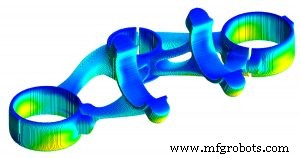
2. Flow Science’s FLOW‑3D
Supported technologies: SLM/DMLS, DED, Binder Jetting
FLOW‑3D offers multiphysics modelling of powder‑bed fusion, melt‑pool dynamics, and binder‑jetting processes. Its detailed thermal and microstructural predictions aid researchers and manufacturers in refining powders and process parameters.
3. COMSOL Multiphysics®
Supported technologies: SLM/DMLS, SLS, FDM
COMSOL predicts final geometry, stress distribution, and microstructure for both metals and polymers. By iterating design and process variables, users identify optimal printing strategies and part geometries that meet industrial quality standards.
4. ESI Additive Manufacturing
Supported technologies: SLM/DMLS, DED
ESI focuses on defect prediction—porosity, residual stresses, surface roughness—and post‑build quality assessment, providing a holistic view from build to finished part.
5. AlphaSTAR’s GENOA 3DP
Supported technologies: SLS, SLM/DMLS
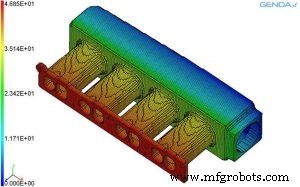
GENOA 3DP predicts deformation, residual stress, and voids across a range of AM processes, recently expanding to metal simulations. Engineers can test multiple build parameters and surface treatments in a virtual environment.
6. e‑Xstream’s Digimat‑AM
Supported technologies: FDM, SLS
Digimat‑AM’s integrated materials database calculates mechanical, thermal, and electrical properties, warpage, residual stress, and porosity. Its orientation analysis helps optimize part placement for strength‑critical features.
7. Additive Works’ Amphyon
Supported technologies: SLM/DMLS
Amphyon simulates the entire metal build cycle—from deposition to post‑processing heat treatment—enabling stress and deformation predictions that inform design changes for higher part quality and process stability.
8. Simufact Additive
Supported technologies: SLM/DMLS
Simufact’s cloud‑based suite automates support design, build orientation, and distortion compensation. By defining tolerable deformation limits, the software generates geometries that minimise costly test prints.
9. Autodesk Netfabb
Supported technologies: SLM/DMLS, DED
Netfabb combines generative design with simulation tools that predict thermal and mechanical behavior. Its cloud platform accelerates simulation of complex parts, improving throughput for production workflows.
10. Dassault Systèmes SIMULIA
Supported technologies: SLM/DMLS, FDM, SLS
SIMULIA offers microstructure, residual stress, and distortion simulations across metals and composites. Its predictive models help select optimal materials and process parameters, enhancing part reliability.
Simulation Software: The Engine of Reliable, Automated AM
Manufacturers adopting AM for production increasingly rely on simulation to overcome the inherent unpredictability of the build process. For metal AM, these tools translate complex physics into actionable insights, accelerating the move from laboratory experiments to production‑grade parts. As the industry advances, simulation will grow more accurate, offering defect correction and real‑time parameter optimisation—key enablers for fully automated, smart additive manufacturing.
3D printing
- Boeing Invests $1 Billion in Dassault Systèmes 3DExperience to Accelerate Global Additive Manufacturing
- Leading Global Companies Driving Investment in 3D Printing Research
- 12 Companies Revolutionizing 3D Printing
- 5 Emerging Trends Shaping 3D Printing Software
- 3D Printing Software: Driving Reliable Digital Production
- Altair’s Ravi Kunju Discusses Simulation-Driven Design & the New Inspire Print3D for 3D Printing
- Revolutionizing Oil & Gas: How 3D Printing Drives Efficiency and Sustainability
- ZBrush for 3D Printing: Unlocking Design Potential
- Top 9 3D Printing Software for Beginners – A Practical Guide
- Choosing the Right 3D Printing Software: A Comprehensive Guide