



Emerging 3D Printing Materials: A Comprehensive Review of Recent Advances
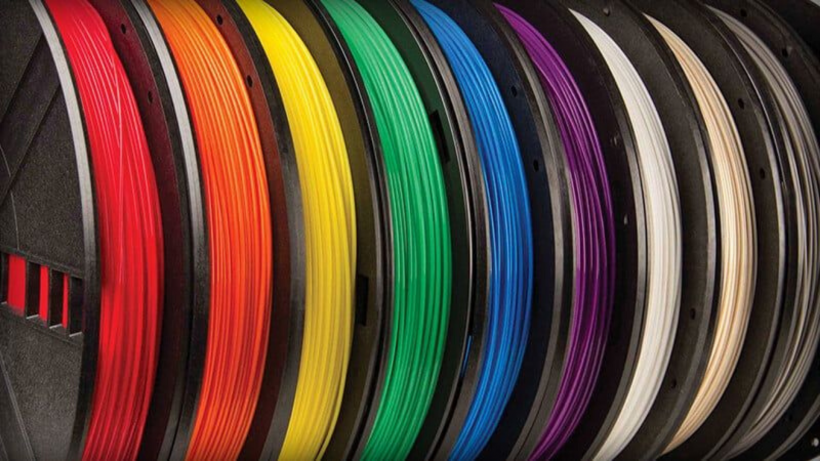
3D printing is advancing at a breakneck pace, driven by continuous improvements in material science and certification standards. The Senvol Database reports that the catalog of additive manufacturing (AM) materials expanded from roughly 1,700 in 2019 to 2,245 in 2020—a 30 % jump in available options.
Medical and Dental Applications
In healthcare, 3D printing is already essential for producing orthopaedic implants, surgical instruments, and dental devices. The COVID‑19 pandemic accelerated adoption, with rapid fabrication of test swabs, face shields, and critical equipment.
Material innovation is a direct response to these demands. Evonik recently introduced the first PEEK‑based filament that satisfies ASTM F2026, enabling 3D‑printed orthopaedic and maxillofacial implants. Meanwhile, Spain’s Andaltec research center is developing antibacterial and analgesic filaments—PoliM3D—for FDM printers, targeting custom implants and prostheses.
Polish manufacturer Spectrum Filaments launched ABS Medical, a filament derived from USP‑certified ABS granulate that meets ISO 10993‑1 and EU Food Contact Regulation No. 10/2011. It is approved for contact with food and suitable for rehabilitation supports and lightweight dentures.
In dentistry, the trend toward printing complete dentures, aligners, and bridges hinges on biocompatible, long‑term materials. 3D Systems’ NextDent® Denture 3D+ received 510(k) clearance from the U.S. Food and Drug Administration in 2019, matching the mechanical properties of conventional denture bases. Rapid Shape’s collaboration with VOCO produced the V‑Print family of dental‑grade resins, while Saremco Dental AG released a new photopolymer resin capable of printing crowns, inlays, onlays, and veneers with mechanical performance comparable to ceramic restorations.
Widespread clinical adoption depends on the continued availability of biocompatible, durable, and certified materials that enable personalized and high‑performance medical and dental products.
High‑Temperature Materials
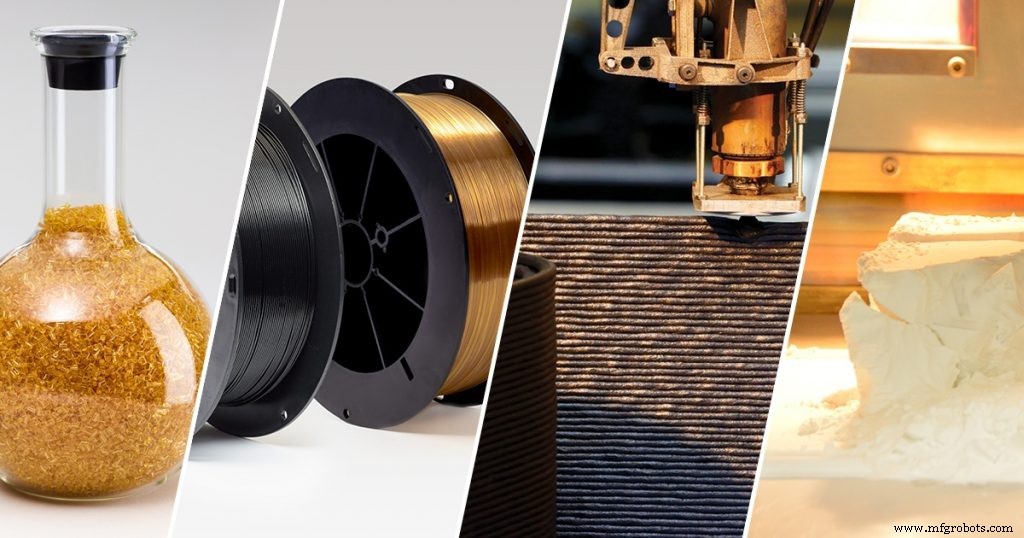
Applications that operate at elevated temperatures are driving demand for heat‑resistant AM materials. Roboze and SABIC partnered to produce EXTEM AMHH811F, an amorphous thermoplastic polyimide filament with a heat‑deflection temperature of 230 °C and a glass‑transition temperature of 247 °C—the highest reported for any 3D‑printable material. The filament also offers excellent flame‑retardant properties, chemical resistance, and maintains mechanical strength under heat.
Essentium’s High‑Speed Extrusion (HSE) platform now includes high‑temperature nylon, suitable for aerospace, semiconductor, and oil‑and‑gas components such as jigs, fixtures, and machine parts.
Aluminium Alloys for Metal AM
Aluminium is projected to remain the fastest‑growing metal AM segment over the next decade, largely due to its lightweight nature and strong performance. A €1.7 million partnership among Oerlikon, Linde, and the Technical University of Munich (TUM) is developing a new high‑strength aluminium alloy specifically engineered for additive manufacturing. The team is tackling challenges such as evaporation loss of alloying elements and micro‑crack formation at high temperatures, with the goal of delivering robust, lightweight parts for aerospace and automotive use.
Engineering firm EDAG’s CustoMat_3D project introduced a crash‑proof aluminium alloy designed for automotive series production. The alloy delivers higher tensile strength and elongation at break, enabling significant weight reductions—up to 30 %—in critical components such as wheel carriers and high‑rigidity wheel‑box elements.
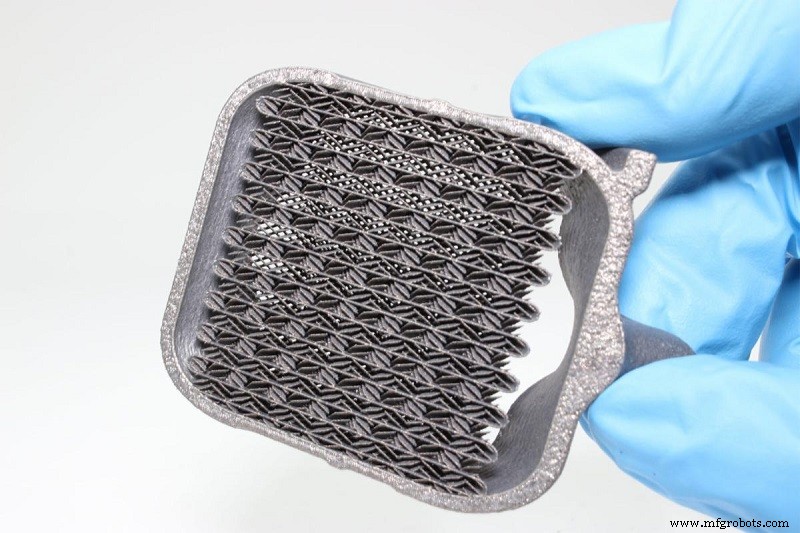
VELO3D released Aluminum F357, an anodisable alloy tailored for Powder Bed Fusion (PBF) systems, gaining traction in aerospace and automotive sectors. Optomec’s LENS technology now offers aluminium alloys for Direct Energy Deposition (DED) that achieve high deposition rates, excellent surface finish, and a density of approximately 99.9 %.
Certification and Characterisation Efforts
Material certification remains critical for industrial adoption, ensuring consistency and reliability of AM parts. UL’s recent study on safety‑critical polymers informed the development of a framework for evaluating flame‑retardant ABS and PEI filaments. The findings provide foundational guidelines for certifying polymers intended for 3D printing.
Consistent material quality begins with rigorous characterisation of feedstock. Element, a global leader in certification, unveiled a dedicated AM powder characterisation facility that performs chemical composition analysis, sieve analysis, particle size distribution, flow rate testing, and more—guaranteeing that powders are authentic, pure, and uniform.
The Evolving 3D Printing Materials Landscape
Daily announcements of new materials, partnerships, and standard‑setting activities highlight the dynamism of the AM sector. As innovations accelerate, the range of available materials will broaden, unlocking new applications and markets across industries.
To learn more about the state of the 3D printing materials market, check out our latest Additive Manufacturing Landscape 2020 report here.
3D printing
- Desktop Metal’s BMD and Microwave Sintering: A New Era for Metal Additive Manufacturing
- Revolutionizing Space Travel with Next‑Generation 3D‑Printed Materials
- 8 Cutting‑Edge Materials Driving Industrial 3D Printing
- Introducing Ultem 1010 & ASA: Advanced FDM Materials for Stratasys Fortus Printers
- Future Directions of 3D Printing in Biomedical Applications
- Stratasys Unveils Antero800na & Nylon12‑CF, New High‑Performance 3D Polymers for Aerospace, Automotive, and Industrial Parts
- Choosing the Right 3D Printing Software: A Comprehensive Guide
- Top Materials for 3D Printing: From Plastics to Biodegradable Options
- Explore the Versatile Applications of 3D Printing in Industry and Healthcare
- 10 Strongest 3D Printing Materials for Ultimate Durability