



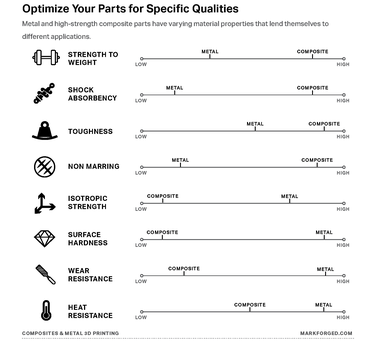
Infographic: Choosing Between Metal and Composite 3D Printing for Optimal Performance
Markforged’s line of composite printers incorporates continuous reinforcing fibers—carbon, fiberglass, or Kevlar®—to produce parts that are up to 23 times stronger than conventional ABS. Their metal printers, on the other hand, fabricate high‑strength stainless steel components. Each technology harnesses the unique advantages of additive manufacturing to meet specific manufacturing needs. By understanding these strengths, you can strategically deploy high‑strength 3D printing in your workflow.
Use the infographic below to quickly determine whether a metal or a composite build will best serve your part’s functional requirements. For a deeper dive into selecting the right material, download our white paper, “Address More Manufacturing Challenges with Composite and Metal 3D Printing.”
3D printing
- How Metal 3D Printing Is Revolutionizing Lightweight Parts for Aerospace and Automotive
- In‑House Production: The Fuse 1 Builds Its Own Parts
- Metal 3D Printing Applications: Prototyping & Tooling – Part 1
- Webinar: Build Stronger 3D Parts with Eiger Software
- Case Study: Autometrix Accelerates Prototype Development with Markforged Mark One
- Setforge & 9T Labs Partner to Replace Metal Parts with Carbon Fiber Composites
- Understanding Weld Components: A Clear Guide with Diagrams
- Are 3D Printed Parts Really Strong?
- Understanding the Parts of a Weld: A Clear Guide with Diagram
- Create Conductive Electronics with Filaflex 3D Printing