



Navigating Company Crisis: Strategies to Boost Productivity During Economic Downturns
A financial crisis that brings down the economy can be devastating especially for businesses. It may have direct and indirect effect on the growth and development of your business. Companies can struggle during financial crisis and can take a toll on the interest and investments of many. An economic crisis can have detrimental effects on both small and larger companies. Since, it can take a good amount of time for an economy crisis to recover, businesses who are affected at the start of the falling economy will most likely endure the negative effects of it for a longer period of time.
During a time of crisis for the company, what should the company do?
- What are things the company can do

Even with a struggling economic crisis you must guarantee that your company stands out from the competition. Capitalize on your existing customers and potential clients. Make sure that customer service is at its best and/or improve it if necessary. Better customer service can draw in more customers and strength current client loyalty.
There is no better time to try new, innovative, and effective techniques to set your business apart from others. You can be creative even when the economy is low. Inspire your customers to stay loyal when you show them that you are willing to put forth new innovative systems to stay at the top of your brand.
- Use the downtime to optimize processes
Processes optimization is the discipline of adjusting existing processes for maximizing output and minimizing cost. The company can start planning ahead for future operations by improving upon existing processes that can help generate more output when the financial crisis passes. For companies that work in manufacturing, there are generally three main areas of optimization.
- Equipment and Maintenance
- Operational Procedures
- Control Optimization
Optimizing Equipment Operations and Maintenance

The first step is to verify that the existing equipment is being used to its fullest advantage by examining operating data to identify poor performance equipment. To improve plant efficiency and profitability, total cost needs to be reduced by optimizing operational processes and maintenance. This is done by continuously improving machine reliability and being proactive with equipment maintenance. Asset management programs and automation systems can significantly improve plant efficiency, product quality, profitability, safety, and the overall operator environment. Here is a small list of how to approach equipment optimization.
- Optimized maintenance for a plant’s entire life-cycle
New and comprehensive maintenance systems play a key role in the maintenance of process equipment, automation, power supply, and information networks. Setting up a system to continuously monitor the plant’s operations will help to eliminate incremental deterioration in performance and to avoid process disturbances. - Shift to Proactive Maintenance
New tools will finally shift the focus of operations from mere repair of malfunctions to systematic, proactive maintenance. System monitoring of mechanical equipment to measure vibrations can inform operators that manufacturing equipment is working properly during daily operations. Successful proactive maintenance makes it possible to react to disturbances immediately and to plan repairs in line with collected measurement data. - Fixing Defects Before Serious Disturbances
The installation of monitoring equipment into processes at various stages of their life-cycles has good results and short-payback times. Identifying sub-component failure before it affects the entire manufacturing process will guarantee that further damage or disruption in production won’t cause operational shutdowns in the future. Fix it before it gets worse. - Automation Solutions
Automation solutions for processes and operations enable increased production speeds while contributing to a safe and ergonomic work environment. Reliability is increased through automatic processes, enabling operators to perform more “value-added” tasks.
Optimizing Operational Procedure

Operational procedure is a fancy title for workflow. Workflow optimization is an important way to reduce cost and provide better services. With inefficient workflows, things take longer and cost more to get done. Rethinking workflow procedures is a critical part of the process of incorporating new and future technologies to the companies manufacturability line. To optimize typical processes the following elements need to be followed:
- Map processes as they currently exist, including problems
- Identify risks and barriers associated with each process
- Mitigate risks and barriers associated with each process
- Identify opportunities for improvement
- Map optimized processes
- Keep record/evaluation of improvements made
Keep in mind that these elements can be applied to anything that has a workflow. This could be for optimizing application processes for clerical work, workflow for manufacturing procedures for production lines, or inventory shipping and receiving operations. Optimizing operational procedures can improve product development time, improved workflow, low manufacturability costs, and increased product output.
Control Optimization

Production facilities are run all-day long and continuously to pump out the most amount of products possible. Process facilities are often monitored by hundreds of sensors that stream real-time data to operators about the plants performance. Manby manufacturing facilities use distributed control systems (DCS) for processes in a manufacturing facility. DCS are dedicated systems used to control manufacturing processes that are continuously operating. DCS are connected to sensors and actuators and use setpoint control to control the flow of materials through the production process.
In order to improve performance it is often advised for plants to purchase performance supervision system (PSS) software for the process facility. This will gather all the real-time data, within the software, from the process control system and calculate performance for process equipment, controls, and operators. For data to be useful they need to measure meaningful, measurable, and actionable information. In most performance supervision systems, the software can be used to diagnose and prioritize opportunity with the equipment, controls, or operators.
- Optimize the inventory

Every company has challenges of matching its supply volume to customer demand. How well the company manages this challenge has a major impact on its profitability.
Note: One of the advantages of using E3.series and customizing it's database is that the company can restrict database components to prefered suppliers. If every project and every team uses the same component models, purchases get cheaper, Inventory has less part diversity. Production and maintenance become cheaper and orders in greater numbers can receive better payment options
There are four main areas of supply chain planning to focus on when trying to get more from your inventory.
- Reduce forecast error with better Demand Planning
- Establish better inventory target levels with multi-echelon inventory optimization
- Further synchronize supply flow with better Sales & Operations Planning
- Improve daily inventory management
- Reduce Forecast Error with Better Demand Planning
The two key factors that will impact the amount of inventory that is required in a supply chain are lead-times and demand uncertainty. Although, forecasting is extremely difficult, and always wrong, there is a great deal that can be done to increase their accuracy with improvements in process and technology. - Establish Better Inventory Target Levels with Multi-Echelon Optimization
Where to place inventory can be difficult to figure out in an end-to-end supply chain with many products. There are many ways to rebalance how inventory budgets are allocated, inventory pooling and product postponement strategies can be complex to execute, as planned. A Multi-Echelon Inventory Optimization (MEIO) system will enable a company to consider all of these in deciding where in the supply chain and how much inventory to have. - Further Synchronize Supply Flow with Better Sales & Operations Planning
As part of the Sales & Operations Planning process a company needs to determine how to meet the inventory demand that comes from forecast demand and backlogs. If a company does not have good Sales & Operations Planning process in place, then it will not be able to make good decisions around inventory. Furthermore, if the Sales & Operations Planning system in place does not consider the effects of finite capacity, materials, and operating constraints, then control over inventory levels will not be achieved. - Improve Daily Inventory Management
Even with a perfect plan, a company cannot keep inventory low and customer service high unless they can execute on moving inventory through the supply chain to meet customer orders. Better inventory management will give improved visibility of inventory through the supply chain and create the orders to move the inventory when required.
- Standardize/Homologate projects/products/procedures
All businesses want to boost productivity and efficiency while reducing errors and accidents, but this can be especially beneficial for small businesses operating with tighter budgets and smaller employee force. Standardization can be an effective way to increase productivity and efficiency by formalizing processes and creating accountability.
One of the key roles in standardization in the workplace is that it creates routine procedures that managers and employees can follow to complete tasks and responsibilities. Since employees won’t need to stop to consider the best way to complete a task, this keeps labor flowing to maintain productivity and efficiency. It also helps ensure uniformity so that final products and services are consistent.
Establishing standardized work relies on collecting and recording data on a few forms. These forms are used by engineers and front-line supervisors to design the process and by operators to make improvements in their own jobs. These three forms are:
- Task Time: Which is the rate at which products must be made in a process to meet customer demand.
- Work Sequence: Which is how an operator performs tasks within task times.
- Standard Inventory: Which includes units in machines, required to keep the process operating smoothly.
The benefit of standardized work include documentation of current process for all shifts, reductions in variability, easier training of new operators, reduction in injury and strain, and a baseline for improvement activities.
It is easy to standardize project components and can save time and money for future development. For instance, electrical engineers use subcircuits constantly in their work. If engineers are using the same subcircuits over and over again, and having to re-create it with each new circuit can become a time waster.
As you build circuits that are more and more sophisticated, you will want to build smaller circuits that you can use multiple times in larger circuits. In Logisim, such a smaller circuit that is used in a larger circuit is called a subcircuit. Using the same subcircuit over and over without having to re-create can save valuable time for the engineer.
In softwares like E3.series, these subcircuits can be saved in the database and "dragged" into new projects to save time and keep new products standard in line with existing products.
- Reduce waste production
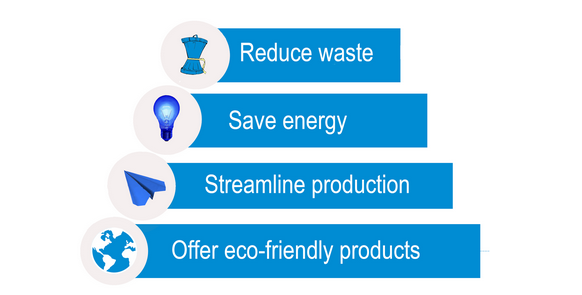
Companies often overlook company waste production. Many companies have been content simply to establish and manage an efficient system for removing waste. Times have changed, and so has waste management. Many companies are seeing dramatic increase in complexity and cost of managing their waste. At the same time, public concern over the effects of waste has grown significantly. Today, more and more customers are taking environmental considerations into account when purchasing products and services.
In addition to saving money through lower waste removal costs, waste reduction makes good business sense in other ways, too. Waste reduction can help reduce expenditures on raw materials, office supplies, equipment, and other purchases. Streamlining operations to reduce waste often can enhance overall efficiency and productivity as well. Furthermore, waste reduction measures can help demonstrate concern for the environment and can increase customer loyalty. For many companies waste reduction is rapidly becoming an important component of their long-term business planning. For example, electrical engineering and manufacturing requires the use of large amounts of copper wires. If projects are not developed with proper communication, between mechanical and electrical engineers, wire lengths are not precise and can result in excess wires and shorten lengths due to drawing error, resulting in copper waste and production costs.
- Implement a new software during the crisis
When company downtime is a direct, or indirect, result of the current economic crisis, there is no avoiding it. This is usually the best time to implement new and innovative solutions. Software implementation can be time consuming and straining on companies that try to set it up during high volume production operations. But low production times are the best moments to implement. It is crucial to keep idle teams busy during downtime and allow teams to remain complete once the crisis is over. Software implementation, especially on a large scale, requires the full support of the company. Overhauling software is not an overnight task.
Has the current economic state affected your company? What have you done during your company downtime?

Industrial Technology
- 5 Key Drivers of Equipment Failure and Proven Prevention Strategies
- Enhance Efficiency: Strategic Equipment Redesign for Peak Productivity
- Machine Maintenance 101: Boost Equipment Health & Maximize Uptime
- Mastering MRO: Boost Profitability by Optimizing Maintenance, Repair, and Operations
- Preventive Maintenance Explained: Key Benefits for Asset Reliability
- Predictive Maintenance Explained: Why It’s Essential for Modern Facilities
- Facility Maintenance Explained: Why It Matters for Safety, Efficiency, and Value
- Understanding Piping and Instrumentation Diagrams (P&IDs): Key Definitions and Applications
- The Role of a Maintenance Director: Responsibilities & Impact
- Sustainable Maintenance: Why It Matters for Business and the Planet