



Understanding Non‑Mechanical Digital Memories: SRAM, DRAM, and Flash
Digital storage has evolved beyond mechanical solutions. Today’s primary memory types—static RAM (SRAM), dynamic RAM (DRAM), and flash—rely on solid‑state circuitry, offering high speed, reliability, and zero moving parts.
SRAM: Bistable Multivibrators in a Compact Array
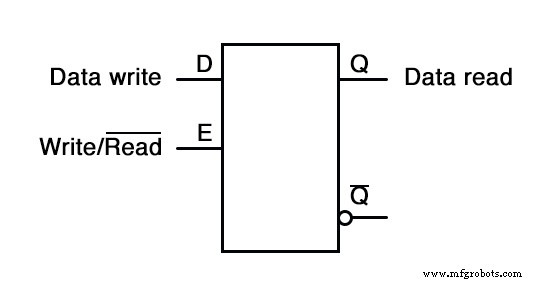
At the core of SRAM lies the bistable multivibrator, often implemented as a D‑latch. It stores a single bit, is volatile (requires continuous power), and delivers nanosecond‑level access times. The D‑latch’s D input writes data, Q outputs the stored value, and an enable pin controls read/write access.
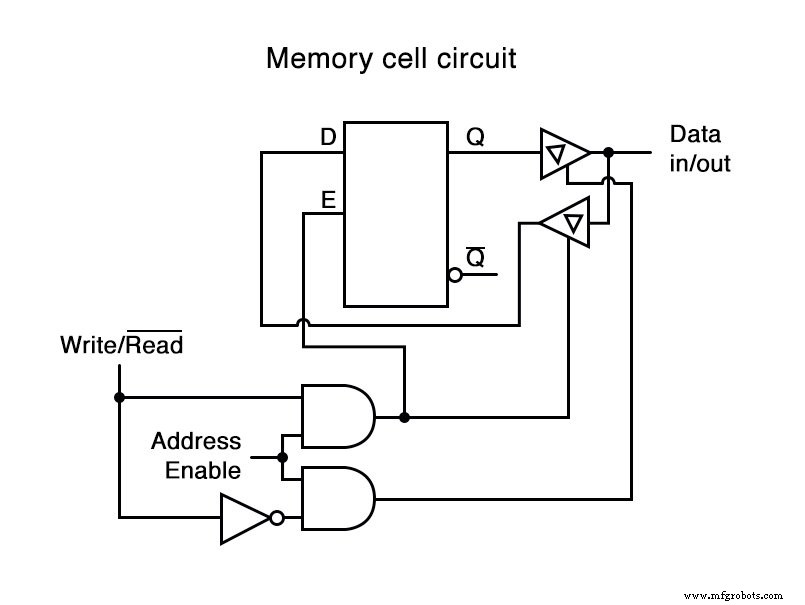
To build a multi‑bit memory, numerous latches are arranged in an array. Tristate buffers gate each latch’s data input and output onto a shared bus, allowing selective addressing. When the address enable (AE) signal is low, the buffers enter high‑Z, isolating the latch from the bus. When AE is high, the latch connects to the bus for read or write operations.
An address decoder (1‑of‑n) supplies the AE signals. For example, a 4‑bit binary decoder addresses 16 cells, each driven by a distinct AE line.
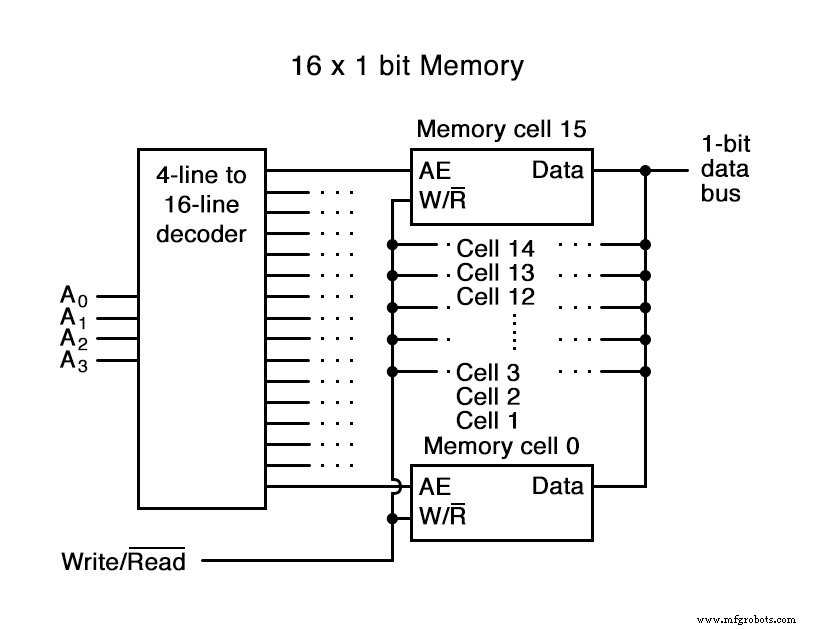
Such a configuration yields a 16 × 1‑bit SRAM—totaling 16 bits of storage. While SRAM offers true random access and no refresh requirement, it consumes considerable power and occupies more silicon area than other RAM types, limiting its density on integrated circuits.
DRAM: Capacitors as Storage Elements
To increase storage density, engineers replaced multivibrators with tiny capacitors. Each capacitor holds a charge that represents a bit, controlled by a MOSFET that connects it to the data bus for charging (write 1), discharging (write 0), or sensing (read).
Because these capacitors leak quickly, DRAM chips include an internal refresh circuitry that periodically reads and recharges every cell. This refresh cycle is why DRAM is termed “dynamic.” Despite the added complexity, DRAM delivers higher density than SRAM while maintaining acceptable power usage, especially with modern CMOS technology.
Flash Memory: Insulated‑Gate Storage
Flash memory extends the capacitor concept further by using the insulated gate of a MOSFET as the storage element itself. This allows non‑volatile retention of data without power and supports larger arrays, making flash ideal for solid‑state drives, USB sticks, and embedded storage.
Historical Context: From Vacuum Tubes to Solid‑State Logic
Before transistors—and particularly MOSFETs—memory relied on vacuum tubes, which were bulky and power‑hungry. These constraints made practical RAM designs impossible. The transistor revolution enabled the compact, low‑power memory structures discussed above, paving the way for modern computing.
For deeper technical details, consult sources such as the IEEE Xplore digital library or the International Solid State Circuits Conference proceedings.
Industrial Technology
- Understanding Network Protocols: From Physical Layer to Advanced Arbitration
- Digital Memory Fundamentals: Addressing, Access, and Volatility
- Early Nonmechanical Memory Technologies: From Delay Lines to Core Memory
- Understanding ROM, PROM, EPROM, and EEPROM: Design, Programming, and Identification
- Understanding Look‑Up Tables: From ROMs to Advanced ALUs
- Microprocessors: The Evolution of Stored‑Program Computing
- Strengthening Security in Automotive Systems: Safeguarding the Future of Connected Vehicles
- 5 Cutting‑Edge Technologies Transforming Modern Manufacturing
- Strategic Data Sourcing: The Key to Resilient Supply Chains
- Data Lakes vs. Data Warehouses: Building a Modern Data Estate