



Electrostatic Discharge: Safeguarding Modern Electronics from Invisible Threats
At the beginning of this discussion we examined static electricity and its creation. Controlling static is far more critical than it first appears— it underpins the reliability of today’s electronics and many other high‑precision fields. An Electrostatic Discharge (ESD) event occurs when a static charge is released in an uncontrolled fashion. From now on we will refer to it simply as ESD.
ESD can range from a modest 50 V equalisation to tens of thousands of volts. The actual power is minuscule, so much so that a person caught in the discharge path rarely feels a danger. It typically takes several thousand volts for a spark to be visible or a zap to be felt. The real threat lies in the fact that even an almost imperceptible discharge can destroy a semiconductor. The high voltage ionises air and other materials, breaking down the delicate structures inside chips.
ESD has never been new. Black‑powder manufacturers and pyrotechnic trades have long faced the danger of unintended static events. In the era of vacuum tubes, ESD was negligible for electronics. With the advent of semiconductors and aggressive mini‑aturisation, the risk escalated dramatically.
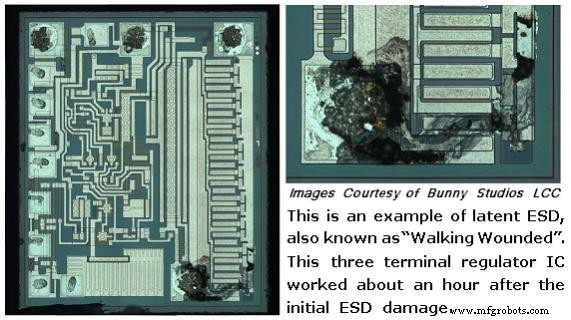
Damage occurs when a component is on the ESD path. Robust parts such as power diodes can tolerate a discharge, but components with thin or fragile geometries may fail. The surge current during an ESD event lasts only nanoseconds to microseconds, yet it can permanently damage a device. Two primary failure modes emerge: catastrophic—complete loss of function—and latent—subtle, “walking‑wounded” failure that may surface days or months later. Latent damage is especially dangerous in safety‑critical systems such as medical or military equipment.
Even seemingly rugged parts are vulnerable. Early bipolar transistors, while more resilient than modern high‑speed devices, can still be compromised. Some high‑speed components may fail with as little as 3 V, and specialised resistors or capacitors built with MOS technology are not exempt from ESD harm.
ESD Damage Prevention
Effective prevention begins with understanding what triggers ESD. Workbench materials fall into three categories: generative, neutral, and conductive (dissipative). Generative materials—most plastics, cat hair, polyester clothing—actively produce static. Neutral materials are insulative but neither generate nor retain significant charge, such as wood, paper, or cotton. Conductive materials, like metal tools or grounded surfaces, bleed charge away rapidly. Some plastics are engineered to be dissipative, offering a compromise between insulation and grounding.
Many everyday actions generate static: peeling adhesive tape, rolling in a chair, or rubbing surfaces together. These activities can create substantial voltages; hence a continuous bleed‑off mechanism is essential. Avoiding high‑static‑generation tasks while handling components reduces risk.
Conductive plastics are a common solution. By incorporating conductive additives, the material’s resistance drops to millions of ohms per square inch, allowing safe charge dissipation. Though mainly used in aerospace for weight reduction, they remain relevant in ESD‑sensitive environments.
Humidity plays a pivotal role. High moisture content increases the conductivity of both the human body and neutral materials, enabling charges to dissipate harmlessly. Consequently, cold, dry winter days often see more sparks, whereas humid summer or rainy days suppress static build‑up. Clean rooms and factory floors regulate temperature and humidity to minimise static.
Grounding establishes a reference voltage, typically zero. Connecting every workstation element to ground—directly or indirectly—ensures any excess electrons find a safe path before an ESD event can occur. In a properly wired home, the AC outlet’s ground pin or the screw on an outlet cover plate can serve as a reliable grounding point. Where house wiring is inadequate, a 3‑foot earth spike or a connection to metal plumbing can provide an external ground.
In ESD control, a resistance of 1–10 MΩ is considered a standard for bleed‑off. This resistance slows the discharge rate, reducing peak current through components and thereby increasing the likelihood of survival. It also protects the user from accidental high‑voltage contact; the resistor limits the current to safe levels.
Industries typically employ a dedicated workbench surface that is conductive or dissipative. Commercial options include conductive plastics with high resistance, or a sheet of metal foil. If constructing a custom surface, attach a 10 MΩ resistor to ground for full protection.
Personal grounding is equally critical. Most people are static generators; the body is a decent conductor. A wrist strap—commercial models incorporate the 10 MΩ resistor—provides a direct path to ground. Disposable wrist straps are inexpensive, and metal watchbands can also serve as grounding points when wired to ground. Heel straps and ESD‑conductive smocks offer secondary protection by short‑circuits charges that may accumulate in clothing or footwear, but they do not replace wrist straps.
Moving air can generate static. Industrial dust‑blowers often contain a small radioactive source that ionises the airflow, turning it into a conductive medium. An alternative is to energise a fan with high voltage to ionise its output. Both methods dramatically reduce the static potential in a workstation.
Distance is a simple yet effective safeguard. Many standards dictate that generative or neutral materials remain at least 12 inches away from active work areas.
When a component is still sealed in its protective packaging, the risk of ESD exposure is greatly reduced. Keeping parts in their original packaging until installation provides an extra layer of defense.
Storage and Transportation of ESD‑Sensitive Components and Boards
Protecting components during storage and transport is as vital as preventing on‑bench ESD. The most common solution is a Faraday‑cage‑in‑a‑bag: an ESD bag. The bag’s thin metal lining shunts external static around the contents, while an internal insulative layer prevents charge build‑up on the component itself. Grounding a permanent Faraday cage, such as an RFI room, is impractical for portable use; instead, placing the bag on a grounded surface achieves the same effect.
ESD bags are constructed from ultra‑thin metal foils, nearly transparent. Even a tiny hole or an unsealed seam compromises the shield, so double‑check for integrity before use.
Other storage options include conductive totes or tubes. These enclose components in a conductive box, forming a self‑contained Faraday cage. Tubes are ideal for ICs with many pins, offering both mechanical protection and electrical shielding.

Conclusion
ESD can range from a subtle, invisible voltage to a dramatic event that threatens operators. While no protection can guarantee 100 % safety, awareness and disciplined practice dramatically reduce risk. Even hobby projects benefit from basic ESD precautions, as the cost of a single damaged component often outweighs the effort to implement safeguards.
In commercial contexts, ESD is a matter of quality, safety, and reputation. Products that survive the first year are more likely to retain customer trust, while a post‑sale failure can tarnish a brand. Therefore, adopting robust ESD controls—from grounding to packaging—is not just good practice, it is essential for long‑term success.
Industrial Technology
- Sensitive Static‑Electricity Detector Using a JFET Switch
- Understanding Gas Discharge Tubes: From Lightning to Modern Thyristors
- Static Electricity Explained: How Rubbing Materials Generates Charge
- C# Static Keyword: Mastering Static Variables, Methods, and Classes
- Introducing Onyx ESD: The Next‑Generation ESD‑Safe 3D‑Printed Material
- Prevent Electrostatic Discharge Damage: Pro Guide to Protect Your Electronics
- Using Polyurethane Coatings to Safely Dissipate Static and Prevent ESD Damage
- Electrostatic Discharge Explained: Causes, Effects, and Prevention Strategies
- Prevent Production Losses with Professional Electrostatic Discharge (ESD) Testing
- Advanced 3D Printing Techniques for Electrostatic Discharge (ESD) Safe Products