



Metric Notation: Understanding SI Prefixes and the New Decimal‑Point‑Free Electrical Format
In the International System of Units (SI), measurement values are expressed using a compact notation that replaces explicit powers of ten with standard alphabetical prefixes. This system simplifies the communication of extremely large or small quantities while maintaining clarity.
The following number line displays some of the most common SI prefixes and their corresponding powers of ten:
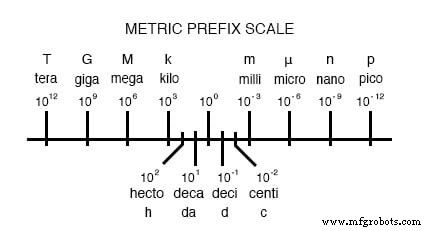
For instance, 2.5 Gigabytes (2.5 GB) equals 2.5 × 109 bytes, or 2.5 billion bytes. Similarly, 3.21 picoamps (3.21 pA) corresponds to 3.21 × 10‑12 amps, or 3.21 trillionths of an amp.
On the smaller end, the prefixes are:
- femto (f) = 10‑15
- atto (a) = 10‑18
- zepto (z) = 10‑21
- yocto (y) = 10‑24
- Peta (P) = 1015
- Exa (E) = 1018
- Zetta (Z) = 1021
- Yotta (Y) = 1024
Because SI prefixes are based on multiples of three (kilo and above, milli and below), the mantissa in metric notation can range from 1 to 999, depending on the chosen prefix. For example, a laboratory sample weighing 0.000267 g can be written as:
- 2.67 × 10‑4 g (scientific notation)
- 267 µg (metric notation)
This same value may also appear as 0.267 mg, but representations with a mantissa greater than 1 are generally preferred for readability.
Recently, a new style of metric notation for electrical quantities has emerged to eliminate the decimal point, reducing misinterpretation caused by poor print quality. The decimal point is replaced by the prefix character: 4.7 k becomes 4k7, and 0.267 m becomes 0m267.
Review:
- The SI metric notation uses alphabetical prefixes to represent powers of ten, providing a concise alternative to scientific notation.
Related Worksheets:
- Ohm’s Law Worksheet
- Scientific Notation and Metric Prefixes Worksheet
Industrial Technology
- Minterms & Maxterms in Karnaugh Maps: Clear Notation & Practical Examples
- Mastering Scientific Notation: Simplifying Extreme Numbers in Science
- Mastering Multiplication and Division with Scientific Notation
- Metric Prefix Conversions Made Simple: Move the Decimal Point
- Mastering Scientific Notation in SPICE: A Practical Guide
- Polar vs. Rectangular Notation for Complex Numbers – A Practical Guide
- Bridging the Gap: Adding Cost to Overall Equipment Effectiveness (OEE)
- Master MATLAB Colon Notation: Create Vectors & Iterate Efficiently
- Comprehensive Guide to Thread Types: NPT, BSP, JIS, SAE, Metric for Industrial Components
- Mitigating Risks When Converting Standard to Metric Tolerance Charts