



Polar vs. Rectangular Notation for Complex Numbers – A Practical Guide
Complex numbers underpin many areas of engineering and mathematics. To work with them efficiently—without drawing vectors each time—two standard notations are used: polar and rectangular. This article explains both forms, the rules for converting between them, and when each is most useful.
Polar Form of a Complex Number
In polar notation a complex number is expressed by its magnitude (also called the modulus or absolute value) and the angle it makes with the positive real axis. The angle is usually written with the symbol ∠.
Think of a map: the polar notation for the vector from New York City to San Diego might read “2400 miles, southwest.” Here are two vectors and their polar representations:
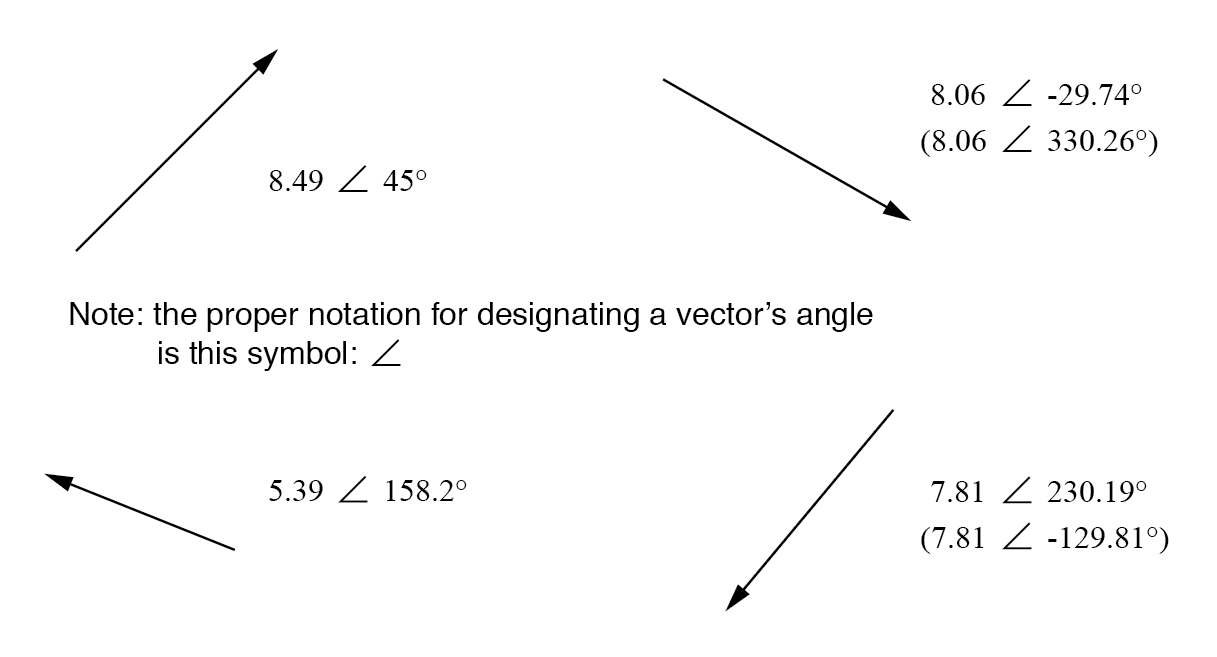
Vectors with polar notations.
In AC‑circuit calculations the standard orientation sets 0° to the right (east), 90° straight up (north), 180° to the left (west), and 270° straight down (south). Vectors that point “down” can be described with angles greater than 180° or as negative angles less than 0°. For example, a vector at ∠270° (directly south) can also be written as –90°. Similarly, the vector 7.81 ∠230.19° can be expressed as 7.81 ∠–129.81°.
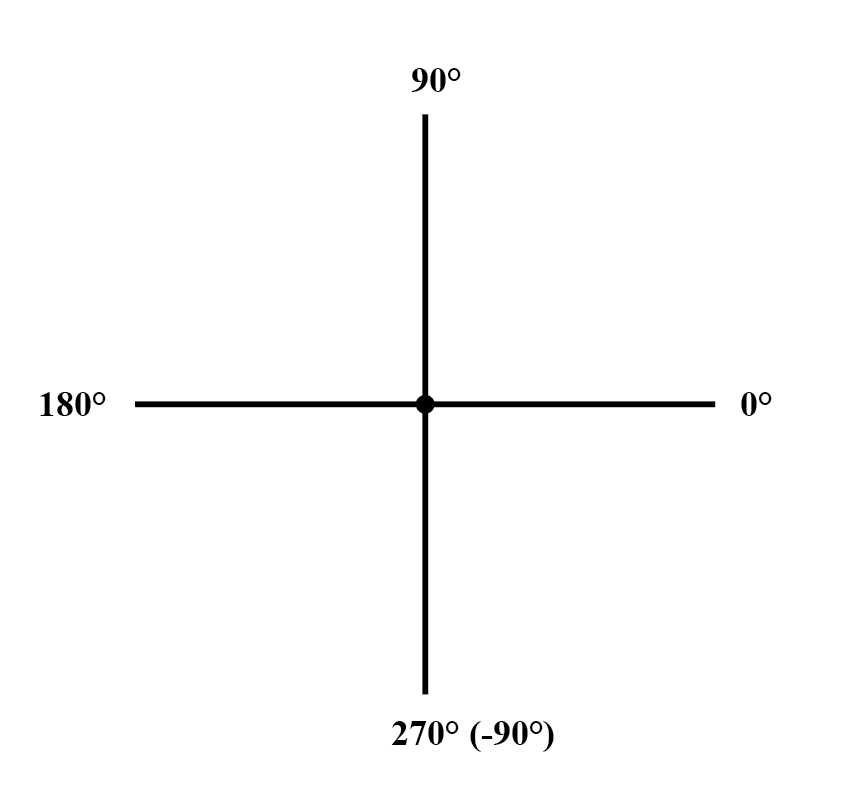
The vector compass.
Rectangular Form of a Complex Number
Rectangular notation describes a complex number by its horizontal (real) and vertical (imaginary) components. Visually, the complex number is the hypotenuse of a right triangle, with the horizontal side representing the real part and the vertical side representing the imaginary part.
In pure mathematics the vertical component is preceded by a lowercase i, while in electrical engineering it is denoted by j. These letters are purely notational operators; they do not represent physical quantities.
Example:
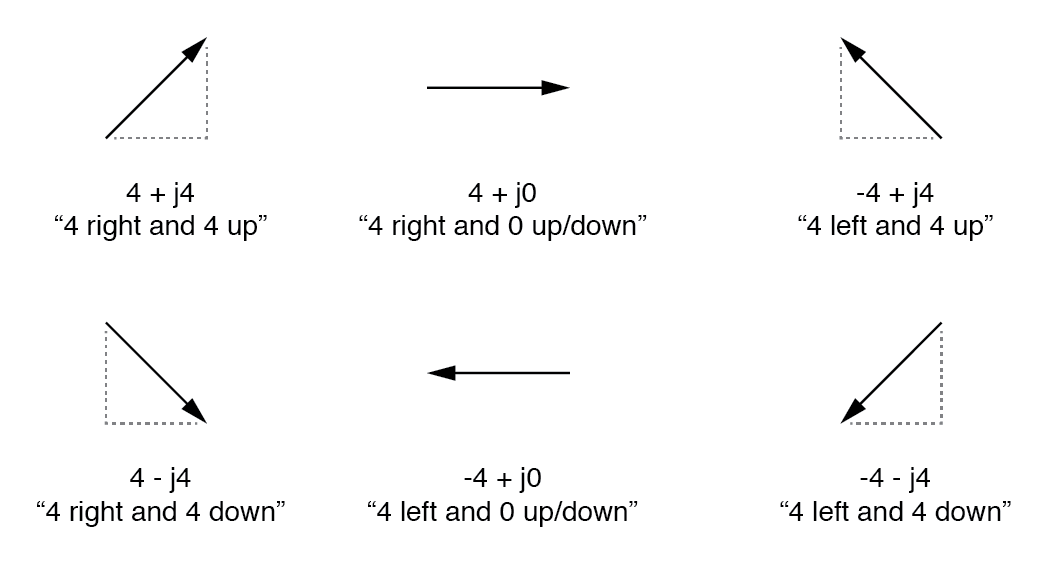
Rectangular form: horizontal (real) + vertical (imaginary) components.
The real axis corresponds to the familiar number line, while the imaginary axis is a second number line rotated 90° from the real axis.
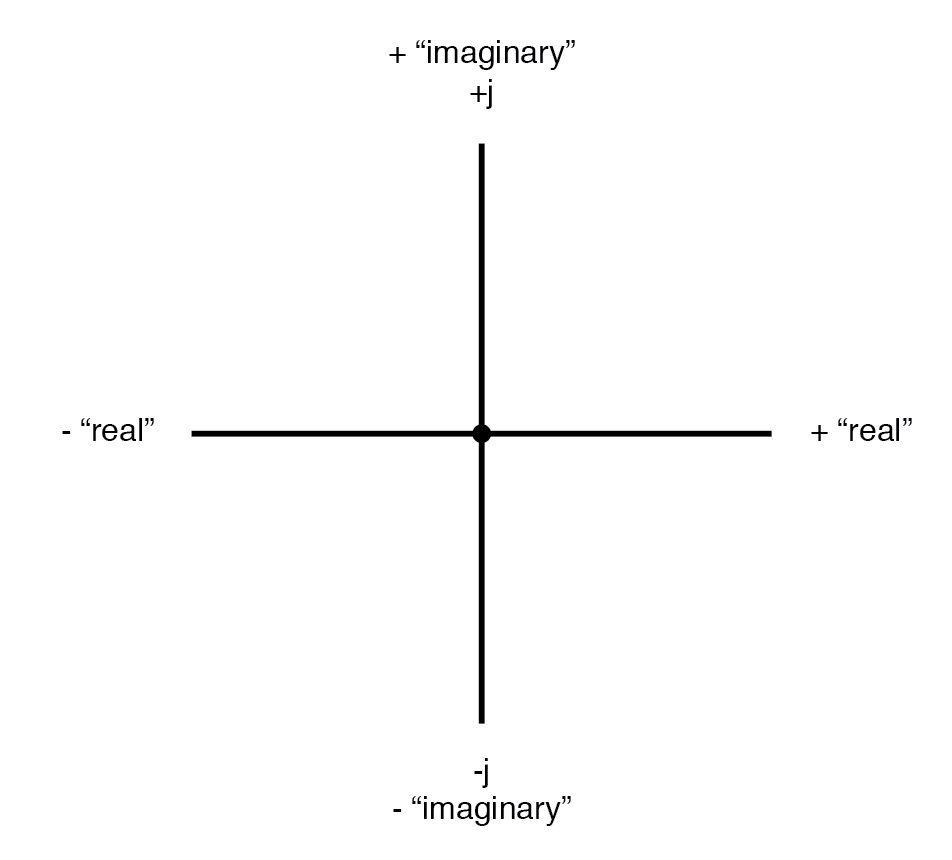
Vector compass showing real and imaginary axes.
Because complex numbers are two‑dimensional, we need two perpendicular axes to represent them. The combined diagram looks like this:
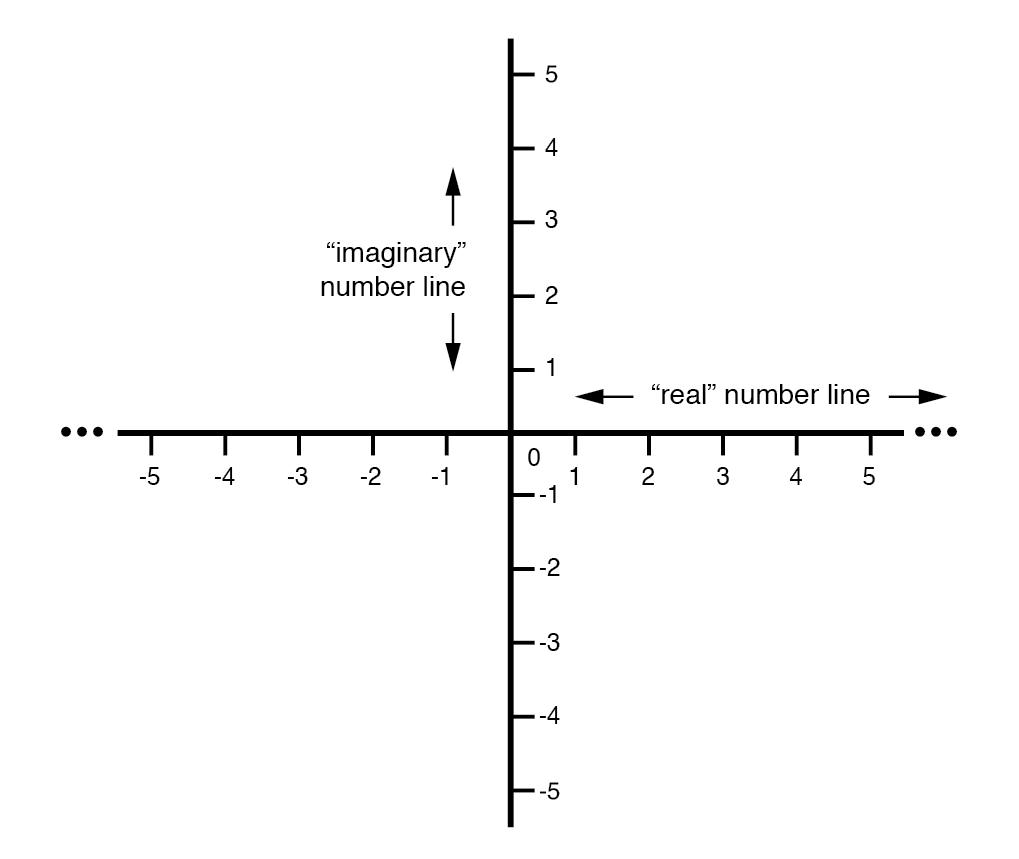
Vector compass with real and imaginary (j) number lines.
Converting from Polar to Rectangular
Both notations are valid; the choice depends on the operation. Rectangular form is convenient for addition and subtraction, while polar form simplifies multiplication and division. Converting from polar to rectangular uses basic trigonometry:
- Real part = magnitude × cos(angle)
- Imaginary part = magnitude × sin(angle)
These relationships arise from the right‑triangle representation of the complex number.
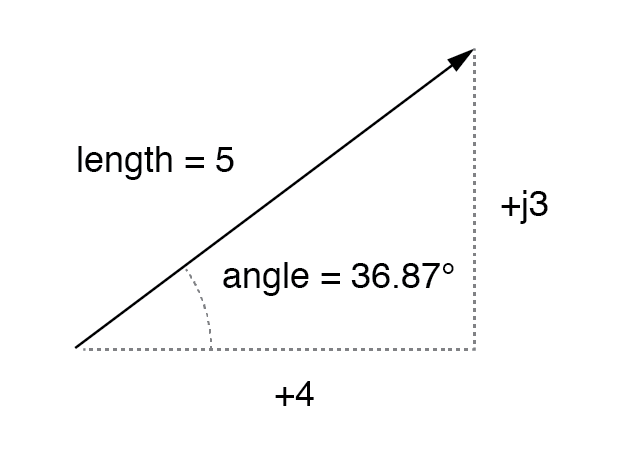
Magnitude vector in terms of real (4) and imaginary (j3) components.
Converting from Rectangular to Polar
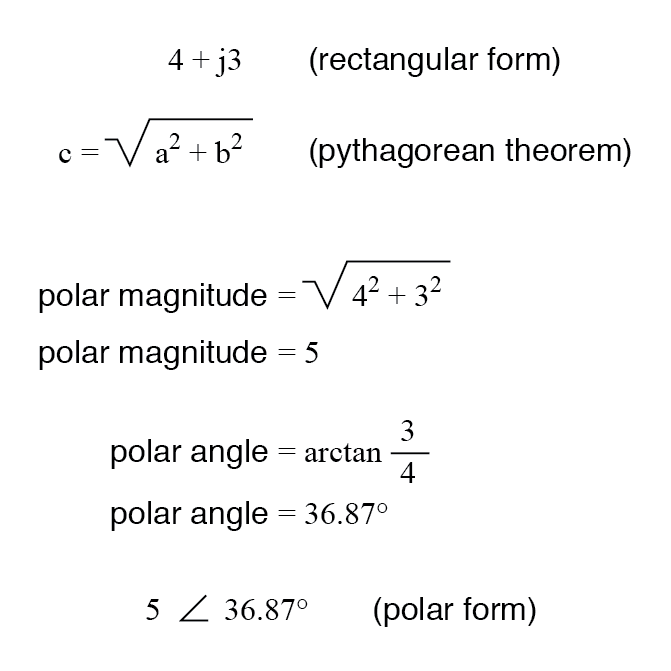
To go the other way, first find the magnitude using the Pythagorean theorem, then determine the angle with the arctangent of the ratio of imaginary to real components:
- Magnitude = √(real² + imaginary²)
- Angle = atan2(imaginary, real)
Example calculations are illustrated in the following figure:
Key Takeaways
- Polar notation expresses a complex number by its length (magnitude) and direction (angle).
- Rectangular notation expresses it by horizontal (real) and vertical (imaginary) components.
- The imaginary component is written with a lowercase
j(in electronics) ori(in mathematics). - Both forms map to a right triangle: hypotenuse = magnitude, adjacent = real part, opposite = imaginary part.
Related Worksheet
Industrial Technology
- Decoding Numbers and Symbols in Electronics
- Minterms & Maxterms in Karnaugh Maps: Clear Notation & Practical Examples
- Advanced Analysis of DC Reactive Circuits with Non‑Zero Initial Conditions
- Understanding Complex Numbers: From Scalars to Phasors in AC Circuit Analysis
- Complex Vector Addition: How AC Voltages Combine
- Mastering Complex Number Arithmetic: Essential Operations & Techniques
- Python Numbers: Understanding Immutable Numeric Data Types
- Essential RF & Microwave Design Principles for Reliable PCB Performance
- Understanding Milling Machines: Functions, Applications, and Benefits
- Advanced 2.5 & 3-Axis Milling Solutions for Complex Projects