



Mastering Complex Number Arithmetic: Essential Operations & Techniques
Since complex numbers are legitimate mathematical entities, just like scalar numbers, they can be added, subtracted, multiplied, divided, squared, inverted, and such, just like any other kind of number.
Some scientific calculators are programmed to directly perform these operations on two or more complex numbers, but these operations can also be done “by hand.” This section will show you how the basic operations are performed.
It is highly recommended that you equip yourself with a scientific calculator capable of performing arithmetic functions easily on complex numbers. It will make your study of AC circuit much more pleasant than if you’re forced to do all calculations the longer way.
Addition and Subtraction of Complex Numbers in Rectangular Form
Addition and subtraction with complex numbers in rectangular form is easy. For addition, simply add up the real components of the complex numbers to determine the real component of the sum, and add up the imaginary components of the complex numbers to determine the imaginary component of the sum:
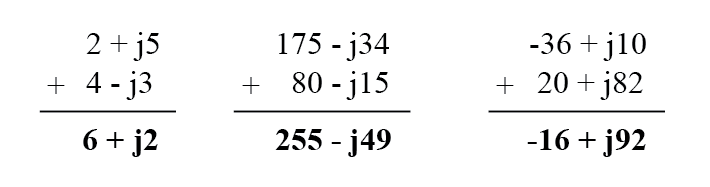
When subtracting complex numbers in rectangular form, simply subtract the real component of the second complex number from the real component of the first to arrive at the real component of the difference, and subtract the imaginary component of the second complex number from the imaginary component of the first to arrive the imaginary component of the difference:
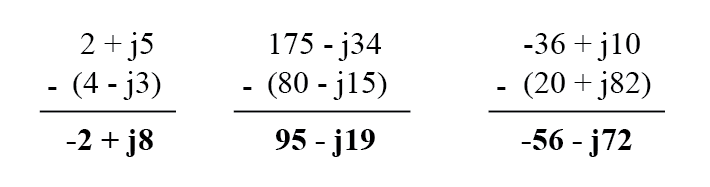
Multiplication and Division of Complex Numbers in Polar Form
For longhand multiplication and division, polar is the favored notation to work with. When multiplying complex numbers in polar form, simply multiply the polar magnitudes of the complex numbers to determine the polar magnitude of the product, and add the angles of the complex numbers to determine the angle of the product:
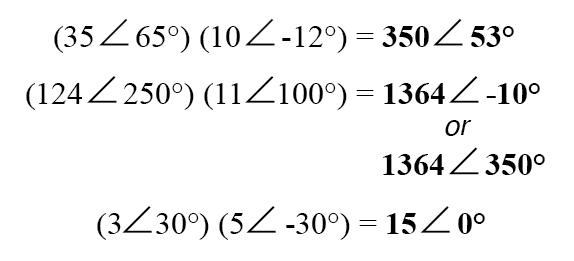
Division of polar-form complex numbers is also easy: simply divide the polar magnitude of the first complex number by the polar magnitude of the second complex number to arrive at the polar magnitude of the quotient, and subtract the angle of the second complex number from the angle of the first complex number to arrive at the angle of the quotient:
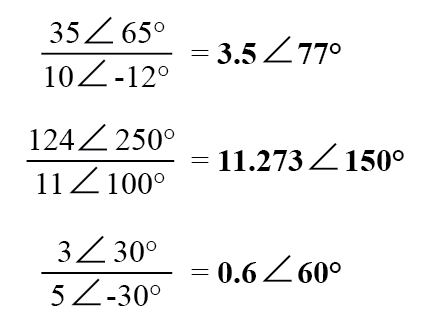
To obtain the reciprocal, or “invert” (1/x), a complex number, simply divide the number (in polar form) into a scalar value of 1, which is nothing more than a complex number with no imaginary component (angle = 0):
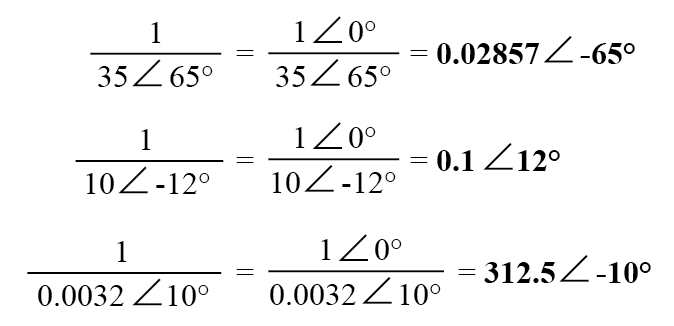
These are the basic operations you will need to know in order to manipulate complex numbers in the analysis of AC circuits. Operations with complex numbers are by no means limited just to addition, subtraction, multiplication, division, and inversion, however.
Virtually any arithmetic operation that can be done with scalar numbers can be done with complex numbers, including powers, roots, solving simultaneous equations with complex coefficients, and even trigonometric functions (although this involves a whole new perspective in trigonometry called hyperbolic functions which is well beyond the scope of this discussion).
Be sure that you’re familiar with the basic arithmetic operations of addition, subtraction, multiplication, division, and inversion, and you’ll have little trouble with AC circuit analysis.
REVIEW:
- To add complex numbers in rectangular form, add the real components and add the imaginary components. Subtraction is similar.
- To multiply complex numbers in polar form, multiply the magnitudes and add the angles. To divide, divide the magnitudes and subtract one angle from the other.
RELATED WORKSHEET:
- AC phase Worksheet
Industrial Technology
- Arithmetic Properties: Associative, Commutative & Distributive Explained
- Decoding Numbers and Symbols in Electronics
- Numbers vs Numeration: Understanding the Distinction and Its Practical Impact
- Understanding Negative Numbers in Binary: Sign-Magnitude, Complement, and Two’s Complement
- Boolean Arithmetic: Adding, Multiplying, and Complementing in Digital Logic
- Analyzing Complex RC Circuits Using Thevenin’s Theorem
- Understanding Complex Numbers: From Scalars to Phasors in AC Circuit Analysis
- Polar vs. Rectangular Notation for Complex Numbers – A Practical Guide
- Beeper (Pager) Technology: From Early Innovations to Tomorrow’s Two‑Way Communication
- Python Numbers: Understanding Immutable Numeric Data Types