



Boolean Arithmetic: Adding, Multiplying, and Complementing in Digital Logic
Let us begin our exploration of Boolean algebra by adding numbers together:
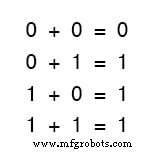
The first three sums make perfect sense to anyone familiar with elementary addition. The last sum, however, is often the source of confusion in digital electronics because it appears to contradict the ordinary rules of arithmetic.
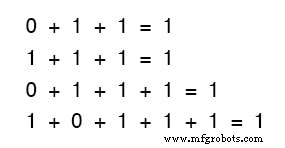
It does contradict the rules for real‑number addition, but not for Boolean values. In Boolean algebra every quantity can only be 0 or 1; there is no “2”. Thus, when we evaluate 1 + 1, the result cannot be 0, so it must be 1.
Whether we add two terms or many, the pattern remains the same:
OR Gate
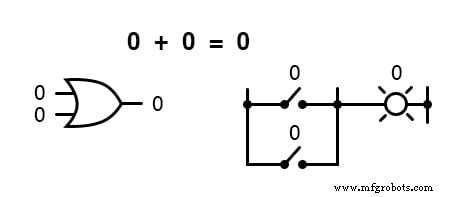
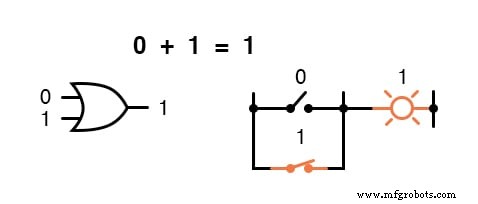
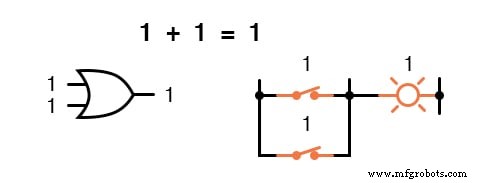
Notice that the two‑term sums in the first set of equations match the truth table for an OR gate. Boolean addition therefore corresponds to the logical OR operation, which is also represented by parallel switch contacts:
There is no subtraction in Boolean mathematics because subtraction requires negative numbers, which do not exist in this domain. Likewise, division is excluded as it is essentially compounded subtraction.
AND Gate
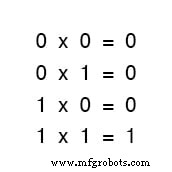
Boolean multiplication follows the same rules as real‑number multiplication: any value multiplied by 0 is 0, and any value multiplied by 1 remains unchanged:
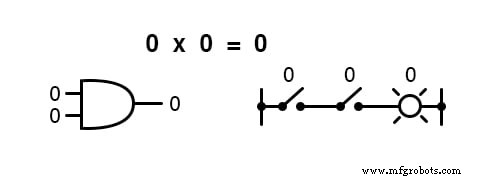
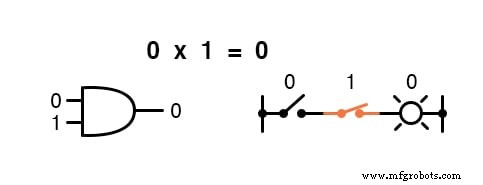
This set of equations mirrors the truth table for an AND gate. Therefore, Boolean multiplication maps directly to the logical AND operation, which is also illustrated by series switch contacts:
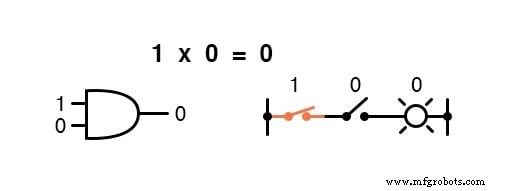
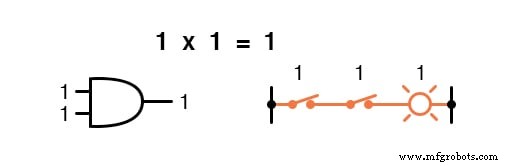
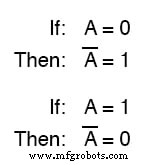
Like conventional algebra, Boolean algebra uses letters to represent variables, but they are always uppercase. Because a Boolean variable can only be 0 or 1, it has a complement – the opposite value. For example, if A = 0, then the complement of A is 1.
Complementation is indicated by a bar above the variable, as shown below:
NOT Gate
In notation, the complement of A is written as Aʹ or A̅. The bar symbol is more common than the prime symbol, which also appears in calculus.
Complementation is represented in circuitry by a NOT gate or a normally‑closed relay contact:
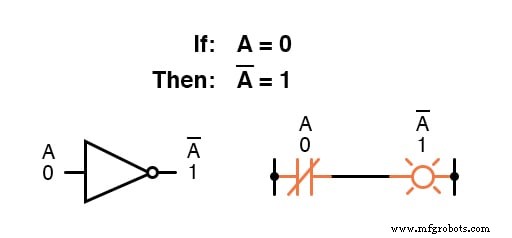
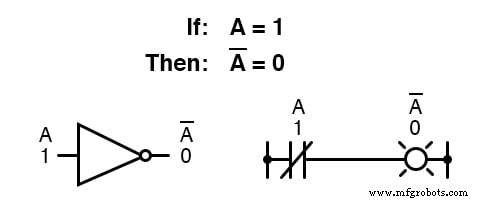
These definitions establish the basic rules of Boolean arithmetic: addition is OR, multiplication is AND, and complementation is NOT. Subtraction and division are not defined.
We will now explore Boolean identities in the next section.
REVIEW:
- Boolean addition ⇔ OR logic, parallel switch contacts.
- Boolean multiplication ⇔ AND logic, series switch contacts.
- Boolean complementation ⇔ NOT logic, normally‑closed relay contacts.
RELATED WORKSHEETS:
- Boolean Algebra Worksheet
Industrial Technology
- Arithmetic Properties: Associative, Commutative & Distributive Explained
- Understanding Boolean Algebra: From Logic Foundations to Digital Circuits
- Key Boolean Algebraic Identities: A Comprehensive Overview
- Core Boolean Algebra Laws: Commutative, Associative, and Distributive Properties
- Essential Boolean Simplification Rules for Logic Circuit Design
- Choosing the Right Tool for Logic Simplification: Karnaugh Maps, Boolean Algebra, and CAD
- Understanding Boolean Relationships Using Venn Diagrams
- Mastering Multiplication and Division with Scientific Notation
- Mastering Complex Number Arithmetic: Essential Operations & Techniques
- Mastering Algebraic Equations in MATLAB: Solve, Simplify & Factor