



Core Boolean Algebra Laws: Commutative, Associative, and Distributive Properties
In Boolean algebra, each law defines how variables interact within logical expressions, ensuring consistency and predictability across digital circuits and set operations.
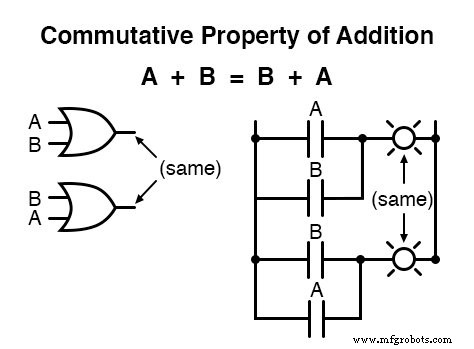
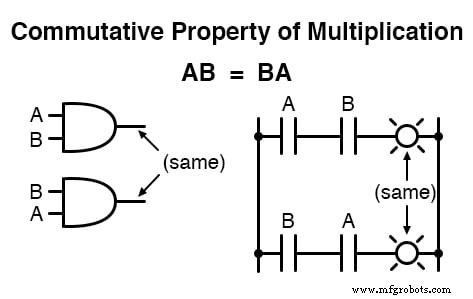
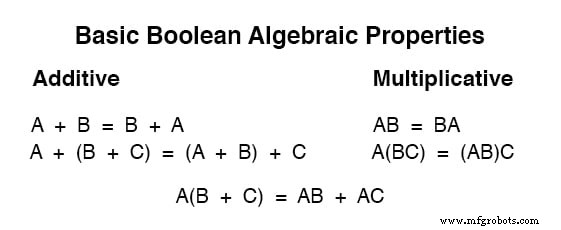
Commutative Property
The commutative property applies to both AND (∧) and OR (∨) operations, allowing operands to be swapped without affecting the outcome:
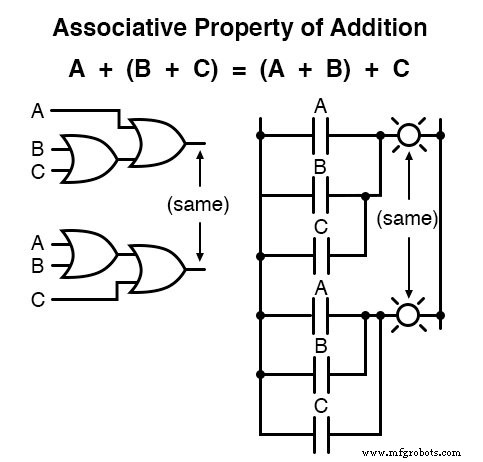
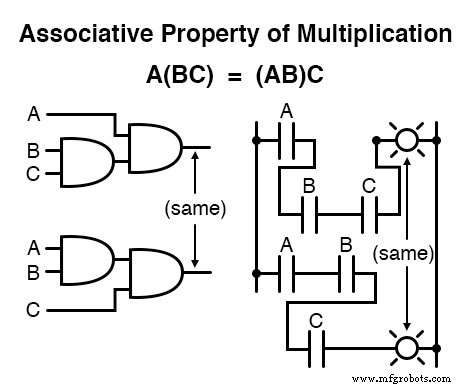
Associative Property
Similarly, the associative property permits regrouping of operands using parentheses, again leaving the value unchanged for both AND and OR:
Distributive Property
When a conjunction multiplies a disjunction (or vice versa), the distributive law expands or factors the expression, simplifying design and analysis:
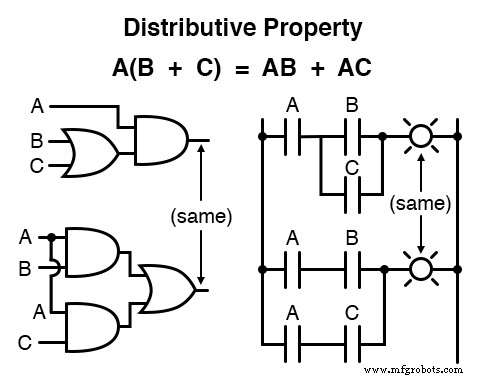
In summary, Boolean algebra relies on three fundamental laws—commutative, associative, and distributive—to maintain logical equivalence across transformations.
RELATED WORKSHEETS:
- Boolean Algebra Worksheet
Industrial Technology
- Arithmetic Properties: Associative, Commutative & Distributive Explained
- Exponent Rules: Key Properties for Algebraic Manipulation
- Boolean Arithmetic: Adding, Multiplying, and Complementing in Digital Logic
- Key Boolean Algebraic Identities: A Comprehensive Overview
- Mastering C# Properties: A Complete Guide
- Understanding Property ID: Definition, Benefits & Types
- WC-Ag Composite: High-Performance Electrical Contact Material
- AA 201.0 T4 Alloy – Key Mechanical & Thermal Properties
- UGI 4418 QT900: Superior Corrosion‑Resistant, High‑Strength Martensitic Steel
- Wood: Key Properties for Construction & Design