



Key Boolean Algebraic Identities: A Comprehensive Overview
In mathematics, an identity is a statement true for all possible values of its variable or variables.
The algebraic identity of x + 0 = x tells us that anything (x) added to zero equals the original “anything,” no matter what value that “anything” (x) may be.
Like ordinary algebra, Boolean algebra has its own unique identities based on the bivalent states of Boolean variables.
Additive Identities
Adding Zero
The first Boolean identity is that the sum of anything and zero is the same as the original “anything.”
This identity is no different from its real-number algebraic equivalent:
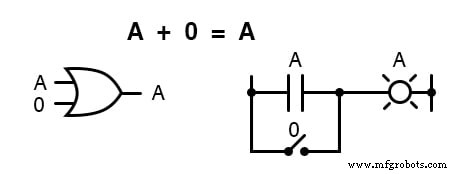
No matter what the value of A, the output will always be the same: when A=1, the output will also be 1; when A=0, the output will also be 0.
Adding One
The next identity is most definitely different from any seen in normal algebra.
Here we discover that the sum of “anything” and one is one:
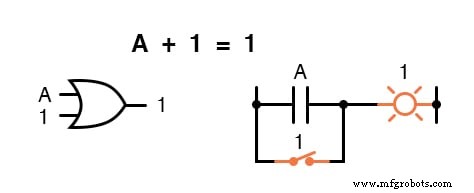
No matter what the value of A, the sum of A and 1 will always be 1.
In a sense, the “1” signal overrides the effect of A on the logic circuit, leaving the output fixed at a logic level of 1.
Adding a Quantity to Itself
Next, we examine the effect of adding A and A together, which is the same as connecting both inputs of an OR gate to each other and activating them with the same signal:
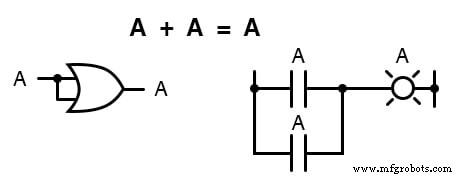
In real-number algebra, the sum of two identical variables is twice the original variable’s value (x + x = 2x), but remember that there is no concept of “2” in the world of Boolean math, only 1 and 0, so we cannot say that A + A = 2A.
Thus, when we add a Boolean quantity to itself, the sum is equal to the original quantity: 0 + 0 = 0, and 1 + 1 = 1.
Adding a Quantity to Its Complement
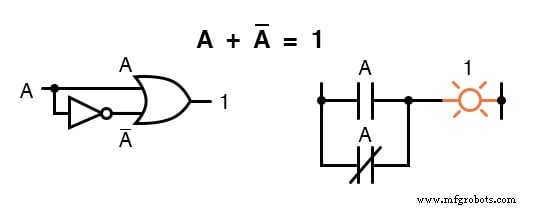
Introducing the uniquely Boolean concept of complementation into an additive identity, we find an interesting effect.
Since there must be one “1” value between any variable and its complement, and since the sum of any Boolean quantity and 1 is 1, the sum of a variable and its complement must be 1:
Multiplicative Identities
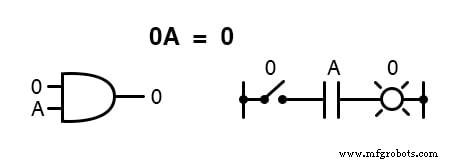
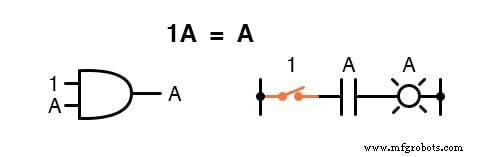
Just as there are four Boolean additive identities (A+0, A+1, A+A, and A+A’), so there are also four multiplicative identities: Ax0, Ax1, AxA, and AxA’. Of these, the first two are no different from their equivalent expressions in regular algebra:
Multiplying by 0 or 1
Multiplying a Quantity by Itself
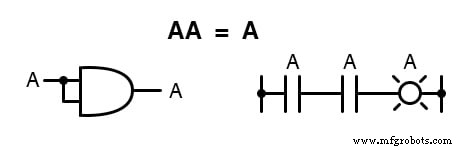
The third multiplicative identity expresses the result of a Boolean quantity multiplied by itself.
In normal algebra, the product of a variable and itself is the square of that variable (3 x 3 = 32 = 9).
However, the concept of square implies a quantity of 2, which has no meaning in Boolean algebra, so we cannot say that A x A = A2.
Instead, we find that the product of a Boolean quantity and itself is the original quantity, since 0 x 0 = 0 and 1 x 1 = 1:
Multiplying a Quantity by Its Complement
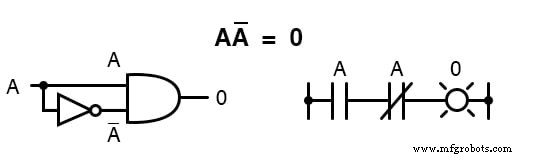
The fourth multiplicative identity has no equivalent in regular algebra because it uses the complement of a variable, a concept unique to Boolean mathematics.
Since there must be one “0” value between any variable and its complement, and since the product of any Boolean quantity and 0 is 0, the product of a variable and its complement must be 0:
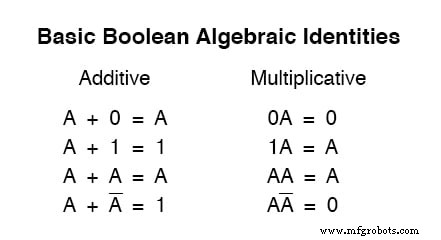
To summarize, then, we have four basic Boolean identities for addition and four for multiplication:
Double Complement
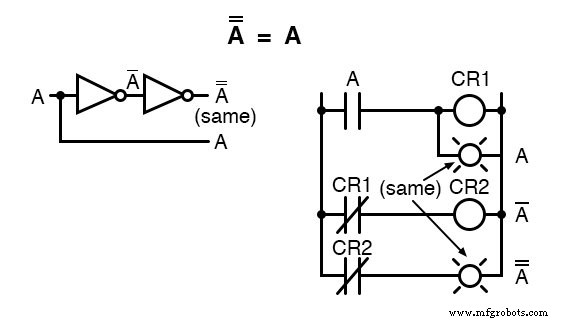
Another identity that has to do with complementation is that of the double complement: a variable inverted twice.
Complementing a variable twice (or any even number of times) results in the original Boolean value.
This is analogous to negating (multiplying by -1) in real-number algebra: an even number of negations cancel to leave the original value:
RELATED WORKSHEETS:
- Boolean Algebra Worksheet
Industrial Technology
- Fundamental Algebraic Identities: Additive, Multiplicative, and Zero Properties
- Understanding Boolean Algebra: From Logic Foundations to Digital Circuits
- Boolean Arithmetic: Adding, Multiplying, and Complementing in Digital Logic
- Core Boolean Algebra Laws: Commutative, Associative, and Distributive Properties
- Essential Boolean Simplification Rules for Logic Circuit Design
- Simplifying Gate Circuits: Step‑by‑Step Boolean Algebra Techniques
- Demystifying the XOR Gate: The Exclusive‑OR Function in Digital Logic
- Choosing the Right Tool for Logic Simplification: Karnaugh Maps, Boolean Algebra, and CAD
- Understanding Boolean Relationships Using Venn Diagrams
- Mastering 4‑Variable Karnaugh Maps: Design, Reduction, and Practical Examples