



Mastering 4‑Variable Karnaugh Maps: Design, Reduction, and Practical Examples
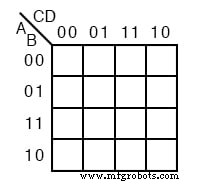
Once you understand Gray code sequencing, extending a 3‑variable Karnaugh map to 4 variables is straightforward: copy the column sequence of the 3‑variable map to the left side of the 4‑variable grid. See the illustration below.
Reductions of 4‑Variable K‑Maps
The following examples demonstrate how Karnaugh maps simplify Boolean expressions that would be tedious to handle with algebra alone. While algebraic manipulation is possible, K‑maps provide a faster, visual approach—especially when many reductions are required.
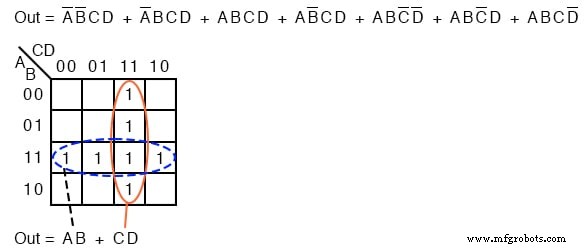
The Boolean expression below contains seven product terms. They are plotted sequentially on the K‑map: the first term, A’B’CD, occupies the top‑row, third cell (A=0, B=0, C=1, D=1). Each subsequent term follows the same left‑to‑right, top‑to‑bottom mapping. By encircling the largest possible groups, we identify two groups of four. The horizontal group yields the simplified term AB, and the vertical group gives CD. The resulting Sum‑of‑Products expression is Out = AB + CD.
Fold the map’s corners as if you were wrapping a napkin; this brings the four corner cells into physical adjacency.
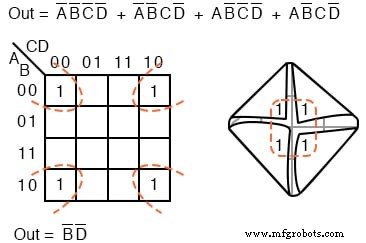
These four cells share the variables B’ and D’ (both equal to 0), while A and C vary. Consequently, the group reduces to the single product term Out = B’D’.
For the next example, imagine rolling the top and bottom edges into a cylinder, creating eight adjacent cells.
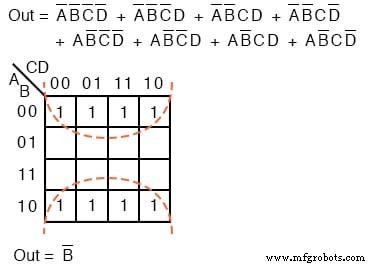
Here, the group of eight shares the common variable B=0, yielding the simplified term Out = B’ from the original eight‑term expression.
P‑Terms in 4‑Variable K‑Maps
Consider an expression with nine product terms, three of which involve only three Boolean variables. In a K‑map, four‑variable terms occupy single cells, while three‑variable terms cover pairs of cells. The mapping is shown below.
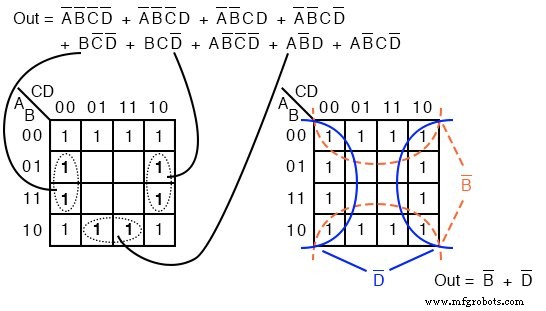
By forming two overlapping groups of eight—where corner cells are shared—we achieve the most efficient simplification: Out = B’ + D.
Below we illustrate the unsimplified expression mapped onto the K‑map.
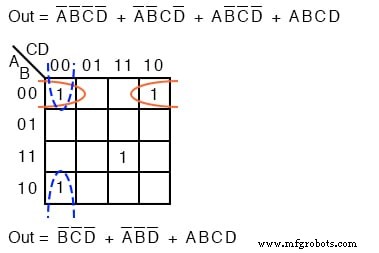
Three cells combine into pairs, leaving one isolated cell that cannot be merged. The isolated term ABCD remains unchanged, resulting in Out = B’C’D’ + A’B’D’ + ABCD.
Often multiple minimal‑cost solutions exist. The following example illustrates two equivalent solutions, each with four product terms of three variables.
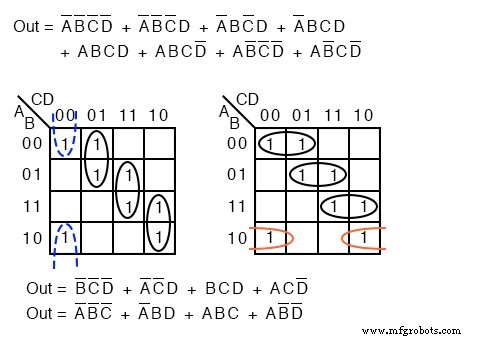
Both solutions satisfy the minimal‑cost criteria—using the fewest gates and inputs—despite differing group arrangements.
When simplifying, begin by identifying a group of four. Subsequent groups are chosen to cover remaining cells, ensuring each group size is a power of two (1, 2, 4, 8, …). Avoid forming groups of three.
Another example shows two valid minimal‑cost solutions. After forming two initial groups of four, the remaining single cell can be paired with either group, producing either ABC’ or ABD as the final term.
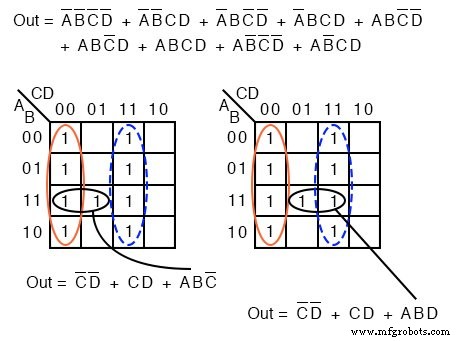
In both cases, the final expressions are equivalent in complexity.
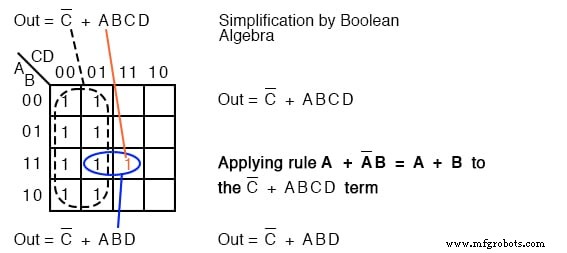
Finally, we compare a Karnaugh‑map approach with Boolean algebra. Plotting C’ covers the left half of the map (eight cells). The remaining single ABCD cell forms a pair with its neighbor, simplifying to ABD. The overall result is Out = C’ + ABD, illustrating a rare case where algebraic simplification is straightforward.
These examples underscore the power of Karnaugh maps for rapid, reliable logic minimization.
RELATED WORKSHEETS:
- Karnaugh Mapping Worksheet
Industrial Technology
- Understanding Boolean Algebra: From Logic Foundations to Digital Circuits
- Boolean Arithmetic: Adding, Multiplying, and Complementing in Digital Logic
- Key Boolean Algebraic Identities: A Comprehensive Overview
- Core Boolean Algebra Laws: Commutative, Associative, and Distributive Properties
- Essential Boolean Simplification Rules for Logic Circuit Design
- Choosing the Right Tool for Logic Simplification: Karnaugh Maps, Boolean Algebra, and CAD
- Understanding Boolean Relationships Using Venn Diagrams
- Mastering Karnaugh Maps: Simplify Logic with Truth Tables & Boolean Expressions
- Mastering Logic Simplification with Karnaugh Maps
- Mastering 5‑ and 6‑Variable Karnaugh Maps for Efficient Logic Design