



Mastering Logic Simplification with Karnaugh Maps
While Boolean algebra can simplify logic expressions swiftly, real‑world problems often demand handling larger truth tables. Karnaugh maps provide a visual, systematic approach to reduce complex logic functions efficiently.
In this article we walk through contrived examples that illustrate the key techniques, preparing you for the more advanced combinatorial logic scenarios in later chapters.
Karnaugh Maps and Gray Code Sequencing
Our Karnaugh map uses the conventional Gray‑code layout:
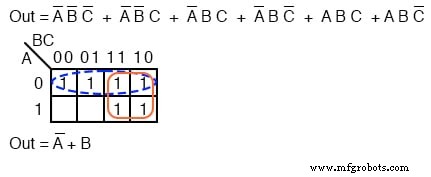
Notice the top row labels: 00, 01, 11, 10. This Gray code sequence changes only one bit between adjacent columns (and rows), ensuring that cells that differ by a single variable are neighbors. This adjacency property is what allows us to spot common factors visually.
Generating Gray Code for Any Map Size
When creating custom K‑maps, you’ll need to generate the appropriate Gray code sequence. The following diagram illustrates the method for any size:
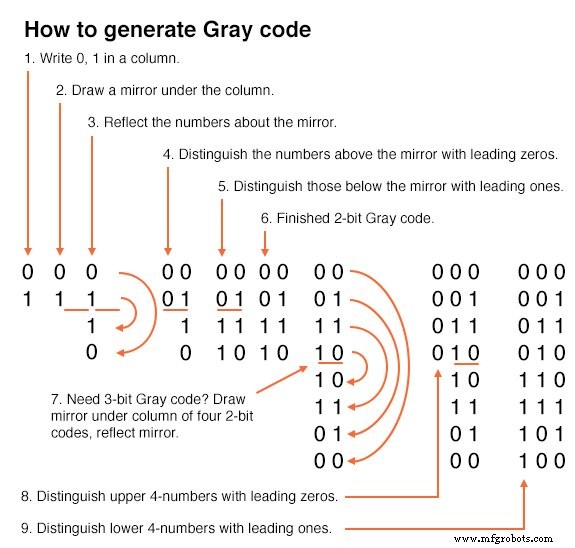
By constructing the sequence so that each successive value differs by only one bit, we preserve adjacency throughout the map.
Examples of Simplification with 3‑Variable Karnaugh Maps
Let’s simplify a few functions using a 3‑variable K‑map. We first place the 1’s corresponding to each product term, then group adjacent cells to derive a Sum‑of‑Products expression.
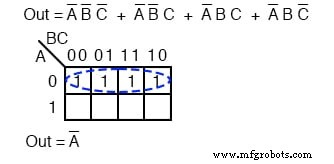
For instance, mapping four product terms can reveal a group of four cells, which simplifies to the single variable A:
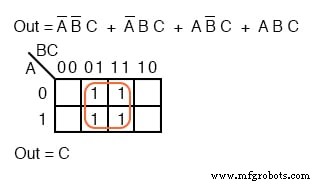
Similarly, another set of four terms can reduce to the single variable C:
When we have six product terms, we often end up with two distinct groups of four cells. Each group yields a separate product term, resulting in a simplified expression such as A’ + B:
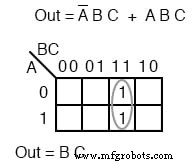
Another example shows a group of two cells simplifying to BC:
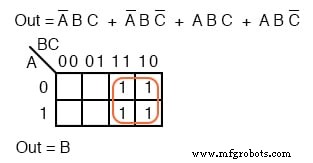
In some cases, wrapping the map edges (visualizing it as a cylinder) reveals a group of four that simplifies to the single variable B:
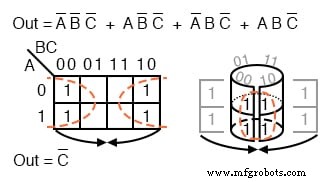
When all four cells share the variable C’, the final result is simply C’:
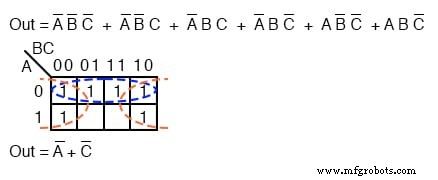
By grouping the six cells into two groups of four, we obtain the concise expression A’ + C’.
Simplifying Boolean Equations with Karnaugh Maps: Toxic Waste Incinerator
We revisit the toxic waste incinerator example from the Boolean algebra chapter. The original expression contains four product terms:
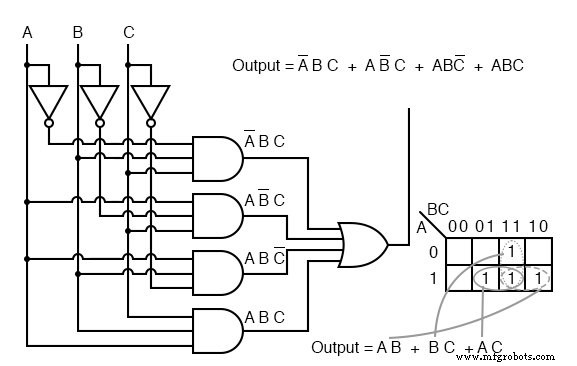
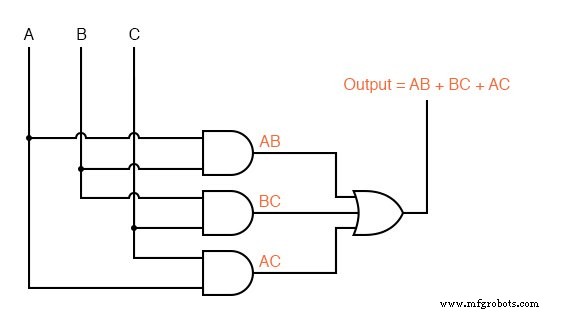
Mapping the four 1’s results in three groups of two cells, each contributing a product term to the simplified Sum‑of‑Products expression. The corresponding gate diagram is shown below:
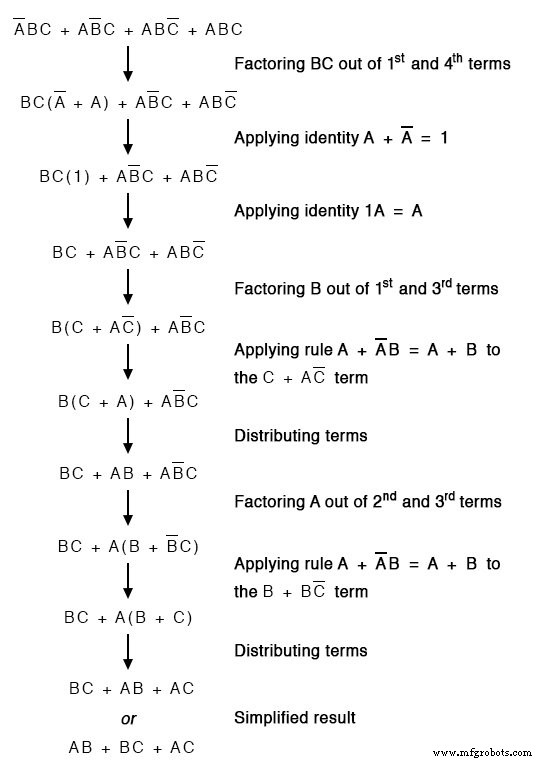
For comparison, we repeat the Boolean algebra simplification:
And the Karnaugh map solution side‑by‑side:
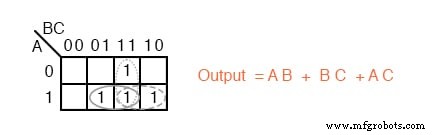
It’s clear that the K‑map approach is far more intuitive and time‑saving than manipulating lengthy algebraic expressions.
RELATED WORKSHEETS:
- Karnaugh Mapping Worksheet
Industrial Technology
- Circuit With a Switch: A Practical Guide to Basic Electrical Circuits
- Mastering Karnaugh Maps: Simplify Logic with Truth Tables & Boolean Expressions
- Mastering 4‑Variable Karnaugh Maps: Design, Reduction, and Practical Examples
- Mastering 5‑ and 6‑Variable Karnaugh Maps for Efficient Logic Design
- Digital Logic with Feedback: From Deterministic Gates to Multivibrators
- Create High‑Quality 3D Printed Topographic Maps from Google Terrain Data
- Designing Combinational Logic in Verilog Using Continuous Assign Statements
- Implementing Combinational Logic Using Verilog's always Block
- Implementing Sequential Logic Using Verilog 'always' Blocks
- Switching to Additive Polymers: 4 Key Questions to Ensure Material Success