



Understanding the Diversity Factor in Electrical Wiring: Why It Matters for Cable Sizing
What is Diversity Factor in Electrical Wiring Installation
In a building, the whole load of electrical wiring installation doesn’t use at the same time. In other words, we do not use all the loads at once at home i.e. switching ON all the fans, light points, Air conditioner, TV, fridge, Water gazer, heater, Electric iron etc at once. Therefore, we consider diversity factor while selecting the proper size of cables and wires for electrical wiring installation.
Diversity factor may e defined as:
Diversity Factor = Total Connected Load / Actual Maximum Load
Good to know:
- Diversity factor may be neglected in case of final sub circuits.
- Except of homes and buildings, diversity factor in electrical wiring installation may be neglected in offices or those places where all connected loads operate at once.
Example:
In a flat, the max demand of load current is follow (90 Amp).
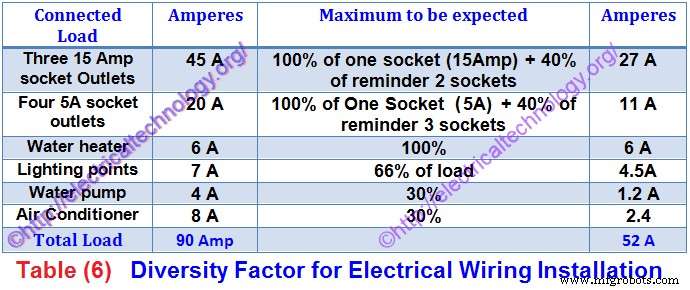
But with the help of using diversity factor, we found total load current about 52A.
In this case, consider 52A (+ 20% for future load = 62.4A) instead of 90A for calculation and selection of proper size of cable for wiring installations.
Industrial Technology
- Comprehensive Electrical Wiring Installation Guides & Diagrams
- Understanding Q Factor: Key Metric for Electrical & Electronics Engineers
- Professional Solar Panel Wiring & Installation Guide: Diagrams, Tips & Best Practices
- Comprehensive Guide to Single‑Phase Electrical Wiring in Multi‑Story Buildings
- Expert Guide to 3‑Phase Electrical Wiring in Multi‑Story Buildings
- Installing a 3‑Phase Electrical Distribution Board in Your Home: NEC & IEC Guidelines
- Comprehensive Guide to Wiring Systems and Electrical Connection Methods
- Emergency Generator Systems: Construction, Installation, Maintenance, and Wiring for Reliable Power
- Professional Guide to Installing Single‑Phase Home Wiring (NEC & IEC Standards)
- Why Power Factor Matters: Key to Efficient Electrical Systems