



Step‑by‑Step Guide to Wiring a 3‑Way Combo Switch with Grounded Outlet
Installation of Three-Way Combo Device for Common and Separated Feed
What is a 3-Way Combination Device?
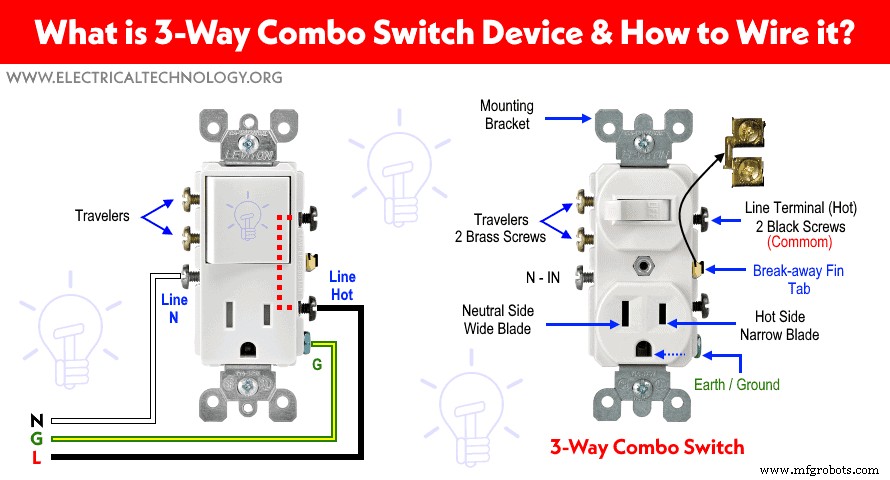
A Three-Way combo device with an outlet is actually the combination of a grounded outlet and a 3-way switch in a single unit (such as Leviton 5245, 5241, 5641 etc.). It can be used for 120V and 240V circuits where a load point (e.g. light bulb) needs to be controlled from two different locations with an additional feature of outlet receptacle.
Construction of 3-Way Combo Device
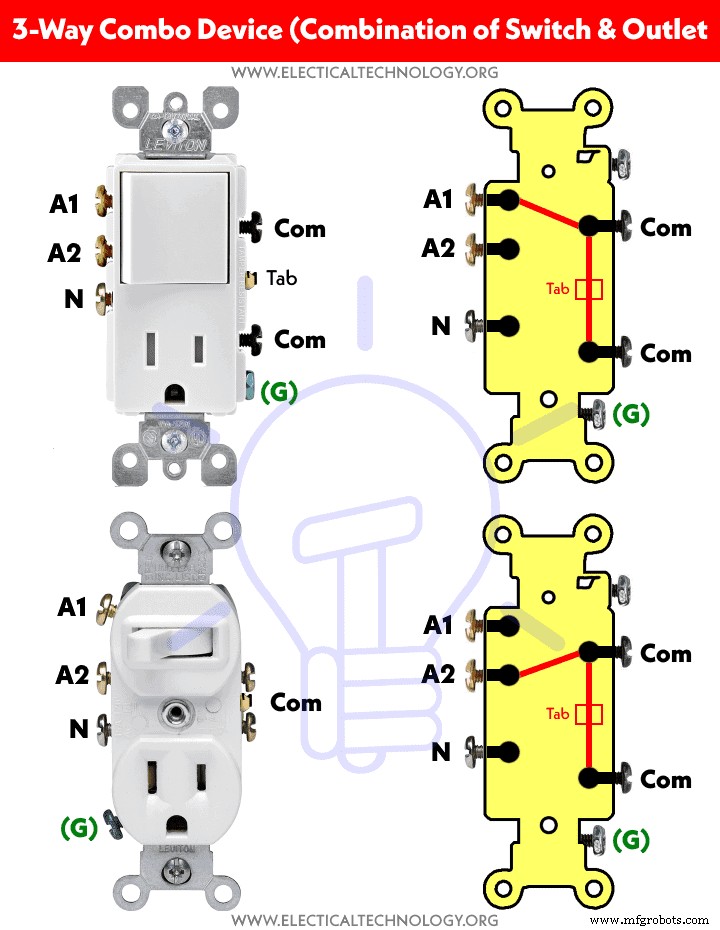
The following figure shows the basic construction of a 3-Way combination switch & outlet device. It has a total of 6 terminal screws. The two brass screws are for travelers wires while the two black screws are common (hot) which is bonded together by a break-off fin. The break-away fin can be removed to use two separate incoming sources from two different breakers. The silver screw is used for Neutral wire while the green colored screw is used for Grounding wire.
The following figures show the operation of internal contacts in a 3-way combo device (combination of a 3-way switch and an outlet).
Let’s see how to wire these types of switches for different load circuits and applications.
Wiring 3-Way Combo Device with Ordinary 3-Way Switch (Common Feed)
The following wiring diagram shows how to control a light bulb from two places using a 3-way combination switch & outlet and an ordinary 3-way switch using common feed. It clearly shows that the incoming Hot (Line) wire is connected to the common dark screws that are bonded together via break-off fin.
The two brass terminals of the 3-way combo device are wired to the A1 and A2 terminals of a typical 3-way switch via travelers wires. The common terminal of an ordinary 3-way switch is connected to the light bulb.
The Neutral wires are connected to the Neutral (Silver) terminal of the 3-Way Combo device and light bulb. Finally, the ground wires are connected to both switches and a light bulb.
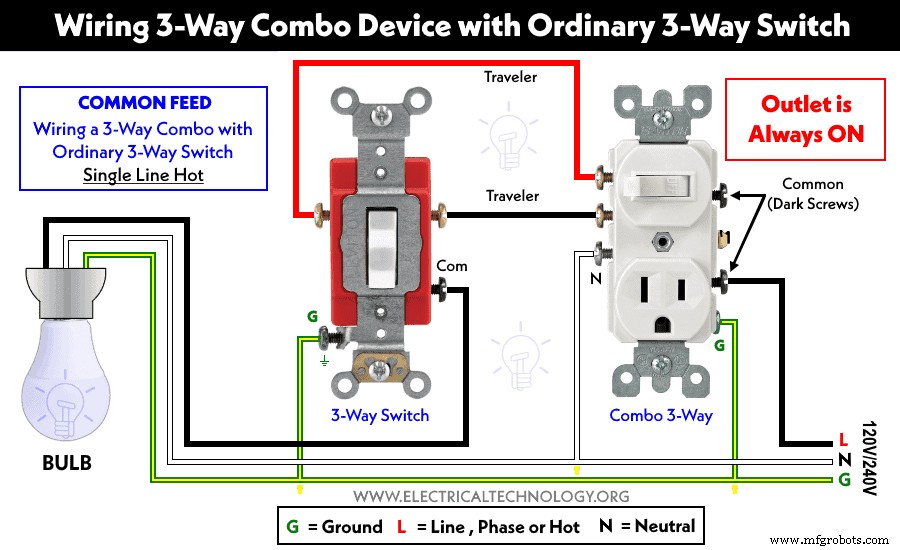
Keep in mind that the outlet in the 3-way combo device is always ON and the light bulb can be switched ON and OFF from two locations using a 3-way and 3-way combo device.
Wiring 3-Way Combo Device with Ordinary 3-Way Switch (Separate Feed)
The following wiring diagram shows how to control a bulb from two different locations using a 3-way combo device and a typical 3-way switch using separate feed.
The wiring diagram is the same as above except the break-away fin removed from the common terminal side of the 3-way combo device. Hence, one screw is connected to Hot 1 (120V from a breaker) and the second dark screw is connected to Hot 2 (120V from another breaker) from the 120/240V main panel.
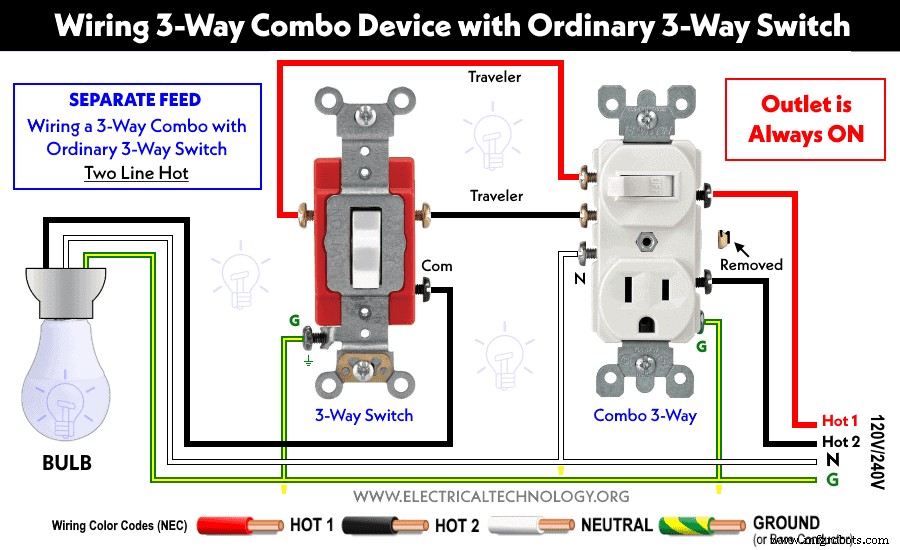
This way, the outlet is always ON which is fed up by a separate (HOT 2) source while the light bulb controlled from different locations are using separate feed via HOT 1. The rest of the circuit and its operation is the same as above.
Controlling a Light Bulb from Two Location using 3-Way Combo Device
The following wiring diagram shows how to control a bulb from two different places using two 3-way combo devices. It clearly shows that the incoming Hot (Line – black wire) wire is connected to the common dark screws that are bonded together via break-away fin of the right side 3-way combo switch and outlet device.
The two brass terminals of both 3-way combo devices are wired through travelers wires. One of the common screws of the left side 3-way combo switch is connected to the light bulb. Finally, both Ground and Neutral wires are connected to the silver and green colored screws of both 3-way combo devices and light bulb respectively.
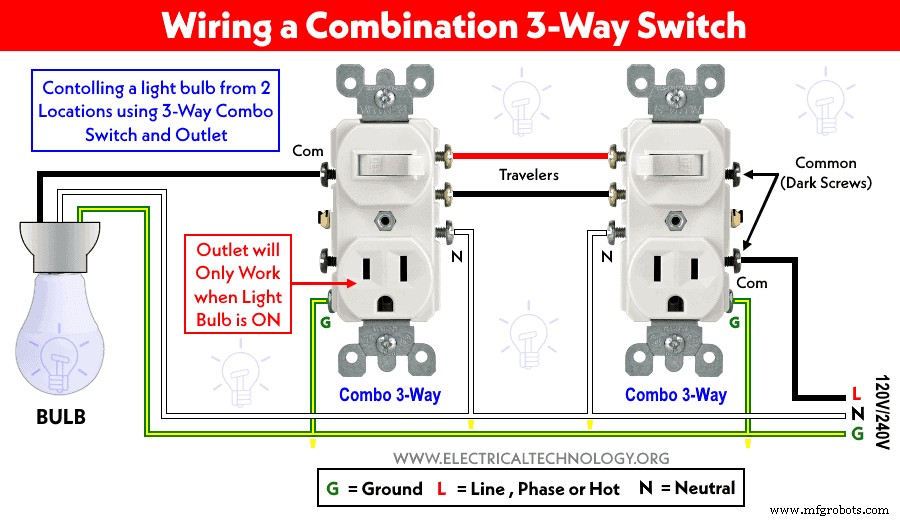
Keep in mind that the outlet on the right side 3-way combo device is always ON while the receptacle outlet on the left side will only ON when the light bulb is ON. This way, the light bulb can be controlled for switched ON and OFF operations from two places using a two number of 3-way combo devices.
Controlling a Bulb from Two Places using Two 3-Way Combo Devices (Both Outlets Always ON)
The following wiring diagram shows the controlling of a bulb from two locations using a two number of 3-way combo devices where both outlets are always ON.
The wiring diagram is the same as above except the break-away fin of the left side 3-way combo device has been removed and the upper dark screw is connected to the light bulb and the lower terminal fed-up by common source from the right side of the 3-way combo device. In other words, The Hot line is connected to both 3-way combination switches while the break-away fin has been removed from the left side 3-way combo device.
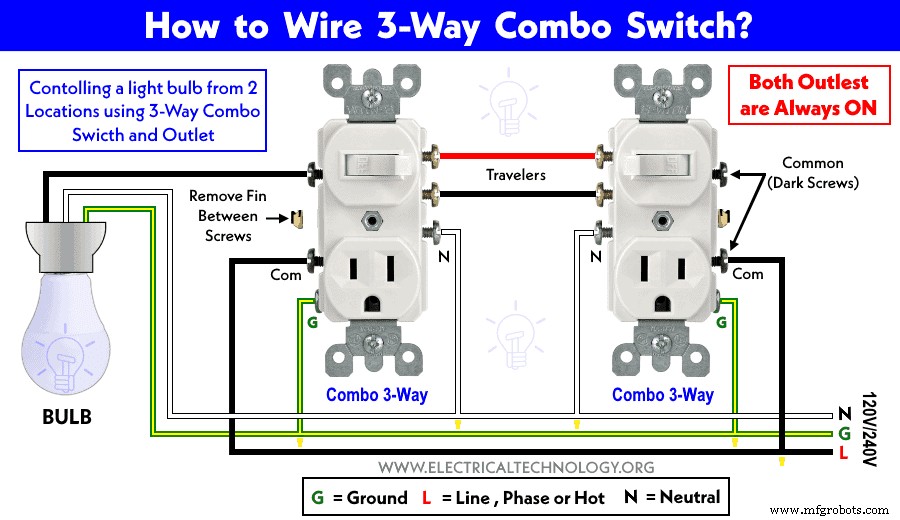
This way, both the outlets are always ON which is fed up by a common source (Line) while the light bulb is controlled from two different places. The rest of the circuit and its operation is the same as above.
- The brass screws should be connected to the Hot (line, live or phase) wire using the IEC & NEC Wire color codes. In case of SPDT and 4-Way (Intermediate switches), black colored screws are used for Hot or common terminals. In short, the color for common terminal is different than other terminals.
- The silver screws should be connected to the Neutral wire (in case of switched outlet)
- The green screw should be connected to the ground / earth wire (Green/Yellow or naked wire)
- If there are no color coded screws on outlets, refer to the user manual or contact a licensed electrician.
- Neutral Wire is not required in 240V outlets wiring (US) Also, Neutral is never connected to the switches.
- Use the suitable voltage and ampere rating of switch with appropriate wire size and proper size MCB according to the load rating.
Precautions:
- Switch off the main circuit breaker to make sure the power supply is OFF before wiring an existing or new outlet or switch with an electrical/junction box.
- Contact the authorized and licensed electrician for switch installation if you are not sure about the wiring diagrams.
- The author will not be liable for any losses, injuries, or damages from the display or use of this information or if you try any circuit in the wrong format. So please! Be careful because it’s all about electricity and electricity is too dangerous.
Industrial Technology
- Step-by-Step Guide to Wiring a Ceiling Fan: Dimmer Switches, Remote Controls, and Compliance with IEC & NEC Standards
- Step-by-Step Guide to Wiring a GFCI Combo Switch and Outlet: Diagrams & Installation Tips
- Installing a GFCI Outlet: Step‑by‑Step Wiring Guide & Circuit Diagrams
- Professional Wiring Guide for Combo Switch/Outlet Devices – Diagrams & Installation Tips
- Step‑by‑Step Guide: Wiring a Household Outlet Receptacle with Clear Diagrams
- Step‑by‑Step Guide: Wiring an AFCI Combo Switch with Diagrams
- How to Wire a Double 3-Way Combination Switch Device: A Complete Installation Guide
- Wiring 4‑Way (NEC) or Intermediate (IEC) Switches as 3‑Way: A Step‑by‑Step Guide
- Step‑by‑Step Guide to Wiring an SPDT (Single Pole Double Throw) 3‑Way Switch
- Touch Switches Explained: Types, Functions, and How to Build One