



STMicroelectronics Unveils Durable MEMS Sensors for Industrial IoT
STMicroelectronics is gearing up to make a big impact in the Industrial IoT space with the announcement of a range of high-accuracy MEMS sensors and components designed to last for at least a decade, serving the needs of advanced automation environments in which machines can be expected to perform for many years.
To kick-start the strategy, the company has launched its first product, the IIS3DHHC low-noise three-axis accelerometer, which is optimized for high measurement resolution and stability to ensure accuracy over time and temperature. It will be available during 2018.
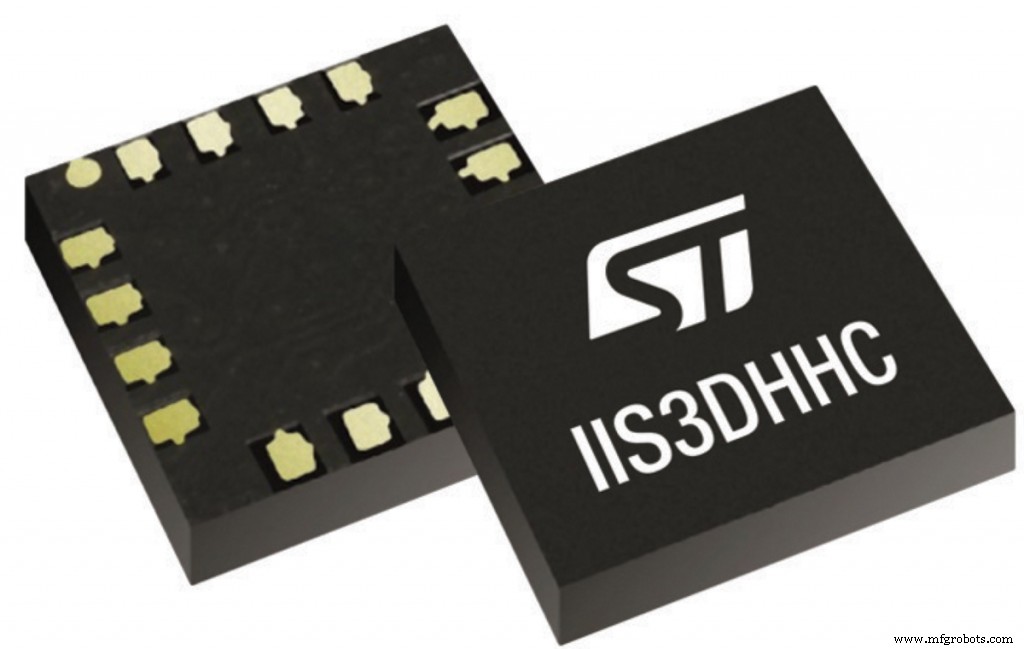
Image via st.com
The MEMS sensor targets precision inclinometers in antenna-positioning mechanisms for communication systems, structural health monitoring (SHM) equipment for keeping buildings and bridges safe, and stabilizers or levelers for a wide variety of industrial platforms. Its long-term accuracy and robustness are also ideal for high-sensitivity tilt and security sensors, as well as image stabilization in high-end digital still cameras (DSCs).
According to author Nitin Dahad:
Andrea Onetti, group VP and general manager, MEMS Sensors Division, STMicroelectronics, told Dahad: “There are big opportunities for MEMS sensors in the industrial environment. In the past five to six years, the adoption of MEMS has been limited and mostly driven by smartphones. But as we enter the age of automation, smart industry, and smart driving, the demand for sensors will grow at a consumer pace here, too. However, there will be a requirement for a completely new generation of MEMS in terms of accuracy, performance, and longevity.”
It’s worth pointing out that Onetti emphasized that MEMS sensors used in the mobile industry to date didn’t need to address accuracy and precision; however, in smart manufacturing, accuracy and longevity would be very important. “The fourth industrial revolution, or Industrie 4.0, is here, and this implies you’ll need a lot of sensors,” Onetti said. “A machine that can detect and analyze its own functions, such as noise, vibration, and temperature, will need its own hardware ecosystem to make the machine smart.”
He said that the sensors would not be limited to human interaction but would involve machine-to-machine interaction and intelligence, and that would require new types of sensors with wider performance characteristics.
Read the full story on our sister site EETimes
Industrial Technology
- Why a Slightly Bigger Design Can Accelerate Innovation and Reduce Risk
- Leveraging Embedded AI to Convert Big Data into Actionable Smart Insights
- Bulgin Launches Slimline Photoelectric Sensors for Affordable IIoT Integration
- Honeywell Teams with Aereon to Expand IIoT in Oil & Gas
- 6G Takes Off: Milestones, Satellites, and Global Telecom Momentum
- Designing with Conductive Polyurethanes: Enhancing Performance & Safety
- Fast-Track Investor Approval with Rapid Prototyping of New Product Concepts
- Unlocking Revenue Growth in Aerospace & Defense OEMs Through IIoT-Driven Digital Transformation
- Latest Advancements in MEMS Sensors for Wearable Technology
- How IIoT Revitalizes Air Conditioning Production: Boosting Efficiency and Quality