



Why a Slightly Bigger Design Can Accelerate Innovation and Reduce Risk
In today’s market, compactness is often equated with sophistication. Yet this assumption can lead to unrealistic promises, costly overruns, and limited functionality. In this article we examine why a modestly larger product can actually improve user experience, reduce development risk, and accelerate time‑to‑market.
Consider the iconic Blaupunkt car stereos of the 1980s. Their 1‑DIN, 2‑inch tall chassis packed a dense array of miniature buttons that, while visually impressive, proved impractical on a moving vehicle. Drivers struggled to reach the right control while keeping eyes on the road, and the cramped interface ultimately constrained future feature expansion. Modern automotive interiors have moved toward larger displays and consolidated controls, demonstrating that size can enhance usability and cost‑efficiency.

From a business standpoint, the Blaupunkt case illustrates that perceived complexity can support a premium positioning. However, the operational limitations of a cramped design highlight the importance of balancing form and function.
In the 1990s, aerospace manufacturers pushed toward “all‑glass” cockpits, replacing analog dials with flat‑screen displays. Transitioning to projection displays was a bold move, offering better durability and a single optical engine for multiple displays. Yet integrating these new displays into legacy aircraft compartments—designed for CRTs—required squeezing a mere 5 mm of additional width into each volume. The effort to retrofit projection displays into existing cockpit architecture was exponentially costly and time‑consuming.

While projection displays were eventually supplanted by AMLCDs and other flat‑screen technologies, the experience underscores a key lesson: the more you constrain size, the more you amplify development complexity and expense. The F‑35, designed with ample display space from the outset, benefited from a smoother implementation of advanced technologies.

Speed to market is critical in emerging product categories. A first‑generation product that is too small can lead to higher costs and longer timelines, especially when new technologies require larger components or additional features that were not initially anticipated. A moderate‑sized first offering allows flexibility for future iterations and helps avoid costly redesigns.

Trimble Navigation’s early handheld GPS, the Trimpack, exemplifies this strategy. Despite its bulk, the device offered a robust, modular enclosure that accommodated evolving GPS capabilities and battery technologies. By leaving room for growth, Trimble avoided expensive re‑engineering as subsequent models became smaller and more refined.

Had Trimble pursued a slimmer design, the initial product would have been constrained by the available satellite‑positioning hardware and battery sizes of the early 1990s. The larger form factor enabled early market entry and set the stage for future, more compact iterations.

Designers at StudioRed routinely face the trade‑off between “sleek” and “sensible.” For startups with limited budgets and novel technologies, a more generous size can reduce risk, shorten development cycles, and improve manufacturability. The cost of refining a tiny chassis often outweighs the perceived benefit, especially when market expectations for compactness are not yet established.
Our process starts by right‑sizing industrial designs around internal components, ensuring thermal management and structural integrity from day one. Even with careful planning, component availability and new learning often necessitate enlarging the enclosure to keep schedules on track. A slightly larger outer package provides the breathing room to accommodate such changes without jeopardizing the product’s look or cost.
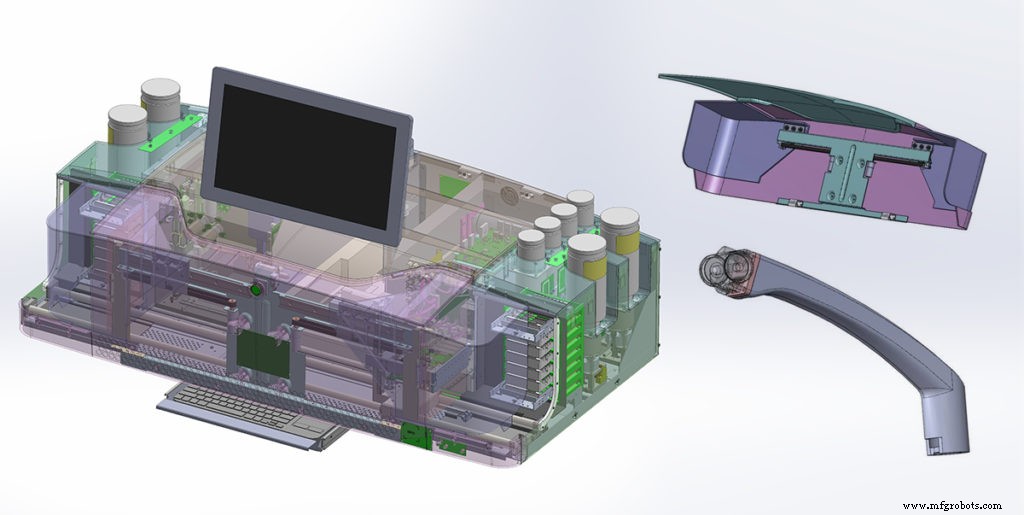
When a product must fit within a strict dimension—such as carry‑on luggage—the design constraints must be considered early, and higher‑cost components may be justified. Conversely, if a first‑of‑its‑kind device is expected to fit in a pocket but the necessary electronics are not yet available, the size discussion should start during the concept phase. Balancing feature set, cost, and schedule is essential to delivering a viable product quickly.
Scaling the industrial shape thoughtfully preserves brand identity and ensures that aesthetic changes do not compromise functionality. The extra room in an initial design can absorb late‑stage adjustments, saving time and money—critical advantages for new entrants in competitive markets.
In sum, when launching a new technology, consider a modestly larger form factor to reduce risk, speed time‑to‑market, and gather valuable user feedback. The next generation can always be shrunk once the core design and manufacturing processes are validated.
About the author: Charlie brings 14 years of product engineering experience to StudioRed, specializing in ruggedized GPS systems, military aircraft displays, and cost‑effective manufacturing for medical, computer, and communications products. As Head of Engineering, he ensures client solutions are both manufacturable and profitable.
Read more from Charlie in his article on prototyping.
Manufacturing process
- Overcoming Hurdles in New Product Development: A Proven Blueprint
- Why a Slightly Bigger Design Can Accelerate Innovation and Reduce Risk
- 5 Proven Product Design Principles to Make Your App Unforgettable
- Expert Insights: Allen Wilson, Lead Product Designer at StudioRed
- Insights from Soyun Kim, Senior Product Designer at StudioRed: UX, UI, and Branding Strategies
- Smart Cube: The Next-Gen Home Control Hub
- Overcoming New Product Development Challenges: Strategies for Success
- STMicroelectronics Unveils Durable MEMS Sensors for Industrial IoT
- Master Product Design with Subtractive Manufacturing: Precision, Cost‑Effectiveness & Reliability
- From Concept to Reality: Turning Creative Designs into Tangible Products