



Maximizing Asset Value with CMMS Data: Expert Guest Blog
Executive Summary
This article seeks to align CMMS data to the broader asset management strategy for the organization. It begins by positioning the CMMS as an important information system, worthy of the organization’s time and effort. I’ve often explained that there’s no software solution powerful enough to withstand an inappropriate data culture. Oftentimes, if your data is consistently wrong, look for culprits in your data culture. In this article, I describe practices that don’t lend themselves to CMMS data creating economic value. This is followed by a description of some core philosophies and practices that are present in effective data cultures. Finally, I will close by exploring the idea of CMMS data being an asset, by identifying ways that it can create value through enabling asset management decision-making, way beyond the bounds of maintenance decisions.
CMMS as an Asset Information System
The Computerized Maintenance Management System (CMMS) is the most common type of asset information system found in asset-dependent firms. Asset information systems are the foundation of Asset Information Management Systems (AIMS) as depicted in Figure 1.0.
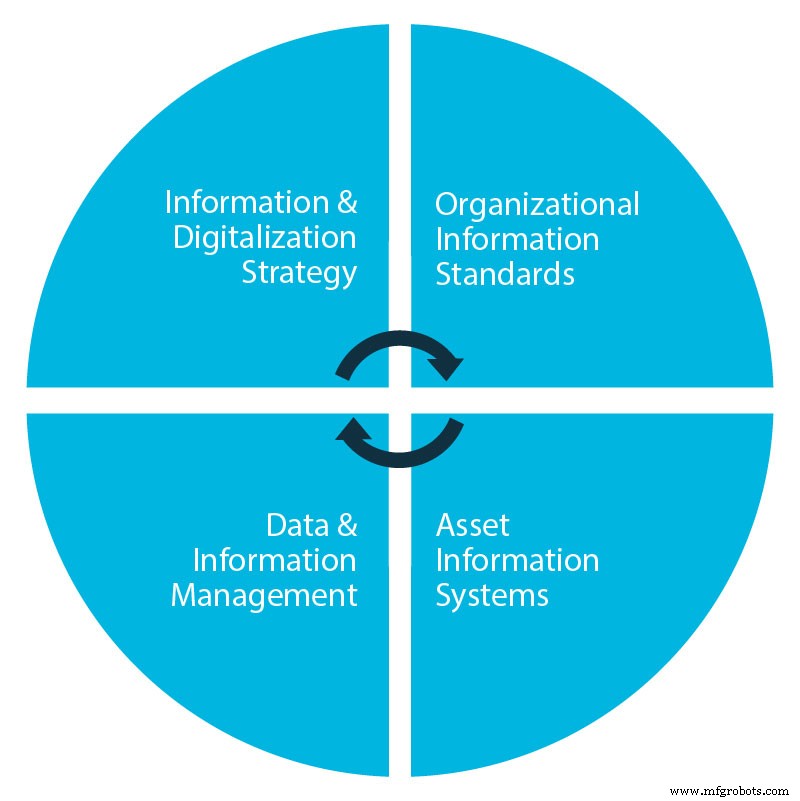
Figure 1: Components of Asset Information Management System
The role of the information system is to facilitate the creation, collection, data storage, analysis, maintenance, transfer, retrieval, and presentation of asset information. A CMMS typically contains asset data records and information aimed at facilitating the deployment of maintenance strategy for facilities with a large asset base. The CMMS software is made up of a series of integrated applications such as asset registry, work order management, inventory management, time and labor management and asset condition (Figure 2.0). It is also quite common to see split responsibilities for inventory management in cases where the ERP and the CMMS are different software.
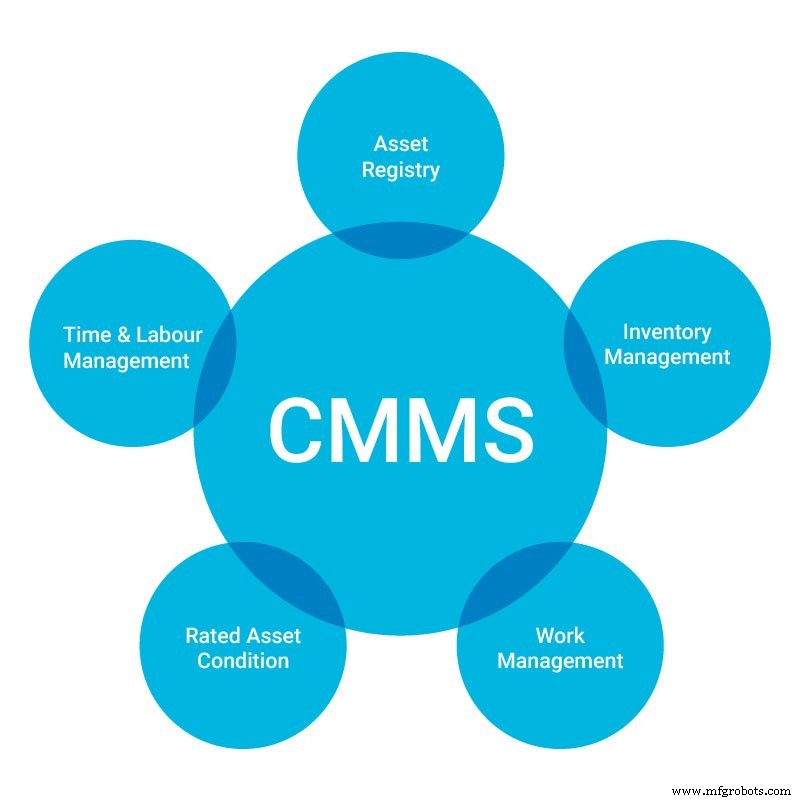
Figure 2. Examples of CMMS App
Inappropriate Data Culture
It is sometimes difficult to spot an inappropriate data culture, but it is usually marked by behaviors and activities that create risks and exposure for the organization. Some of these are:
-
Lack of Asset Information Strategy – The strategy is needed to connect asset information management efforts to the organizational strategy and to define how the information will be used in decision-making.
-
Lack of Organizational Standards – Insufficient organizational standards to define what CMMS information should look like.
-
Insufficient Governance – Allowing unregulated changes to the CMMS data without oversight and rules.
-
Insufficient Business Processes and Workflows – Workflows and business processes are needed to instruct the CMMS what to do with the data. This is how value is created. Sadly, they are missing from many CMMS platforms.
-
Inappropriate Ownership – This stems from insufficient partnership between the maintenance and IT teams and manifests in one of three ways:
-
Overt ownership of the CMMS by IT and the reduction of the maintenance voice, or
-
Overt ownership by the maintenance team with very little oversight from IT, leaving the maintenance team to deal with network and cyber security issues, or
-
CMMS in no man’s land with a lack of ownership.
-
-
Excessive departmental independence – This ranges from siloed departments and subsidiaries being allowed to purchase their own CMMS or create inefficiencies by duplicating information or preventing business information from being shared efficiently.
-
Insufficient Digitalization – Bypassing the CMMS’ role by creating and using manual data. This usually happens when there is a lack of confidence in the CMMS data.
-
Under-utilization – Relegating the CMMS to only creating work orders or recording time. The average CMMS can manage so much more of the information value chain.
-
Inappropriate Work Order Processes – Not creating a work order for every asset activity. This robs the CMMS of a core duty of efficiently capturing asset and activity costs. This usually results in costs being duplicated or missed from not being accurately recorded or residing in multiple spreadsheets with no relationship to each other.
-
Panacea Effect – Creating scope drift by using the CMMS as a “catch- all” for every type of information. CMMS’ are not usually designed to manage as-built drawings and may grind to a halt if you directly upload O&M manuals to each asset.
Creating the Right Data Culture
Creating the right data culture is the first step in ensuring that the right data is collected. This is a combination of good strategy, effective organizational standards, and robust data and information management practices. It is easy to spot an appropriate data culture. Here are some core philosophies and practices that are present when an organization has the right data culture:
-
AIMS – The organization has a documented management system for asset information that outlines the philosophies and standards used to managed data.
-
Interoperability – The information produced in one area of the business is used in another part without significant manipulation. For example, if the CMMS is the system of record for the technical asset registry, then it is the single source of truth for asset records.
-
Ownership – The CMMS and other information systems are owned by the business units with oversight for the related organizational decision with IT as a key business partner. Therefore, Finance owns the ERP for example and Maintenance owns the CMMS. This also means that these business owners are responsible for establishing the AIMS with the support of IT.
-
Governance & Data Management – Roles and responsibilities, access protocols, clear rules for managing changes and regular audits are in place. Governance and data management also align with organizational functions. For example, where a Maintenance Manager is the custodian of the CMMS, the organizational chart also contains a position of Maintenance Manager who develops the relevant standards and whose authorization is required to modify the data.
-
Organizational Culture – There is evidence of good governance in the wider organizational culture which supports the establishment of an effective data culture. The data culture is a microcosm of the wider organizational culture and the organization’s attitude to process discipline will be reflected in the data culture.
-
Top Management’s Involvement – Top management’s involvement is evident from their general oversight, review of audit results, and assignment of resources to correct data non-conformances.
Establishing an appropriate culture allows the right data to be collected in the most efficient way, leading to effective decision-making. Defining data and information requirements is a key step in getting data right. This process should always begin with the information consumer who is making business decisions. Figure 3.0 demonstrates three key data roles and their responsibilities in the developing and meeting data requirements.
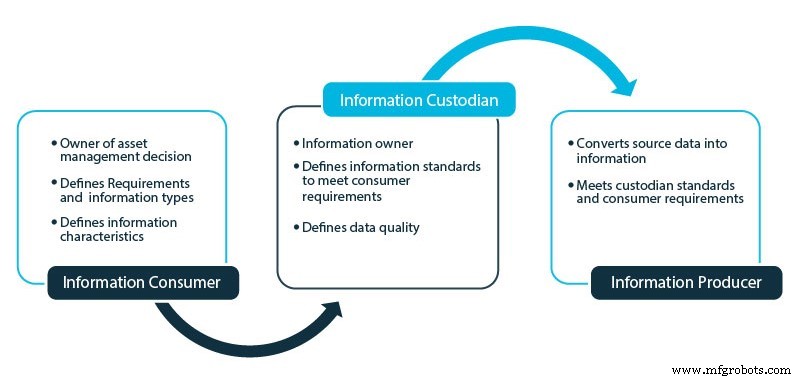
Figure 3: Main type of Asset Information contained in CMMS
For a practical demonstration of this concept, let us consider a stakeholder map for asset and maintenance costs. In Figure 4.0, we begin with identifying the information consumer and work our way back to the information producer.

Figure 4: Example of Stakeholder Map for Asset and Maintenance Cost
In this way, the type of decisions dictates the characteristics of the information and information producer produces information that complies with the requirements of the consumer and the standards set by the custodian. Together the stakeholders collaboratively define requirements and ensure that data produced is fit for purpose.
Conclusions – Data as an Asset
ISO 55000:2014 has defined an asset as anything that provides (or has the capability to provide) value to the organization’s stakeholders. Data is an asset because data and information are the source of asset strategies and strategies are how value is realized.
However, the fact remains, unused data does nothing and hence has no intrinsic value. To be an asset, data must be actively used in developing the strategies to manage the assets. For example, knowing that an asset’s criticality is 5 does nothing for the organization, until someone uses it to prioritize break-in work or capital projects. So, the question becomes, once data is being collected in the CMMS, what can companies do with it to create value from it.
In performing its core functions, the CMMS provides key information to enable asset management decisions as shown in the examples in the table below. This is not an extensive list, but for the purposes of this article, a few types of asset information were selected for analysis against typical decisions made by various departments.
Asset information is generated at all phases of the asset’s life cycle. It predates the asset’s physical presence and extends even beyond the retirement of the asset. There are many sources of asset information, in fact, a single asset has many sources that need to be managed. Much of this information and data is contained in the CMMS. Asset information management aims to generate good quality information for decision-making. Managing asset information requires deliberate action by the organization, it will not happen organically. This has been realized with many facets of organization’s business such as quality, environment, safety, and asset management. Similarly, for asset information, a management system is also required. The goal of the management system is to improve the effectiveness of asset management decisions based on accurate asset performance, cost and risk information.
While the issues around culture and information management may take time to resolve, it is my hope that this article has inspired you to recognize the importance of the CMMS and to initiate steps to increase the usefulness and value of your CMMS data.
Trivia Question: What is in your CMMS?
Answer: Anything that you put in there.
More about Suzane Greeman
Her book, Risk-based Asset Criticality Assessment Handbook
Her upcoming courses:
- Executive Leadership in Asset Management (Winnipeg)
- Essentials of Asset Management & ISO 5500x (Winnipeg)
- Essentials of Asset Management & ISO 5500x (Online)
Industrial Technology
- Expert Guide to Enhancing Cloud Management: Strategies, Best Practices, and Key Benefits
- Industry 4.0: Building Value‑Stream Organizations for Continuous Improvement
- Industry 4.0 for SMEs: Leveraging Cloud‑Based Data Monitoring to Boost Production Efficiency
- Unlock Real Business Value with Data Science for Industrial Asset Maintenance
- Leveraging Data Analytics to Drive Efficiency and Profitability for Oil & Gas Asset Owners
- Why Data is Critical for Industry 4.0 Success
- Turning Industry 4.0 into Reality: From Shopfloor to Data Center Alignment
- Unlocking CMMS Success: How Machine Data Drives Maintenance Efficiency
- Maximizing Industrial Asset Performance with Advanced APM Strategies
- Seamless CMMS Migration: Expert Guidelines for Data Transfer