



Transformerless Power Supplies: A Proven Solution to Cut Cost and Space
Generally, a step-down transformer or switch-mode power supply converts high AC mains voltage to a low AC voltage. Then, it furthers the conversion to a desirable low DC voltage.While it’s efficient, the process is costly and needs more space when designing or manufacturing a product. And so, to reduce the challenges, we use a transformerless power supply. Today, we will explore more about a transformerless power supply. Thus, we’ll discuss its working types and give simple transformerless power supply circuit designs you can try.
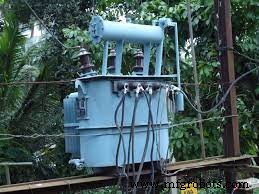
A step-down transformer
What is a Transformerless Power Supply?
As per the name, a transformerless power supply produces low DC voltage from high AC voltage without transformers or inductors.
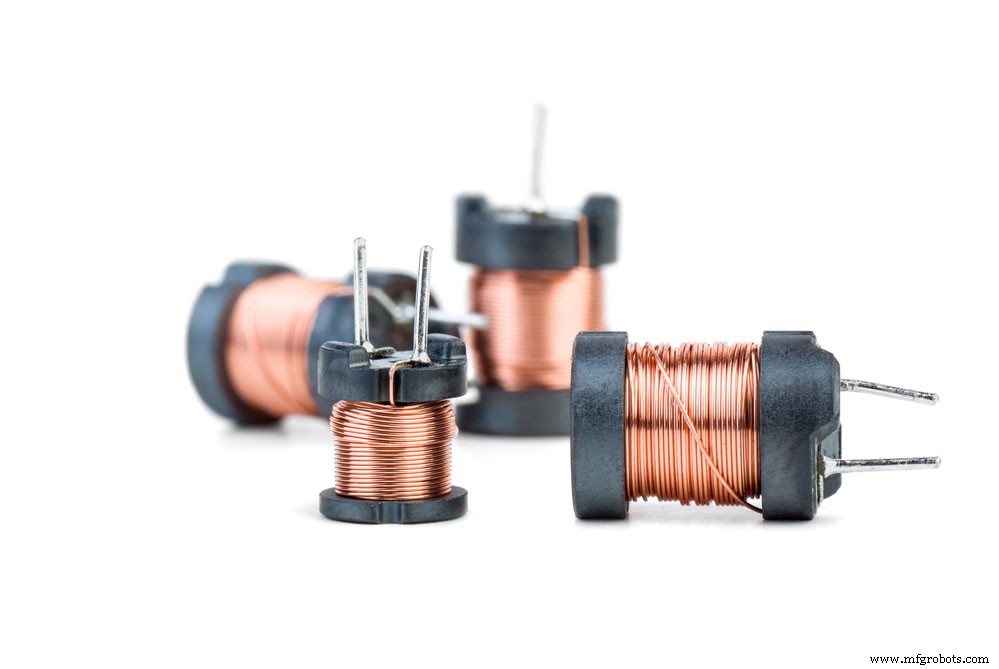
(inductors)
Working Principle
The working principle of a transformerless supply is the conversion of a high voltage single-phase AC to a low DC voltage. The concept uses a voltage divider circuit working without inductors or transformers. In addition, the power supply circuit incorporates processes like inrush limiting, voltage division, regulation, and rectification.
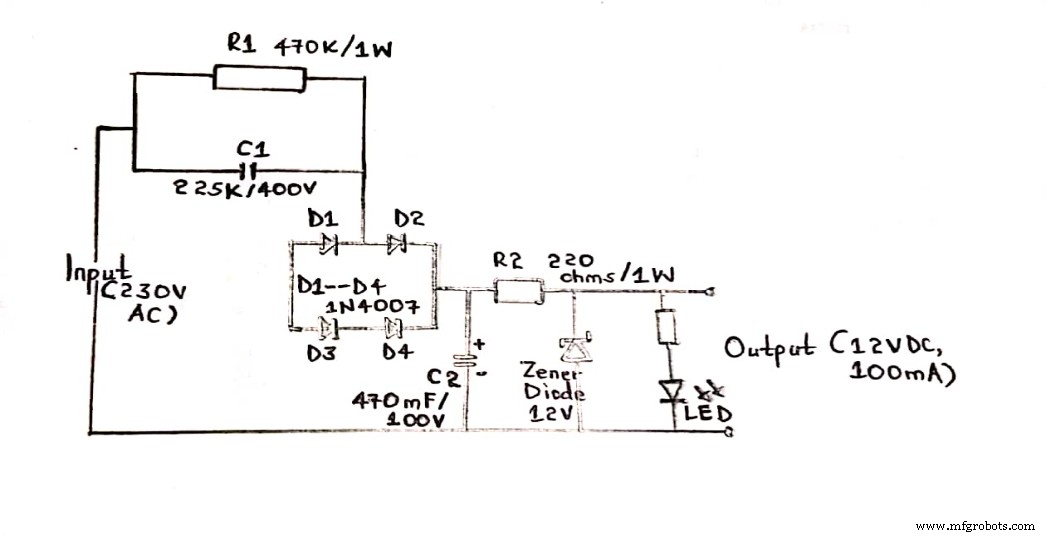
Now, the diagram above works as follows;
- We aim to convert the high voltage single-phase AC (230V/120V) to a required low DC voltage (5V/3V/12V).
- The diodes rectify and regulate the high AC voltage to low DC voltage.
- Further, the capacitor (in a series connection to the AC) limits AC flow because of its reactance. In that way, the current flow gets to a specific value as per the transformerless power supply type. At all times, an X-rated capacitor is preferable in the power supply.
- Moreover, the resistor helps in excess current and heat dissipation.
- Then, the bridge rectifier rids the circuit of a voltage, and through a rectification process, it steadies the peak voltage.
- Connecting to a LED bulb finally tests circuit functioning.
Types of Transformerless Power Supply
The two basic types of transformerless power supply include;
Resistive transformerless power supply
The resistive transformerless power supply uses a voltage-dropping resistor. Its resistance further helps in removing excess heat. Often, a double-rated power resistor is recommendable as it dissipates more power.
Capacitive transformerless power supply
Conversely, a capacitive transformerless power supply has low power loss and heat dissipation. Here, an X-rated capacitor (of 400V, 230V, or 600V) is the voltage dropping capacitor, and it drops off excess voltage.
- Advantages and disadvantages of using a transformerless power supply circuit
Advantages
- First of all, its design is cheap and suits low-powered applications compared to transformer-based circuits.
- Also, it is less bulky and compact and thus requires less space.
Disadvantages
- A transformerless power supply circuit can’t generate high current output (1 Ampere). Thus, it only favors applications requiring less than or equal to 1 Ampere current.
- Then, there’s no isolation of the circuit from AC mains potential, which is a danger to the handler.
- Also, its excessive heat dissipations interfere with the output voltage.
- Lastly, it permits voltage surges that can ultimately destroy the supply circuitry and powered circuit.
Fortunately, the circuit examples below give solutions to some of the challenges. So, keep on reading.
Four Simple Transformerless Power Supply Circuits Explained
Basic Transformerless Design
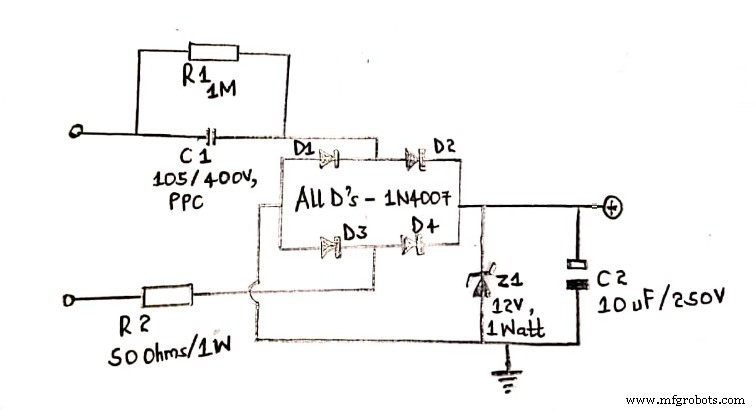
A basic transformerless circuit design
Circuit operation and design
- C1 reduces high AC (120V or 220V mains) to a lower DC for a better output DC load.
- Secondly, whenever you unplug the circuit from the mains input, R1 gives a discharge path for the high voltage C1. As such, you prevent any voltage shock from plug pins when C1 isn’t in the main power supply.
- Then, D1 to D4 are bridge rectifiers. They convert low AC from C1 to low DC.
- The resulting DC voltage is now high for most low voltage devices other than a relay. A Zener diode will shunt the high voltage into a recommended value as you require.
- Further on, we have R2 as the current limiting resistor. C1 only offers a short circuit for milliseconds on the first application AC mains input. The few milliseconds permit AC high current into the circuit but may destroy the output load. R2, therefore, prevents the damage.
- Finally, C2 acts as the filter capacitor. It generates smooth 100Hz ripples from bridge rectifiers to a cleaner DC.
Upgrading to Voltage Stabilized Transformerless Power Supply
Here, we’ll rans form a capacitive power supply circuit to a variable or surge-free voltage stabilized transformerless power supply.
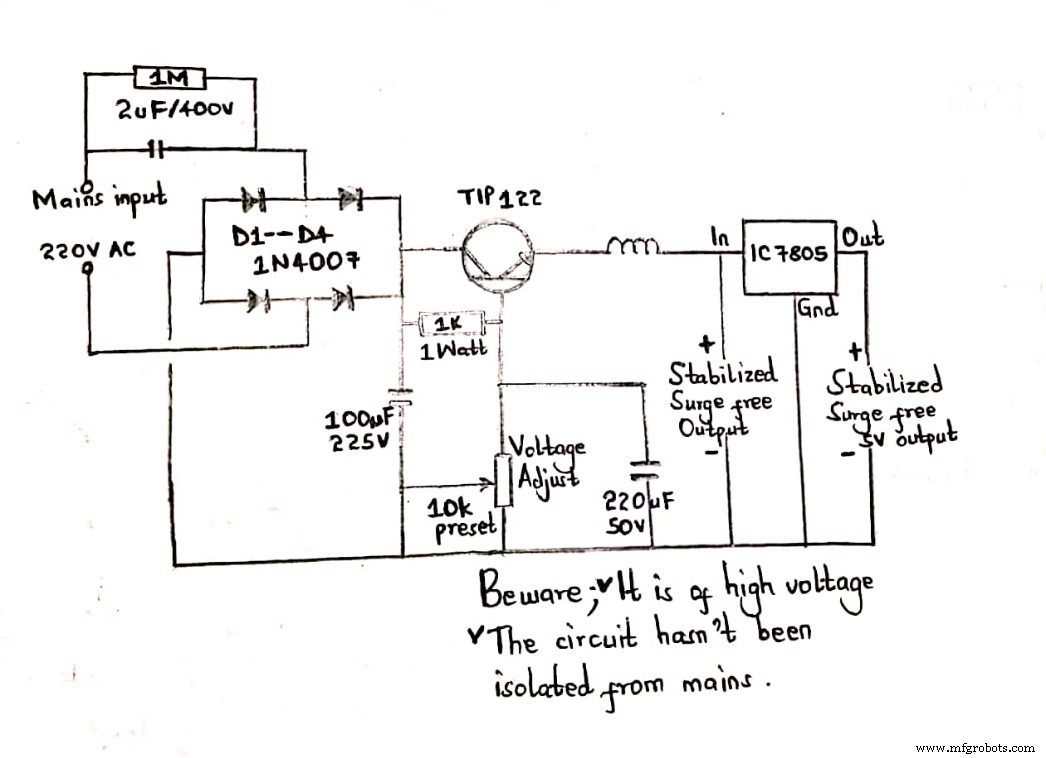
The circuit on upgrading to voltage stabilized transformerless power supply.
Circuit design/operation
- IN4007 diodes rectify the mains voltage while the 10uF/400V capacitor filters it. Then, the resulting peak voltage, rectified from mains, gets to 310V.
- The base of TIP122 (you can also use MJE13005) configures the voltage divider network, thus maintaining a required output voltage. In addition, you can achieve a 12V by setting the 10k pot across TIP122’s ground/emitter.
- The 220uF/50V capacitor creates a momentary zero voltage at the base to switch if OFF in a switched-on circuit.
- Further, in the switch ON period, the inductor, via the coil, restricts inrush currents from getting in the circuit. Moreover, it provides high resistance, thereby preventing damages from occurring.
Takeaway; you can also use a voltage regulator, IC7805, to achieve an attached stepped down voltage or a 5V.
Zero-Crossing Transformerless Power Supply Circuit
Our third project mainly applies to a capacitive transformerless power supply for zero-crossing detection. ItIt’secause capacitors act like shorts for a few milliseconds when it receives a supply voltage. Afterward, it charges up and goes back to its specified output level.
Circuit Design and Operation
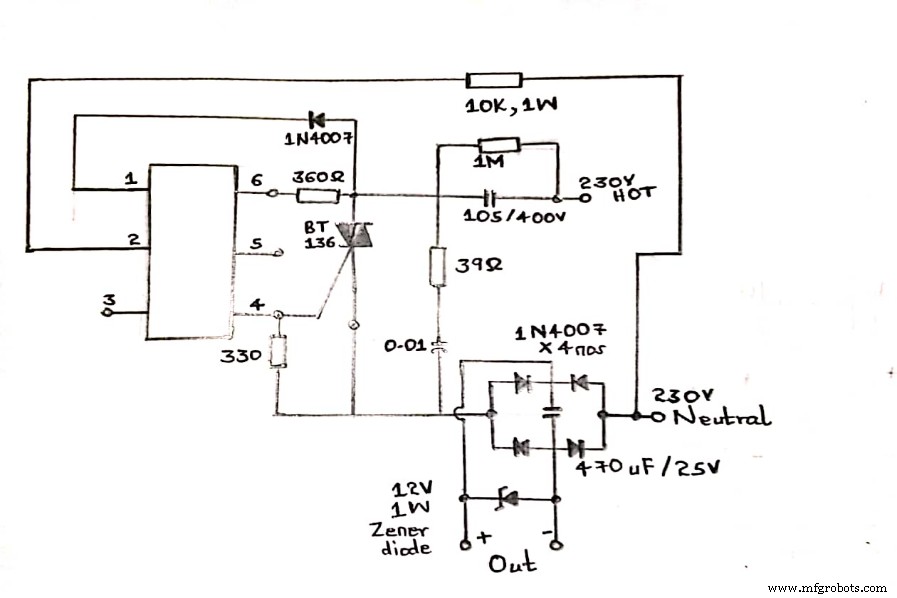
Zero crossing transformerless power supply circuit
Zero crossing in AC mains
An AC main potential includes voltage cycles that rise and fall from zero to maximum or vice versa with polarities.
So, when the mains voltage nears the cycle peak, it has a high current and voltage. Switching on the capacitive power supply causes the high voltage to break through the DC load and power supply.
Conversely, in a mains zero crossing, the main gets a weak voltage and current as it nears phase zero. Therefore, switching ON any device now is safe and can’t experience any surge current.
Briefly, switching on a capacitive power supply as the AC input passes through phase zero prevents surge current.
How It works
- Switching ON power initially maintains a switched OFF triac because of lacking a gate driver. Additionally, the load connected to the bridge network stays in a switched OFF state.
- Then, feed voltage from 105V/400V capacitor output passes pin 1/2 of Octo-coupler IC to get to the IR LED. An IR LED light response helps in monitoring and processing the input. Hence, when the circuit detects the AC cycle approaching a zero-crossing point, the internal switch toggles.
- Lastly, it fires the triac, thereby maintaining a switched-on state at the unit until you switch it ON/OFF again.
Switching Transformerless Power Supply using IC 555
The final solution involves using IC 555 in its monostable mode to regulate the rush surge. Further, the IC 555 incorporates the zero-crossing switching circuit concept.
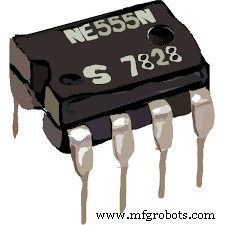
555 timer IC
Definition of zero-crossing switching
A sine wave in an AC main begins from a zero potential mark. Then, it progressively rises to a peak voltage point (120 or 220). Afterward, it reverts to the initial zero likely mark. We term the cycle as a positive cycle.
So, after the positive cycle, the waveform will dip and go through the above process again. However, it’s in a negative direction till it gets to the zero mark. Depending on the mains utility requirements, the circuit cycle can happen 50 to 60 times per sec.
As the waveform enters the circuit, any point with no zero disrupts the switch ON surge. The immediate reason is due to the wave form’s high current. The load should confront the ON switch during zero crossing to avoid any problem. In that way, a gradual rise won’t resent a danger.
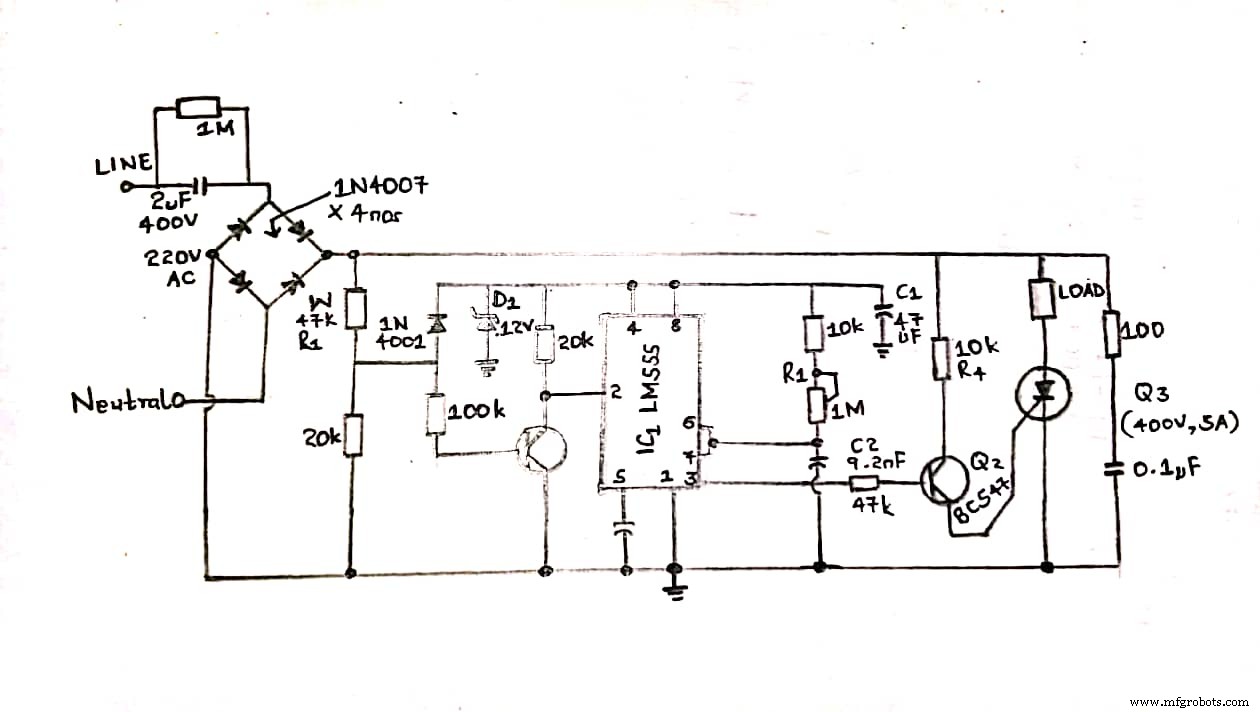
Switching transformerless circuit using IC555
Circuit operation
From our circuit diagram above;
- The four 1N4007 diodes operate as a standard bridge rectifiers configuration, with the cathode junction producing a 100 Hz ripple.
- The 47k/20K potential divider drops the 100 Hz frequency, which later gets to the positive rail of IC555. The potential receives regulation, then C1 and D1 filter it.
- Through a 100k resistor, the base Q1 also receives the potential.
- When AC mains is beyond (+) 0.6, Q1 maintains a switched to OFF state. However, the AC waveform getting below (+)0.6 Volts switches ON Q1. Additionally, it grounds pin2 then produces a positive output on pin3 of the IC.
- Afterward, the IC output switches on the load and SCR and maintains the state till the MMV period passes. Then, a new cycle begins.
- A stable ON time generates extra current to the load, contributing to a bright LED. You can also vary the 1M preset to set the ON time of your monostable. The IC555 circuit gets a restriction at a near-zero AC hence, no surge in voltage in ON time.
Applications of Transformerless Power Supply
Applications of a transformerless power supply mainly comprise low-cost and low power devices like;
- Analog to digital converters,
- LED bulbs,
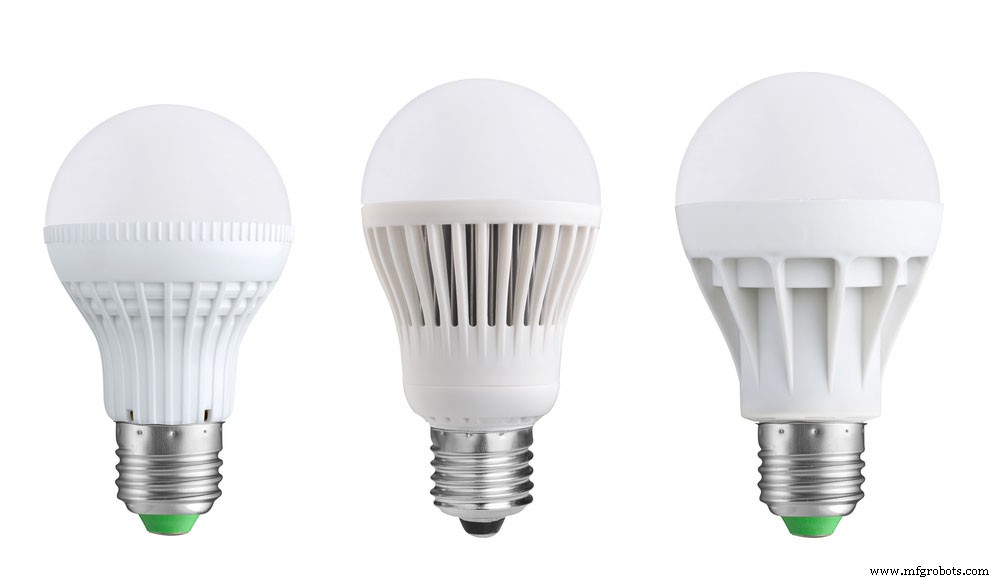
(LED bulbs)
- Digital communication systems,
- Mobile chargers,
- Electronic toys,
- TV receivers,
- Emergency lights,

(emergency lights)
- Telecommunications systems, and
- Voltage regulator and divider circuits.
Conclusion
All in all, transformerless power supply circuits have undoubtedly replaced transformer-based power supplies. Their low current production benefits low voltage applications. Also, they’re cheap and compact.
The article elaborates ways by which you can make your transformerless circuits with the necessary steps. However, if you still want to make more inquiries, kindly reach out to us.
Industrial Technology
- Transformer‑Based Power Supply: Building a Safe 12 VAC Step‑Down Circuit
- Power Supply Circuits: Types, Design Principles, and Performance
- True, Reactive, and Apparent Power
- Unlocking Supply Chain Synergy: Overcoming Obstacles for Resilient Growth
- Safeguard Your Power Supplies: Prevent Heat-Related Failures & Extend Lifespan
- Build a Custom Variable Power Supply with Arduino UNO – Step‑by‑Step Circuit & Code
- Transformerless Power Supplies: Fundamentals, Operation, and Design Requirements
- High‑Performance Variable Voltage & Current Power Supply – Stable Output for Lab and Industrial Use
- X‑Rated Capacitors: Safe Integration into Transformerless Power Supplies
- Understanding Adapter Pricing: Key Factors & Future Trends