



Accelerometer vs Gyroscope: Key Differences & How to Choose the Right Sensor
Motion sensors are crucial in the technological world with a storm as they detect and measure movements. The sensors include an accelerometer vs gyroscope operating through a microelectromechanical system (MEMS).
The good news is that you’ll find tons of sensors in the market. However, settling for the best device may be tough hence we’ll discuss the differences between an accelerometer and VS gyroscope today.
Gyroscope

(gyroscope)
Definition
A gyroscope sensor is a compact device that determines the orientation or rotational changes with the help of Earth’s gravity. Then its major principle is preserving angular momentum.
Some gyroscopes include MEMS, electronic and mechanical gyroscopes, etc.
Working principle
The gyroscope structure consists of a rotor, gimbals (three rings surrounding the rotor), a gyroscope frame, and a spin axis.
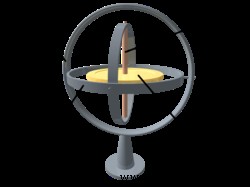
Parts of a gyroscope
Normally, a gyroscope operates via a precession effect whereby rotating the spin axis enables it to defy gravity. In other words, it’ll instantaneously adjust itself to the side rather than fall over due to the force of gravity.
Applications
- Some of the gyroscope’s applications include;
- Consumer electrons via MEMS gyroscopes such as high-end and mid-range Android phones,
- Inertial guidance systems through the Inertial Measurement Unit (IMU),
- Stability in ships, motorcycles, and vehicles,
- Space stations, and

(orbital space station)
- Aircraft.
Accelerometer
Definition
An accelerometer is an electromechanical device that detects and measures non-gravitational acceleration. That is to say, responsive to vibrations brought about by movement to time.
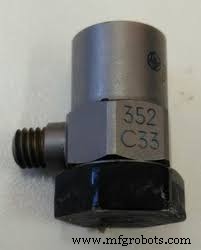
PCB Accelerometer
Furthermore, they commonly determine the orientation and detect vibration, velocity, or position.
Working principle
Accelerometers have two distinct working principles, i.e., change in capacitance and piezoelectric effect.
Change in capacitance
The first method uses a formula to find acceleration. So, Force = Mass × Acceleration. Therefore, acceleration will be the present Force/Mass of the object.
Steps in working
- First, there are two capacitive plates.
- Then, an object’s mass will press on one of the capacitive plates and cause a change in capacitance. In that way, you’ll also measure the force.
- Finally, we measure acceleration using the value of known mass and force.
Piezoelectric effect
Steps
- Accelerometers will produce a voltage when there are vibrations since it contains microscopic crystal structures that generate voltage when pressed.
- Secondly, the voltage produced gives the reading on the amount of present acceleration.
Applications
- Accelerometer applications are as follows;
- Applications or games requiring motion sensing like Kinect, Wii, etc.,
- Fitness wearables or trackers,

(wearable wireless body area network)
- Medical devices, e.g., artificial body parts,
- Fall sensing,
- Earthquake detection,
- Tilt sensing, like in iPhones to detect if the phone is in a landscape or portrait mode,
- Map/compass applications in a mobile device via axis-based sensing (Android, iPhones, etc.)
Difference Between Gyroscope and Accelerometer
The comparative table below shows the difference between the accelerometer and gyroscope.
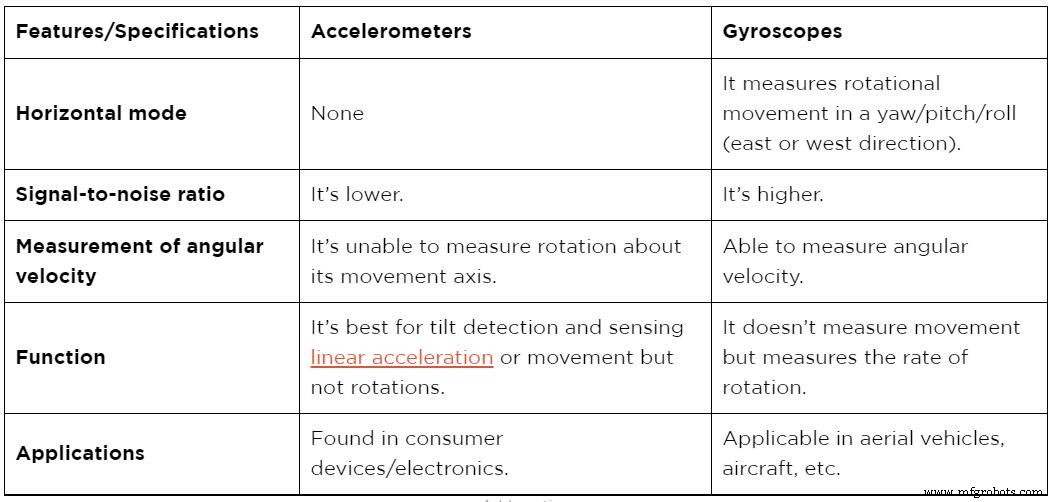
How to choose an Accelerometer vs Gyroscope?
When choosing an accelerometer or gyroscope, there are several criteria you need to factor in before your purchase. Moreover, your choice often depends on the project at hand and its requirement.
Let’s now look into the wide range of factors needed.
Accelerometer
Factors include;
- Range
If you wish to measure high precision accelerations, choose an accelerometer with a high range, preferably 2Gs or above. The highest measured acceleration can approximate to 5000Gs.
- Interface
Despite being able to connect accelerometers via analog and digital circuits, it’s best to settle for one using digital interfaces. Examples of interfaces are serial interfaces such as I2C or SPI, PWM interfaces, or Analog-to-digital converters interfaces. It can also interface with boards like Raspberry Pi and Arduino.
- The number of axes measured.
The two kinds of accelerometers include three or two axes.
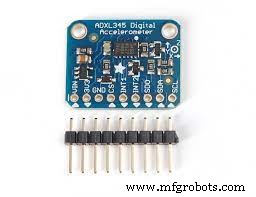
A triple-axis accelerometer
Nowadays, the focus has shifted to a one-axis accelerometer that appears like a miniature 3-axis accelerometer. The mini-3-axis accelerometers are ideal because they measure acceleration with high precision but only work on a few devices. Nonetheless, they’re affordable.
- Power Usage
Then, consider the size of the integrated circuit board and mass of the accelerometer since they affect its power consumption and performance sensitivity. Also, the recommended current consumption is around 100s of a µA range.
Furthermore, you can find a digital accelerometer with a sleep feature because it’ll help conserve energy when the device is inactive.
- Bonus Features
Newer accelerometer models have bonus features like tap sensing, 0-g detection, sleep control, and selectable measurement ranges.
- Sensitivity
Sensitivity refers to the measurable amount of vertical force by an accelerometer according to a change in acceleration. Sadly, accelerating the accelerometer consistently results in an inaccurate measurement due to low sensitive output.
- Cost
Lastly, always look into your budget. For instance, if you need to measure acceleration at a small cost, opt for tilt/Richter switches and not accelerometers.
Accelerometer VS Gyroscope: Gyroscope
Factors include;
- Range
First, keep the gyroscope’s maximum range lower than the maximum angular velocity you need to measure. On the other hand, keep the gyroscope’s range slightly higher than the expected value for higher precision and sensitivity.
- Digital vs. Analog (Interfaces)
Almost all gyroscopes have analog output interfaces, but in rare cases, you’ll find some with digital interfaces, i.e., I2C or SPI. The analog output interface is easy to integrate with an MCU.
- The number of axes measured.
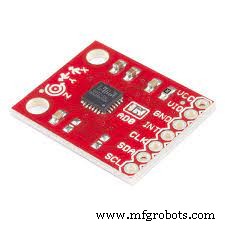
Triple axis gyroscope
A 3-axis gyroscope recently is beginning to rise, the available gyros in the market being 2-or 1-axis. During your selection, go for a gyroscope that fits your measuring requirements. For instance, some 2-axis devices often measure roll and pitch, while the rest can measure yaw and pitch.
- Power Usage
If you’re working on a battery-powered project, your choice of gyros should be in consideration in terms of power consumption. The standard current consumption is in the 100s of the µA range.
Also, see if the gyro has sleep functionality for energy conservation when it’s not needed.
- Bonus Features
Most gyros have an additional feature in temperature output which helps in compensation for drift.
- Cost
The cost of gyroscopes doesn’t override the other factors. Therefore, you can settle for an inexpensive one.
Conclusion
Thank you for sticking around till the last bit of this topic. We hope that moving forward, and you’ll make informed choices on accelerometers or gyroscopes. If, however, you need some clarifications, kindly reach out to us for assistance.
Industrial Technology
- How 5G is Transforming Smart Factories into High‑Performance Powerhouses
- How Connected Networks Are Revolutionizing Modern Agriculture
- Hire the Right ISO Consultant: Boost Your Manufacturing Quality and Competitive Edge
- How 0G Network Sensors Safeguard Vaccine Cold Chains
- Choosing the Right ERP System: A Guide to Finalizing Your Decision
- AC vs DC Generators: Key Differences Explained
- Revolutionizing Education: How AI Shapes Modern Learning
- How Sensors Transform Manufacturing Efficiency and Insight
- Choosing the Right Filling Sensor: Accuracy, Reliability & Profitability
- BGA vs. LGA: Key Differences in IC Grid Array Packaging