



Mastering the ATmega8 Pinout: Optimize Performance & Control in Your Microcontroller Projects
In the present day, the value of microcontrollers in electronic systems cannot be overemphasized. As the human brain is to the body, so does this integrated circuit control the operations of a device. Unlike others, the ATMEGA8 pinout is a microcontroller that allows synchronous and asynchronous data transmission.
Further, the ATMEGA8 is excellent for analytical purposes in industrial automation systems. With a 28-pin interface and a USART module for PC communication, it is easy to see why it is a common choice for programmers. As you read on, this instructable covers how to get the best out of this MCU.
ATMEGA8 Description
The ATMEGA8 pinout is a RISC 8-bit AVR microcontroller on low-power CMOS technology. Typically, it produces throughputs up to 1MIPS per MHz in a single clock cycle. Therefore, it allows system designers to execute strong instructions while balancing processing speed and power consumption.
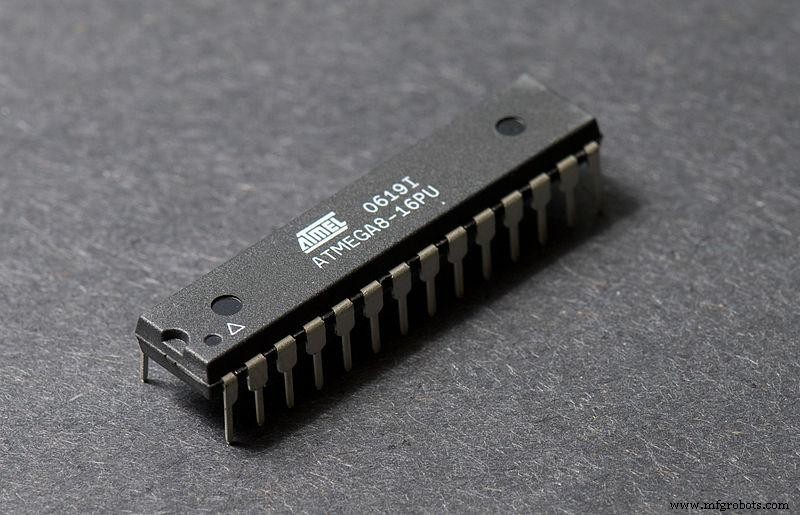
(A typical ATMEGA8 pinout).
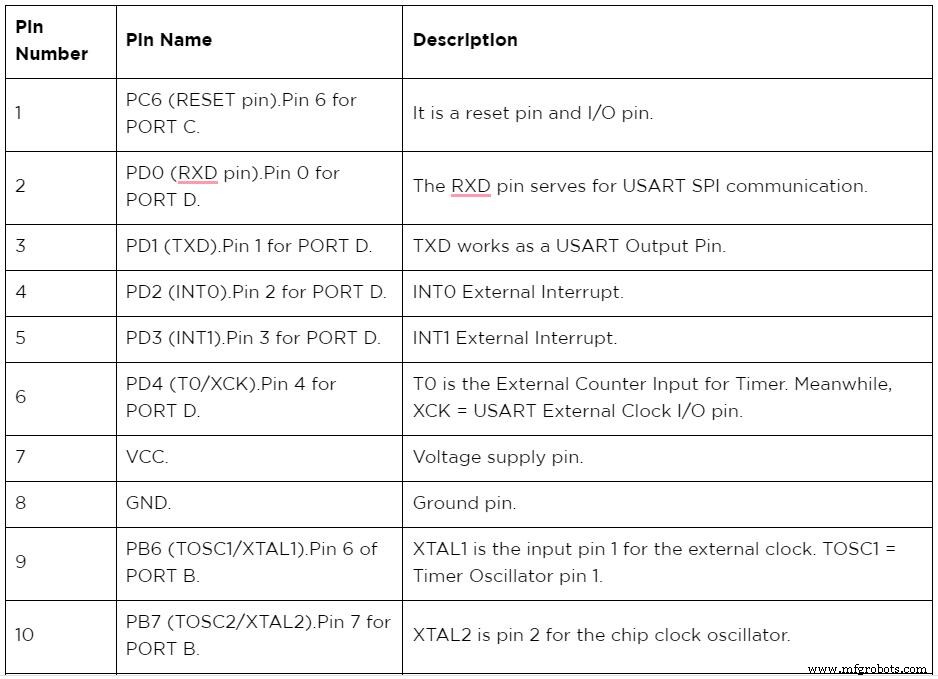
ATMEGA8 Pin Configuration
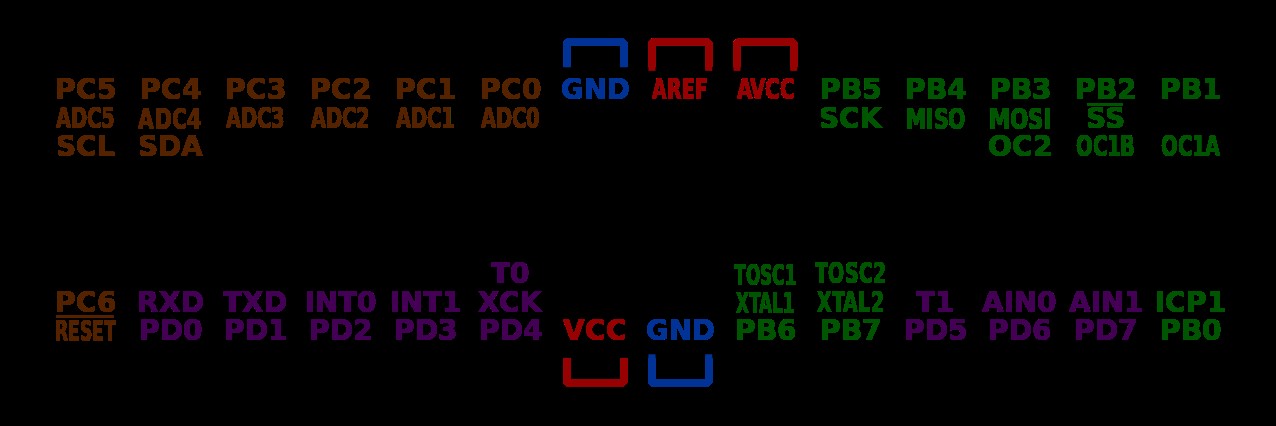
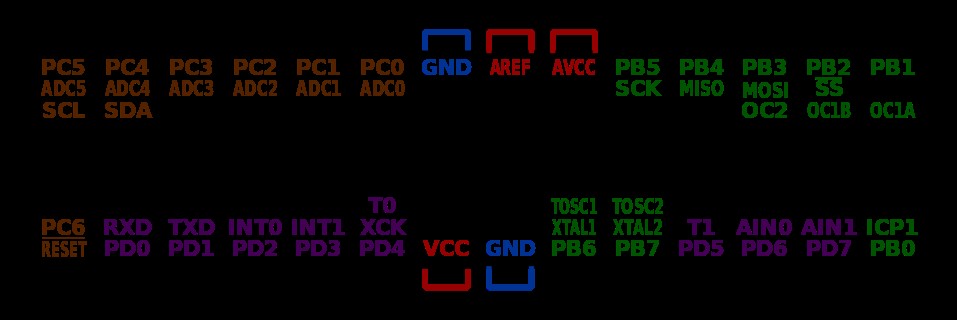
(ATMEGA pinout diagram showing the pin names).
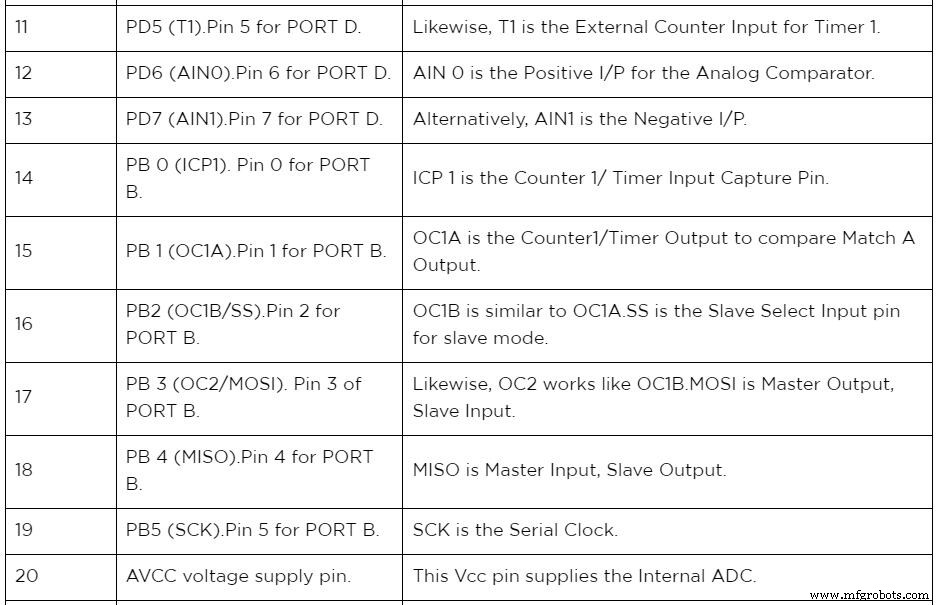
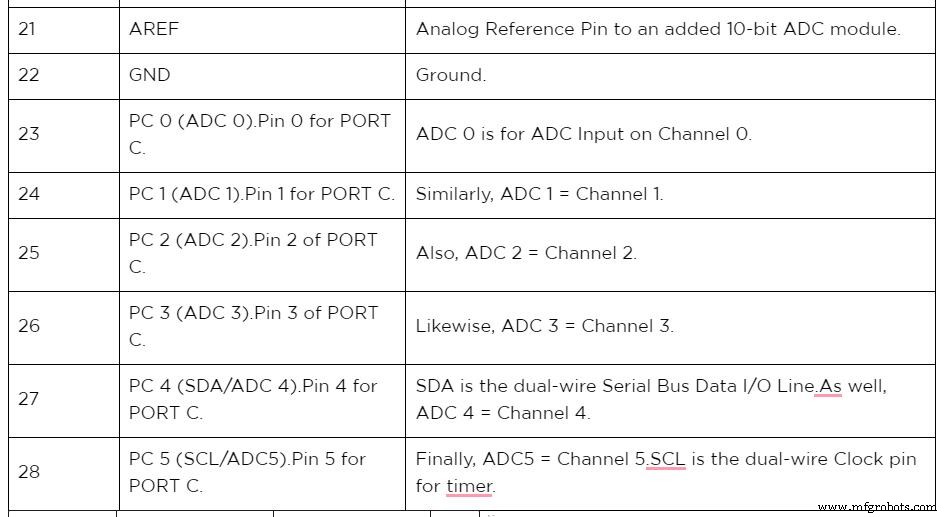
ATMEGA8 Features
- To begin with, the CPU is an 8-bit AVR.
- For ATmega8L, the ideal supply voltage is between +2.7 V and +5.5 V.
- However, ATmega8 has a +4.5 V to +5V supply voltage. (+5.5V is the absolute maximum supply voltage).
- A total of 23 I/O pins are available on the board.
- The ADC module has a 10-bit resolution and six channels.
- Timer module pins comprise a 16-bit timer and two 8-bit counters.
- One analog comparator is present.
- There are three PWM channels.
- ATMEGA8L uses a 0-8MHz External Oscillator, while ATMEGA8 uses 0-16MHz.
- However, it has an RC Internal Oscillator calibrated at 0-8MHz.
- A Flash Program Memory of 8 Kbytes is included. That is, 10k write/erase cycles.
- CPU Speed is 16 MIPS.
- The chip also contains 1 KByte of RAM and 512 bytes of EEPROM.
- Hardware units include a watchdog timer and an on-chip oscillator.
- Lastly, it has a program lock feature.
ATMEGA8 Replacements
ATMEGA328P.
ATMEGA8 Alternatives
ATMEGA8535, ATMEGA32, ATMEGA16.
Other 8-bit Microcontrollers
ATMega2560 Microcontroller.
Where to use ATMEGA8 Microcontroller?
The ATMEGA8 microcontroller has a compact size and a powerful performance allowing it to work on smaller boards. Additionally, the watchdog timer feature is useful in systems that require less human interference.
How to Use ATMEGA8 Microcontroller?
- First, write the functions you want the ATMEGA8 to execute. Use an IDE program to write these functions in a suitable programming language, preferably the “C” language.
- After writing the functions, use a compiler to erase bugs.
- Generate a HEX file with the IDE for the program you are writing.
- Next, select a programming tool. For example, an SPI programmer for AVR controllers is good for connecting your ATMEGA8 to a PC.
- Select a suitable SPI program HEX file.
- Afterward, select “burn bootloader.”
- Finally, detach the programming tool and connect the necessary controller peripherals to start the system.
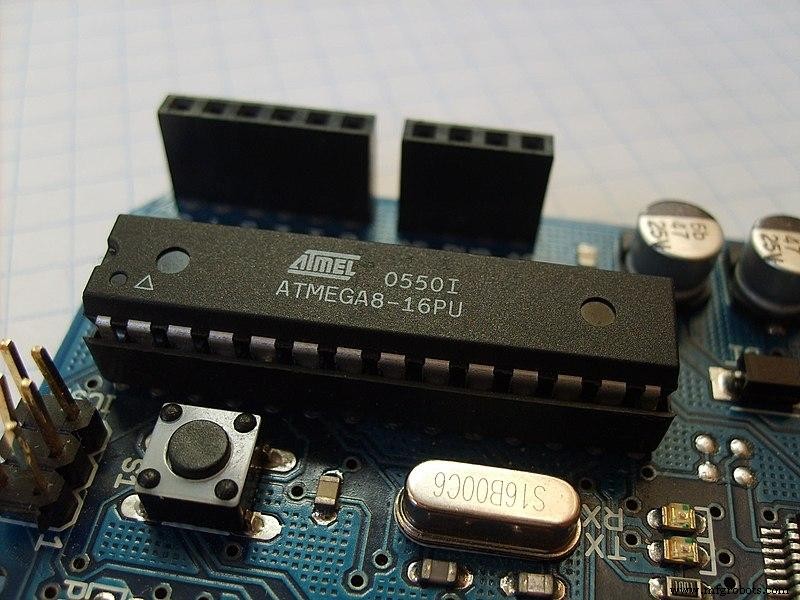
(AVR ATMEGA8 microcontroller on Arduino board).
8. ATmega8 Microcontroller Sleep Modes
Generally, the ATMEGA8 microcontroller has five sleep modes. They are
Power save mode
This mode is useful when the power-up timer clocks asynchronously. Often, it helps to save power.
Idle Mode
In idle mode, the CPU stops working. However, other parts like the ADC, SPI, TWI, Watchdog, and interrupt system still function.
Power down mode
It disables the external oscillator and clock signal. At the same time, it enables the watchdog, external interrupts, and the two-wire serial interface.
ADC Noise Reduction Mode
This mode allows the ADC channels, 8-bit timer, and external interrupts to function.
Stand-By mode
Also, this mode reduces all other microcontroller operations. The oscillator, however, is the only exception.
9. Applications
- Measuring and manipulating analog signals.
- Industrial control systems.
- Embedded systems.
- Display units and motor control units.
- Peripheral interface systems.
- Power regulation systems and SMPS.
(Embedded System Symbol)
Conclusion
The ATMEGA8 pinout is an 8-bit microcontroller. Due to its powerful performance and small size, it serves a major function in embedded applications and industrial automation projects.
Now that you have this information, you can begin working on a project using ATMEGA8. However, expert knowledge and assistance are always recommendable. You can always contact us here.
Industrial Technology
- Top 4 Sources for Expert Industrial IoT Insights This Summer
- Maximizing the Value of Your CMMS/EAM System: Strategies for Integration and Predictive Maintenance
- Maximizing the Performance of Your Industrial Physical Assets
- Celebrating Manufacturing Day: Its Impact and How You Can Join the Movement
- Maximize Efficiency: Expert Tips for Your Warehouse Scanning System
- Maximize ROI from Your Lead Generation Investment
- Choosing the Best Online PCB Manufacturer: A Guide to Top-Quality Service
- S‑Video to RCA Cables: Optimizing Video Quality for Modern TVs
- STM32 Pinout Guide: Mastering Microcontroller Connections
- Unlock the Best Car Insurance Deals: A Step-by-Step Guide