



Eclipse Unide: A Practical Guide to Interpreting Industrial Device Data
When traveling abroad, I’ve often picked up a few key phrases in the local language—just enough to navigate and connect. You don’t need to be fluent, but a handful of simple expressions can make a big difference. Over time, I’ve built a mini‑phrasebook that’s proved invaluable. The manufacturing sector faces a comparable challenge.
“There are a lot of different machines out there, using a lot of different languages and accents.”
Legacy equipment often lacks support for modern protocols such as OPC‑UA, yet we still need to monitor their performance and decode specific measurements.
Had there been a straightforward method to transmit and interpret device‑specific data across multiple systems, the path to a fully connected factory would have been much clearer.
Our collaboration with customers and partners has revealed which data points are essential for making sense of industrial devices. For instance, when transmitting measurement data, it is only interpretable if accompanied by the current part or lot number and the machine identifier.
We distilled these requirements into a concise payload format. Much like a versatile phrasebook that can be used on a phone, in a letter, or in person, this payload is designed for transmission over any of the major protocols—REST, MQTT, AMQP, and more.
After deploying the format in production environments with partners, we aim to share sample implementations of these payload exchanges with the Eclipse community.
Why Production Performance Management Protocol (PPMP)?
In recent years, manufacturers have faced mounting pressure from cost competition, rapid market cycles, and ever‑rising quality expectations. Speed, flexibility, and precision are now non‑negotiable. Production Performance Management (PPM) is the discipline that turns machine data into actionable insights, enabling continuous improvement across the shop floor.
- Torque and angle during a tightening operation
- Inflow/outflow of a throttle‑plate test station
- Power draw of spindles in a cutting process
Guidelines for a one‑way exchange of information
- The data structure must be flexible enough to traverse multiple transport protocols, avoiding the need to reinvent the wheel and leveraging existing infrastructure.
- It should remain consistent across implementations, allowing a single piece of software to decode the data irrespective of the source.
- Clarity is paramount—implementers should grasp the payload’s meaning without extensive documentation.
- Keep the format as lean as possible to prevent unnecessary complexity.
- Yet it must contain all information required by the core use cases.
Modern machines are often equipped with advanced communication stacks, but legacy equipment, smaller factories, and SMEs can struggle to keep pace with emerging IT standards. In many cases, hardware constraints further limit connectivity options.
In a production environment, monitoring is only valuable if it covers the entire process—no blind spots. Upgrading or retrofitting equipment can address this, but the latter must be as unobtrusive as possible. Therefore, we identified a minimal set of mandatory fields and optional, extensible metadata to enable a low‑friction, one‑way data exchange.
Industry benefits of Eclipse Unide
Eclipse Unide is engineered to make PPM affordable for small and medium enterprises. By simplifying data communication and reducing integration overhead, it empowers businesses to harness machine telemetry without a large IT footprint.
The PPMP payload was first tested at a mid‑size Bosch plant, where it facilitated collaboration between the OEM and its SME suppliers. This pilot demonstrates how a shared, lightweight data model can bridge the gap between large and small players.
PPMP delivers interoperability across devices and software. It aggregates machine and sensor data from diverse sources using a JSON schema that can travel via REST, AMQP, MQTT, and more. Its core objectives are:
- Seamless device integration across industrial domains, such as manufacturing and energy.
- Providing a lightweight, plug‑and‑play solution that lowers the barrier for SMEs.
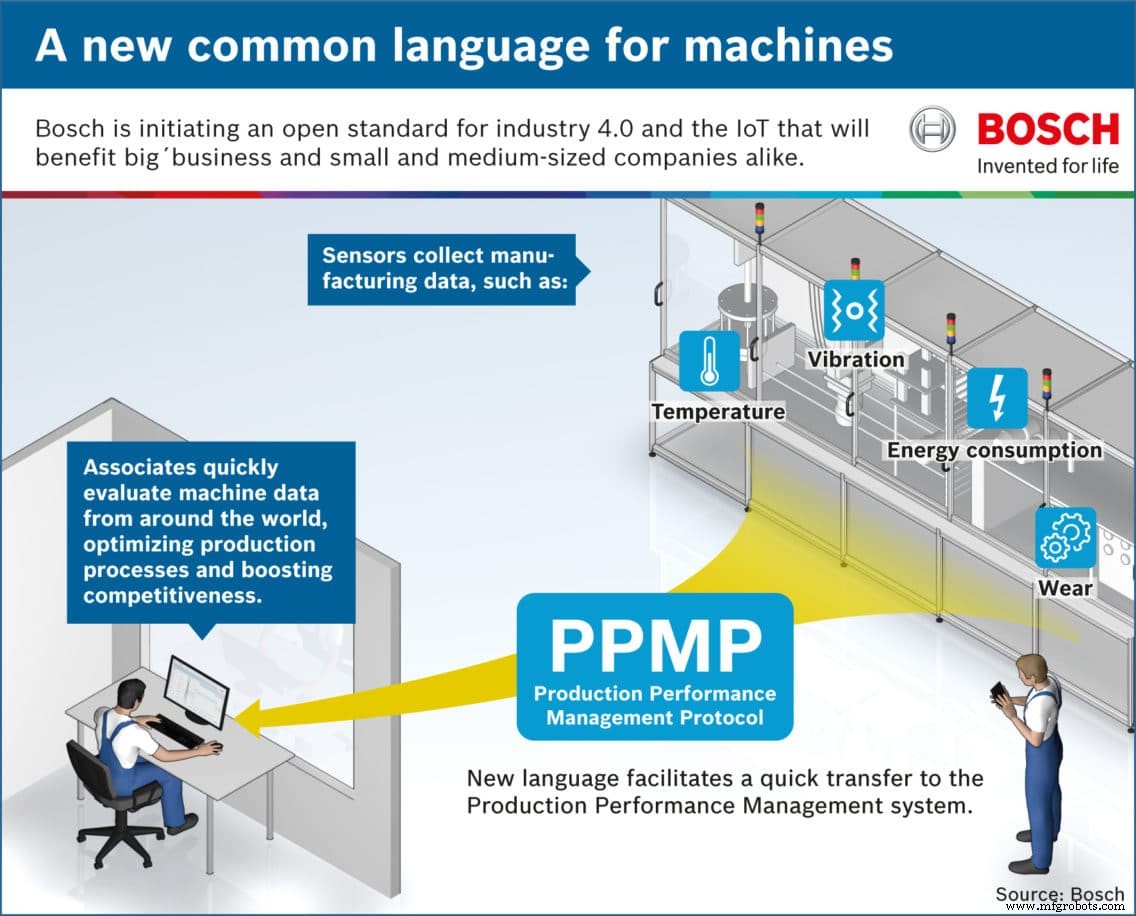
Bosch is championing an open standard for Industry 4.0 and the IoT, benefiting enterprises of all sizes.
Why open source? And why Eclipse Unide?
PPMP builds on the Eclipse IoT ecosystem, offering a streamlined format for aggregating time‑series and alert data from industrial sensors. It is protocol‑agnostic—working over REST, AMQP, MQTT—yet it eliminates the need for costly middleware or licensing fees.
Leveraging Eclipse’s mature open‑source infrastructure (projects like hono, Paho, and Kura) gives PPMP a strong foundation and a ready community of developers. This collaboration ensures that the format evolves in close alignment with industry needs.
A recent industry survey—though limited to German respondents—found that 55 % of participants viewed open standards as essential for implementing Industry 4.0.
Next steps
The Eclipse Unide project will publish the latest version of the Production Performance Management Protocol and provide turnkey server and client samples. These prototypes will persist payloads in a database and render them through a simple dashboard, enabling anyone to adopt the pattern for custom condition‑monitoring applications.
Industrial Technology
- How Metal Powders Are Made: A Comprehensive Guide to Preparation Methods
- Industrial Internet of Things vs Industry 4.0: What You Need to Know
- Industry 4.0: 6 Essential Actions for Manufacturers Today
- Navigating IT Challenges in Modern Manufacturing: Strategies for Digital Transformation
- Three Proven Strategies to Strengthen Supply Chains Amid Global Disruptions
- ERP Systems: The Backbone of Industry 4.0 Data Integration
- Industrial Automation 4.0: Revolutionizing Production Efficiency
- FDA Unveils Proposed UDI Rule to Standardize Medical Device Identification
- Mastering Solder Mask Design: 6 Essential Steps for Long-Lasting PCBs
- Bringing Legacy Systems into Industry 4.0: Overcoming Multi-Protocol Challenges